

Confronting
Community Gallery Guide for Paula Rego: Visions of English Literature
Community Gallery Guide for Paula Rego: Visions of English Literature
COMMUNITY RESPONSES INSPIRED BY PAULA REGO: VISIONS OF ENGLISH LITERATURE
This guide brings together responses from local female writers from Shut Up and Write!
The works included were created in dialogue with the exhibition and reflect group discussions of their favourite pieces, emotional reactions, and Rego’s visual language. Through writing, members explore themes of subversion in storytelling, women’s inner worlds, and historical power imbalances
and dynamics.
ABOUT SHUT UP AND WRITE! CHELTENHAM
Shut Up and Write! is a writing group which runs each Sunday in the café rooms of the Wilson. An international network and non-profit, Shut Up and Write! represents a shared creative space intended to help writers build discipline and better writing habits. SUAP has a broad remit and invites writers of all types to attend; amateur, professional, bloggers, authors, researchers, and everything in between. You can learn more here.
The Internal World of Women in Paula Rego’s art
One of the most striking things about Paula Rego’s art, particularly in the Jane Eyre series, is how she presents the internal world of women. Jane Eyre is a character who lives not only within the private sphere of women, but within her own internal world as well. This is best illustrated in the art pieces Getting Ready for the Ball and Girl Reading at Window, where Jane is shown either standing in the far end of the room watching the activities, or sat in her own enclave reading a book. Jane is always an onlooker, an outsider in the world, even within the domestic sphere of women. Rego is shown to understand this aspect of the novel, and builds upon it by illustrating and expanding on Jane’s relationship with Bertha. In Scarecrow, Rego depicts Jane as Bertha’s peer, and together they dress up Rochester as a Scarecrow. In another print Rego presents Jane kneeling in awe at Bertha as she lies on Grace Pool’s lap – a pose that pays homage to the well-known artistic trope the Pieta, and positions Bertha as a Christ-like figure whom Jane worships.
This relationship between Bertha and Jane cannot be over examined and the contrasts and comparisons between the two women further emphasizes the theme of the internal world of woen within the Jane Eyre art pieces. Rego presents Jane as isolated but ultimately independent and empowered, as shown in the prints Jane Eyre and Inspection, where Jane is presented in a way that asserts her power over the viewer – in Jane Eyre she faces away from the viewer and looks into a black void – facing an uncertain future with dignity and strength away from the gaze of the audience, and in Inspection, even as a little girl, Jane Eyre is able to meet Mr Brocklehurst at eye level and stand her ground. By contrast, Rego presents Bertha as vulnerable and in needing care, as shown in Bertha, where, despite her glare at an unseen viewer, she cradles herself. Rego further contrasts Bertha from Jane by presenting her as a figure of retaliatory violence, as suggested in Biting, where she bites the abuser groping at her breast. Jane’s internal world as a woman is shown to be one of isolated intellectualism, and when she is presented with Bertha, she is not only contrasted by Bertha’s domineering presence, she is complimented by Bertha’s raw assertion of power, in a domain where she has been made to feel powerless. Jane and Bertha are kindred spirits in Rego’s art pieces – two tormented women, both forced by a cruel patriarchal world to retreat into their own internal worlds.
What is additionally fascinating is how Rego interprets Jane’s journey with the patriarchy in her artwork. In the novel, Jane refuses to become Rochester’s mistress after the revelation of his marriage to Bertha. After leaving Rochester, she finds her family, inherits from her uncle, and creates a rich and happy life for herself as a schoolteacher – fulfilling a lifelong dream of setting up her own school for girls. Despite these accomplishments, she leaves them all behind to answer Rochester’s ghostly distant call to come to him. Bronte’s Jane Eyre is a story of a young woman’s journey to self-actualization in a world that has never given her reason to find it. As a result of this journey, she finds a true equal in Rochester and lives, for all intents and purposes, happily ever after. Paula Rego, however, does not lend such optimism in her artworks for the novel. Perhaps due to her own experiences taking care of a sick husband, (who himself was married to another woman when they met), Rego’s Jane Eyre does not portray Rochester in the same charitable as that of the novel. Many of her prints depict Rochester at his most moody and domineering. This is seen especially in the self-titled Rochester, where Rochester sits atop his horse looming disapprovingly over the audience. This interpretation of his character is further emphasised in Pleasing Mr Rochester and Dancing for Mr Rochester, where Rochester is shown to never satisfied with little Adele’s dancing, or with any of the women in his life who do much to please him. One wonders, as John Sutherland once did, if Jane Eyre can ever be happy in Rochester’s world, or if, like Bertha, her spirit and independence will be suppressed by an older patriarch who loves until it is inconvenient for him to do so. In comparing Rochester to his literary ascendant Bluebeard, Sutherland speculated “Could one be entirely confident that his wife killing ways would not return?†With these words in mind, one wonders, under the threat of Rochester’s “wife killing†ways, might Jane Eyre return to the comfort and peace of her inner world.
Paula Rego’s works, particularly the Jane Eyre and Fairy Tale pieces, demonstrate the violence of the world of women. In an interview with Kate Kellaway, Kellaway asked Rego why it was important to show women at their worst, to which Rego replied: “It is more interesting to paint women as they are.†suggesting that the natural world of women is one of violence. In Rego’s work, women are tormented, punished and gawked at – whether by male authority figures like Rochester, or surrealist fairy tale creatures like giant spiders and rams.
It is important to note, however, that these women are not always the subject of violence-they are also it’s perpetrators. In Polly Put the Kettle On, the chocolate soldiers have no idea that they are to be dinner for the girls. In Three Blind Mice, a woman stalks giant mice with a knife. Even in her Jane Eyre prints we can see this theme of female violence, most notably in the piece Biting, where Bertha retaliates from molestation by biting her abuser. Rego’s art world is one of violence, and within the internal worlds of women, violence is ever present. In becoming the victims of it, they become it’s inflictors, perpetuating the cycle.
Through the mediumship of picaresque storybook illustration and printmaking, Rego is able to present the challenges of womanhood – it’s internal conflicts and external results. As a writer myself, I can see how Rego identifies with storybook protagonists in order to tell her own story, as well as the stories of other women. As you view these pieces, it would be good to ask yourself questions in order to not only engage with Rego’s work, but with your own subconscious fears and fantasies. Rego’s art world is one of terror, violence, anxiety, and desire. She was once quoted as saying, “I always need a story. Without a story, I can’t get going.†As an artist, she always sought inspiration from fiction in order to tell the truths of the internal lives of women.
When you view these works today, ask yourself some questions about your own life:
How are you the protagonist of your life story?
Which art pieces have you seen today reflect the worst moment of your life? Which picture reflected the best?
Which fictional stories have you read that best represent your life’s journey so far?
If you could give the terrors in your life a face, what would that face look like?
References
Kellaway, Kate. “Paula Rego: ‘Making a painting can reveal things you keep secret from yourself’.†The Guardian, 4 July 2021, https://www.theguardian.com/artanddesign/2021/jul/04/paula-rego-tate-britain-exhibition-interview. Accessed 28th December 2025.
Sutherland, John. Can Jane Eyre Be Happy?: More Puzzles in Classic Fiction. Icon Books, 2017.
Paula Rego’s Jane Eyre
Abigail Penny
As the fire burns my lashes
and turns my love to ashes
there is nothing in the attic
that makes our great love tragic
Tapping at the bottom of the stairs
your one good hand summoning
“Jane Eyre, Jane Eyreâ€
I’m coming, I’m coming
my tears track down to ashes
a thousand whipping lashes
I pull you down to paradise
you insist on getting lost
in moonlight, body-bearing like a vice
I earned my ending, but not the cost:
Salt-water burns my lashes,
and turns my love to ashes
Our infant wriggles, the June sun drops
the leaves of Milton blow in the breeze
you’re squawking, heavy-set, “I can’t get upâ€
off you’re middle-aged knees
slowly our love burns ashes
from what was great and magic
there once were ghosts in every hall
and fires burning the marriage bed
now motes float silent, the servants droll
from your knee I hear what’s said:
a beast trapped in your attic,
a life and death so tragic
my shameful predecessor
whose wails had kept me waking
whose voice could not be spoken
whose gaze held mine unbreaking
what did she want to say to me
on the first and last we met?
about the man who wanted me
who was already wed?
My hateful predecessor
my Lilith out of Eden
there was no truth you could have bled
that would have granted freedom
I left, and when he called,
returned with bosom-heaving
I understand what truth you told
n eyes so red and streaming:
As the fire burned your lashes
you turned your love to ashes
I do not need an attic
to be trapped in love so tragic
I can only now take pity
servants scurry as he stands
“Lead me, lead meâ€
slowly gives me his good hand
out the door and down the floor
our selves, our lives, matrimony
all is burned to ashes
the tears fall down my lashes
Facing Fear: Paula Rego and the Power of the Primal
Amélie Doche
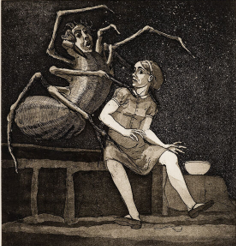
Carl Jung once wrote, ‘Where your fear is, there is your task’. Paula Rego lived this idea through her art. She painted, she said, to ‘give a face to fear’. Across her work, and especially in the Nursery Rhymes series, familiar childhood stories open into something darker, deeper, and far more psychologically charged.
Consider Little Miss Muffet. In the nursery rhyme, a young girl flees when a spider sits beside her. Rego reimagines this moment not as a simple fright, but as a tense encounter. The spider grows enormous, its face uncannily human. It looms, yet it does not snarl. Miss Muffet looks frightened, but she does not run. This ambiguity matters. Sigmund Freud associated spiders with the mother figure and the tangled emotions that shape the mother-child bond. Carl Jung, meanwhile, saw the spider as an image of the Shadow Self – the parts of ourselves we repress, deny, or refuse to acknowledge, even as they continue to shape us. In Rego’s Little Miss Muffet, these meanings converge. Fear does not arrive from outside alone; it emerges from intimacy, from what is familiar – so familiar that it becomes difficult to escape.
Rego’s own life sharpens this reading. Her mother was an artist, yet she discouraged Paula from becoming one herself, convinced that art was not a woman’s place. Female creativity had to be contained and kept in line. Read this way, the spider’s expression feels almost gentle, even protective. It embodies authority rather than outright menace. Miss Muffet’s appearance reinforces this tension. She wears a neat dress. Her hair stays firmly in place beneath a headband. She looks perfect, well-behaved, compliant. These were precisely the expectations placed upon women in Rego’s time. To become an artist meant pushing against these limits, risking disapproval, choosing fear over obedience. Rego’s work stages this inner struggle – not as a victory over fear, but as a willingness to sit with it.
Throughout the Nursery Rhymes series, Rego repeatedly returns to what feels raw and elemental. She favours primary colours – red, blue, black, white – colours that refuse softness or subtlety. The actions she depicts feel equally fundamental: biting, looming, grasping, threatening. Fear belongs to our oldest human inheritance. Long before language or culture, it kept us alive. From an evolutionary perspective, it triggers the body’s survival systems. Writing in The Principles of Psychology (1890), William James identified fear as one of the most basic human emotions. Rego speaks directly to this ancient register. Her images bypass explanation and move straight into the body, where fear first takes hold.
Animals play a crucial role in this process. Spiders, mice, and other creatures appear again and again – beings associated with darkness, corners, floors, and hidden spaces. They live close to the ground, close to what we habitually ignore or step over. Seen together, the Nursery Rhymes quietly challenge a powerful cultural assumption: good is up. We talk about moving up in the world, rising above difficulty, climbing ladders. What lies below often signals failure, danger, or shame. Rego turns this logic on its head. She invites us to look down – towards what came first, towards instinct, feeling, and bodily truth. In doing so, she echoes Samuel Taylor Coleridge’s warning about a world that increasingly becomes ‘varnished rather than polished; perilously over-civilised, and most pitiably uncultivated’.
Rego’s work does not apologise for human irrationality. It insists that fear, rage, desire, and passion do not weaken us – they animate us. By giving fear a face, Rego asks us to recognise it as part of ourselves. This recognition deepens when we notice that both Little Miss Muffet and the spider look directly out of the image, towards us. We do not watch fear from a safe distance. We meet its gaze. The spider’s gaze confronts us with what we might rather avoid. Fear no longer belongs only to the girl, the mother, or the artist. It moves between image and viewer, alive in the space we share.
Rego’s art offers no easy comfort. Instead, it offers honesty – and with it, the possibility of a deeper understanding: of ourselves, of our shadows, and of the fierce, fertile ground from which creativity grows.
Â
General
Rego’s Jane Eyre collection is a storyboard of contrasts: passion vs restraint, strength vs vulnerability, light vs darkness. A dominant Mr Rochester sits upon his horse to then be propped up by Jane and Bertha in another painting within the same series. Little Jane sits by the pastel-coloured window in Girl Reading At The Window, while older Jane is framed by a bloody red that mirrors her strength in Come To Me. Like Bronte, Rego has captured the roaring emotions that lie beneath the surface, and how wild and distorted they become if we continue to cast them aside.
—-
In almost every piece, Rego shrouds Jane in darkness. From the heavy shading of her dress in The Comfort Of A Bonnet to her standing in shadows in The Scarecrow, Jane still captivates despite being pushed into darkness, out of sight. She cannot be completely erased.
Portrayed only as a victim, Rego’s Bertha is soft and delicate. Free from the black smudges that cloak Jane, she’s instead enveloped by fragility, and the emptiness that comes with feeling lonely.
Come To Me
Come To Me is bold, heavy-handed and intense. Jane wears a blue dress that represents the detachment she maintained right up to this pivotal moment. The passion ignited by Mr Rochester’s burns a brilliant red pressed heavily onto the page, heavy enough to press against Jane herself like an emotional weight that threatens to overflow, tethering herself to him. Rego portrays this tethering as a violent act rather than a heartwarming scene; a passion that Jane – and the viewer – cannot ignore.
—
In Come To Me, Rego takes an emotional scene in Brontë’s novel and strips it of the warmth and intimacy that we often associate with love. Instead, Rego lays those emotions bare through primary colours and aggressive scratchings. It’s like she’s stripped back the societal constraints Victorian women were expected to follow and allowed her true simmering emotions to bleed freely through the sky.
The Scarecrow
The scarecrow is a symbol of guardianship and control. Rego creates an intimate moment between Jane and Bertha, in which Mr Rochester becomes, as he does at the end of the novel, a ‘prop’. These opposing characters come together to position him onto a crucifix, creating an interesting paradox: Rochester is elevated, assuming his role as the protector, yet he was placed there by the two women he crushed under his own weight.

