
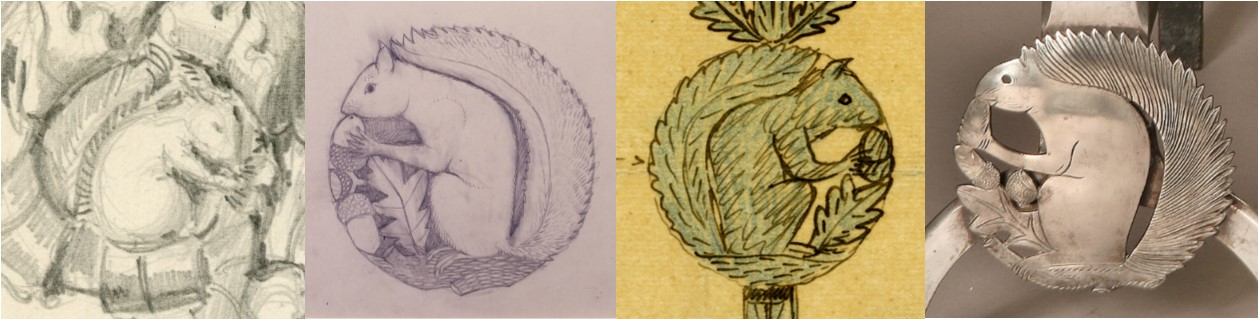
These fire dogs were made after Gimson’s death in 1919, probably in the early 1920s. The originals of the design were made for Lord Bathurst, for his library, also designed by Gimson, at Pinbury Park, near Sapperton, Cirencester. Lord Bathurst had been Gimson and the Barnsley’s landlord, but had taken the Pinbury properties back for himself and his wife in 1902, and gave the young architects plots of land in nearby Sapperton on which to build their own houses.
Find out more about the story of the fire dogs in our collection by clicking on the titles below or have a look at the images in the gallery below.
The Sketch – Winchester 1886
In 1886 the 22-year-old Gimson was on a holiday visiting sites in the south of England. He was working at J D Sedding’s architectural practice at the time. He visited Winchester cathedral and made lots of sketches of the wood- and stonework in the cathedral. In the Lady Chapel, he found a carving on a bench end in the choir stalls of a squirrel eating acorns, and sketched it. He also sketched some other whimsical animals there – they seem to have tickled his sense of humour.
Find out more about this sketchbook.
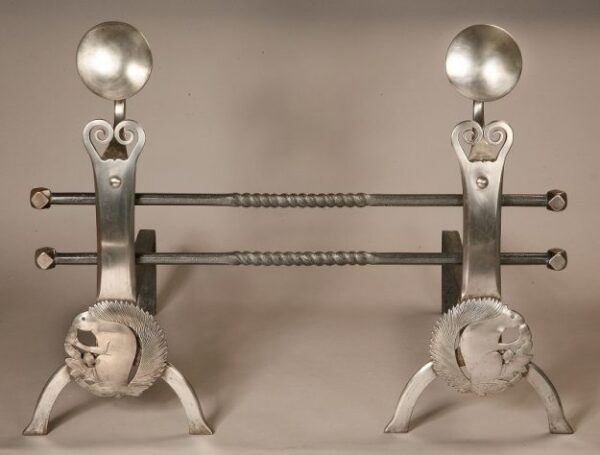
1956_72-625×474
Fire dogs in polished steel and iron designed by Ernest Gimson about 1905, and made by Alfred Bucknell, early 1920s.
Pinbury Squirrels
Gimson moved to Pinbury Park, near Sapperton, Cirencester, in 1894. He and his friends were to repair and restore the old house for the owner, Lord Bathurst, for a reduced rent. In 1903, after he’d moved to Sapperton and Lord Bathurst and his wife had taken over the manor house, Gimson designed a new room for the house, a library. He used squirrels on the fireplace. He seems to have particularly associated squirrels with Pinbury.
Find out more about Gimson’s architectural designs.
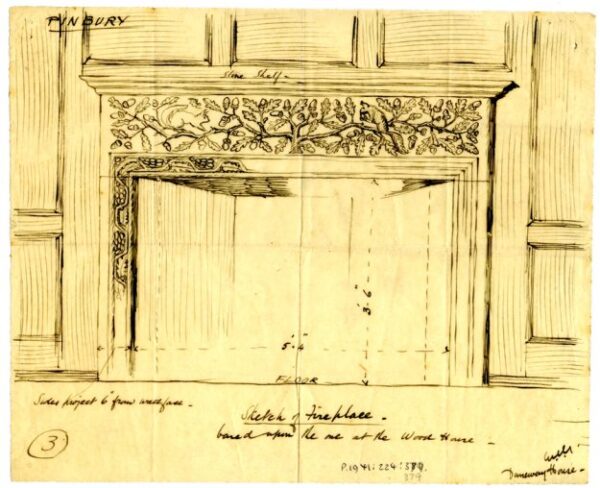
1941_224_379-625×508
Pinbury: Sketch of Fireplace, 1903.
Thinking about the design
The first sketch for the fire dogs dates from when Gimson was setting up his blacksmith’s shop with the son of the nearby Water Lane blacksmith, Alfred Bucknell. Gimson had a big commission for metalwork in Scotland, at the Old Place at Mochrum in 1904. His friend, the architect Robert Weir Schultz, was making improvements to the house. On one side of the drawing is a thistle. Gimson designed thistle-headed fire dogs and other metalwork for the Old Place, but was clearly thinking about the squirrel in his sketchbook, too!
Find out more about Gimson’s metalworks. design
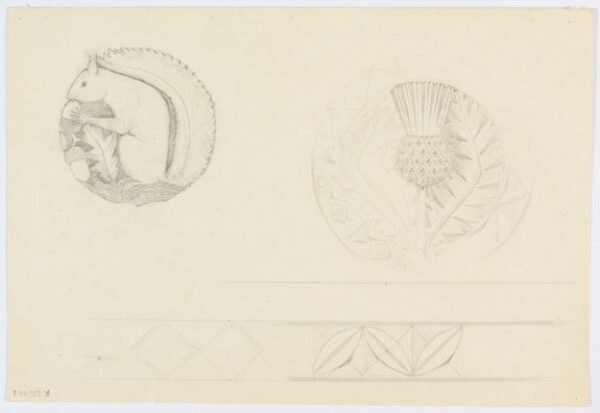
1941_223_24-625×430
Design for roundels for fire dogs, about 1904.
Experimenting with different ideas
Not everything Gimson made a design for was made. We don’t have the design for the squirrel fire dogs, but we do have this alternative design with two roundels on each upright, and a pattern of oak leaves on the stem. It’s similar to the thistle fire dogs he designed for Mochrum. The design that was made in the end is much simpler. Perhaps Gimson felt this design was more successful, or maybe it was more cost effective to make them this way!
Find out more about Gimson’s metalwork designs.
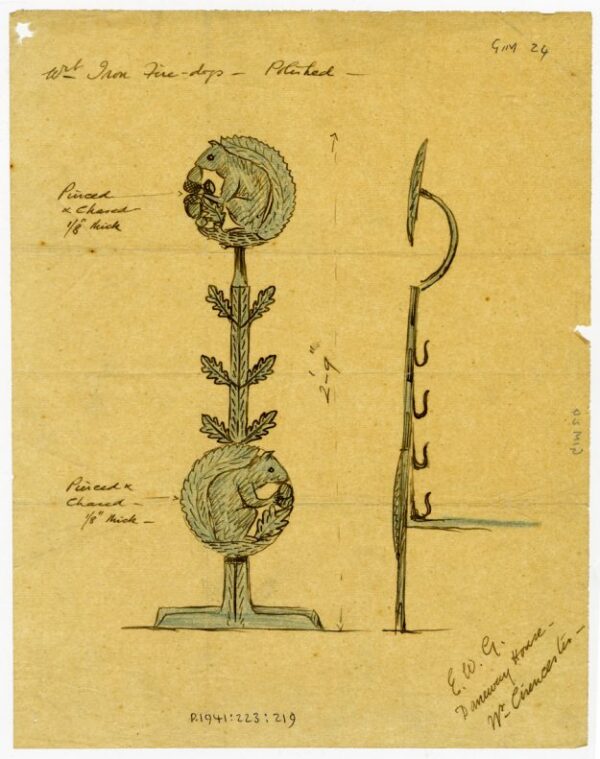
1941_223_219-625×791
Design for wrought iron fire dogs, 1905-1910.
The working drawing
This drawing would have been used in the blacksmith’s shop to transfer the design onto the metal. You can see it has been folded over, and, if you look very carefully, you can see the small holes where the metalworker has pricked out the design using. After cutting or piercing the holes in the design, a chisel is used to cut grooves into the metal to create the pattern. Then, the whole thing is given depth by beating out the back of the roundel.
Find out more about Gimson’s metalwork designs.
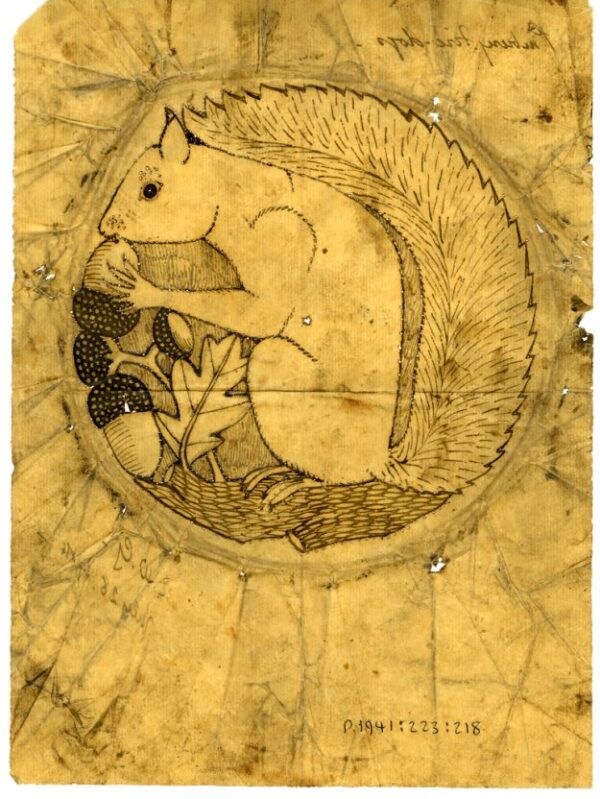
1941_223_218-625×832
Working drawing for fire dog roundel, about 1905-1910.
Share this article
Follow us
A quick overview of the topics covered in this article.