
Kelmscott Manor is a 16th and 17th century manor house in the village of Kelmscott, Oxfordshire. William Morris first encountered the house in 1871, when looking for ‘a little house out of London’. He leased it with his friend, the artist Dante Gabriel Rossetti. Living in central London, the Morris’s were concerned for their children’s health, but there was another reason for wanting a country home. Morris’s wife Jane and Rossetti had embarked on an affair. The house in country would allow them to have time together with a veneer of respectability. Despite these unusual circumstances, Morris fell in love with the Manor and its location on the River Thames, calling it ‘a heaven on earth’.
The Wilson holds a number of images of the Manor from the time that William Morris and his family were involved in the Manor, mainly part of the Emery Walker Library, but also by other Arts and Crafts Movement artists. The Manor is currently managed by the Society for Antiquaries.

Kelmscott, from the
Orchard by Edmund Hort New,
about 1895.
Morris never lived permanently at Kelmscott. That first summer, it was Jane, Rossetti, and the two Morris daughters, Jenny and May, who lived there, while Morris went to Iceland. Morris enjoyed the chance of escaping the city. Growing up in the 1830s in Walthamstow, not then fully part of London, and then at school in Marlborough and escaping onto the Downs, he loved the countryside and took great inspiration from southern England’s landscape and flora. He would go fishing on the Thames, and once boated all the way up from Hammersmith. He said of the area: ‘here you may walk between the fields and hedges that are as it were one huge nosegay for you, redolent of bean-flowers and clover…’

Edmund Hort New, about 1895.
The Wilson holds a number of images of Kelmscott Manor in the Emery Walker Library. In 1895, the last year Morris’s life, Birmingham artist Edmund Hort New visited Kelmscott and made a number of sketches of the manor. He returned after Morris’s death to do illustrations for JW MacKail’s Life of William Morris, which the Wilson holds.

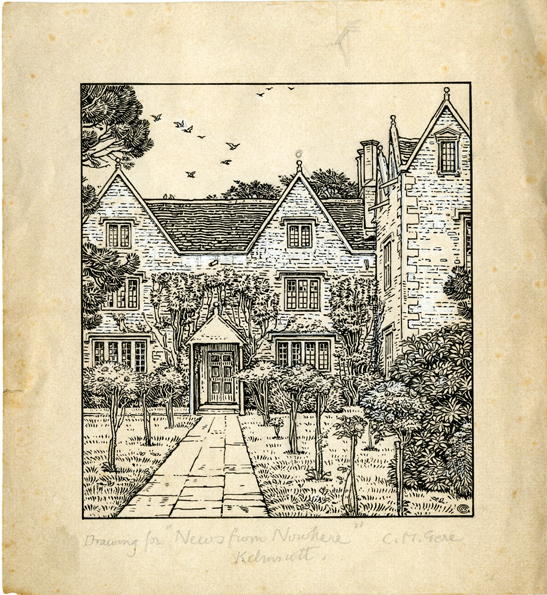
1892-3.
In 1893 William Morris published his utopian novel News from Nowhere with his Kelmscott Press. The frontispiece was by Charles March Gere and shows Kelmscott Manor. It is captioned: ‘This the old house by the Thames to which the people in the story went.’ In the book, the protagonist, Guest, who has come from Morris’s time to an idyllic far future Britain after a socialist revolution, and his companions travel up the river by boat, and stay at the old house. Gere visited Kelmscott in 1892, and spent several days sketching the manor and its surroundings on two occasions. The Wilson holds these sketches, and also Morris’s letters to Gere, which show Morris’s attention to detail, and the care he took to both encourage the young artist, but also ensure that he got the effect he wanted.

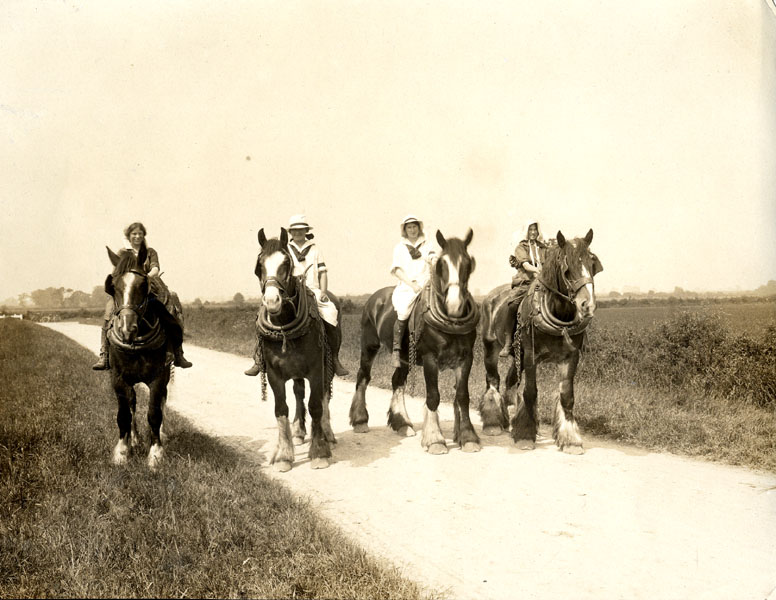
August, 1916.
May Morris and her mother, Jane, spent far more time at Kelmscott than William. Jane eventually bought the house in 1914, shortly before her own death. Before that, as a memorial to her husband, she commissioned a pair of houses for the village by their friend Philip Webb. May followed suit, asking Ernest Gimson to build another pair, and also design a village hall. The First World War and Gimson’s death in 1919 delayed the building of the hall. It wasn’t opened until 1834, the centenary of Morris’s birth. The opening was a big event, attracting over 300 people. George Bernard Shaw, who had known Morris in their London socialist days, gave the opeining speech. The Prime Minister, Ramsay MacDonald, surprised everyone by attending.
May became very involved in village life. She founded the Kelmscott WI, and became its first president. During the First World War, she supported and encouraged the women working to maintain the farms, writing an article saying they were ‘truly a gallant company, of augury for the future.’ She moved permanently to Kelmscott in the 1920s, and lived there until her death in 1938. She bequeathed the house to Oxford University, who passed it to the Society of Antiquaries, who run it today.
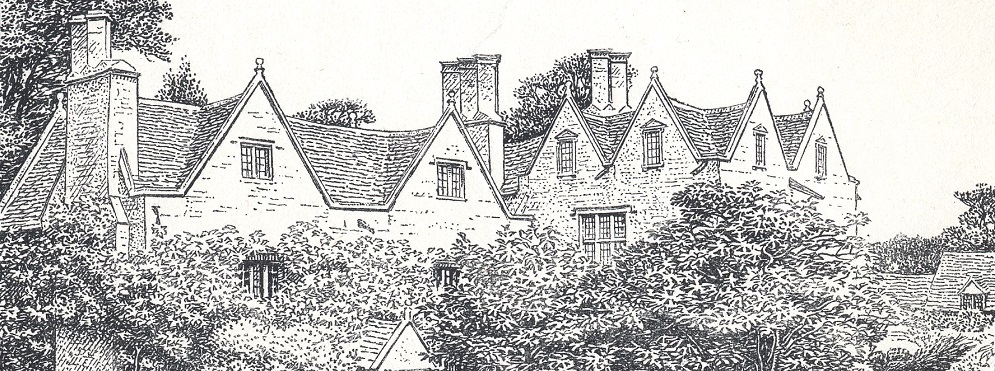
1991_1016_836_001
The Manor, Kelmscott, from the Farm by Edmund Hort New, about 1895.
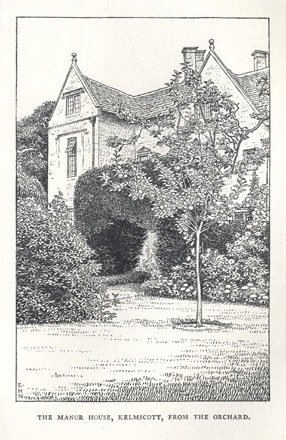
1991_1016_836_008-detail
The Manor House, Kelmscott, from the Orchard by Edmund Hort New, about 1895.
1991_1016_842_001.jpg
Four girls on ponies at Kelmscott, August, 1916.
1993_316_001
Kelmscott Manor by Charles March Gere, 1892-3.
Share this article
Follow us
A quick overview of the topics covered in this article.