

Those who remained in Cheltenham provided great support to the war effort by organising fundraising events and knitting items for the troops abroad. Many women had signed up to the scheme for the Organisation of Voluntary Aid which was set up in 1909 to provide additional aid to the medical services in times of war. These women became voluntary nurses at hospitals that were set up at houses and schools across Cheltenham. The Racecourse was even used as a VAD hospital, as they were known, where the buildings were used and temporary structures build in the Paddock area. These hospitals received patients from a variety of nationalities including Canadian, Belgian and New Zealanders. The museum has two books from these hospitals where the soldiers wrote their names and messages. The first hospital to open was New Court Hospital on Landsdown Road, which was given only 12 hours’ notice to open and be ready for casualties coming from Belgium. Nursing courses were provided at the Town Hall and the Technical School, St Margaret’s Road.
The Ladies’ College provided its students with nursing training with all pupils required to take first aid and nursing exams, and by 1914 400 pupils held nursing certificates. They would be taught to correctly carry stretchers and to set up outdoor kitchens to prepare for nursing on the front lines. Many girls would volunteer to one of the VAD hospitals in Cheltenham, likely their own Eversleigh boarding house which became a hospital in 1915. One of the classrooms was turned into an operating theatre and the labs were used to make anaesthetics for the Royal Society War Committee. The college also held plays and other entertainments, the proceeds of which would go to the war effort.
The people of Cheltenham helped the war effort further by investing over £2,250,000 in War Bonds and Saving Certificates. This scheme allowed people to buy bonds from the government for a reduced price. The money would be used the fund the war with tanks, ammunition, uniforms, medicine, food and anything else needed. These bonds would then later be paid back to the loaner at the full price. In recognition of their support the Treasury presented Cheltenham with a tank which was to be kept at Westal Green on the Lansdown Road. A poster for the occasion is in the Wilson’s collection. However, getting the tank there proved to be a trickier task than expected. After it was unloaded from St James Station on the Malvern Road it initially would not start and then broke down twice on its way to Westal Green. When it finally arrived it was over an hour late and all the presentation speeches had finished. The tank was moved to the Montpellier Gardens in 1927 and then was used as scrap in the Second World War.
Many Cheltenham companies also aided the war. The company H H Martyn & Co was world renowned for its craftsmanship in a range of materials including wood, stone, metal and glass. They made fluted columns and possibly the staircase for the Titanic as well as work on the Lusitania as well as international projects such as a palace in India. During the First World War they were making ammunition boxes when the company was given a trial contract to make spares for Maurice Farman Longhorn and Short fighter planes. The level of quality H H Martyn showed during this trail meant further contracts followed ending in the opportunity to build wings and fuselages for Maurice Farman’s, D.H.4s, D.H.5s, D.H.6s, D.H.9s and Bristol and Nighthawk fighters. Increasing demand meant that the Winter Gardens in the Imperial Gardens were used from 1916 for the manufacturing of D.H.6s and Bristol fighters. In June 1917 Herbert Henry Martyn’s son Alfred Willy Martyn set up the Gloucestershire Aircraft Company (later the Gloster Aircraft Company, or GAC) and by 1918 the company was turning out 45 aircraft a week (180 a month). By the end of the war the company had provided the war with 150 fuselages for D.H.6s and D.H.9s, 461 complete Bristol F2B Fighters and 165 Fe2bs, Nieuport and Nighthawk fighters.

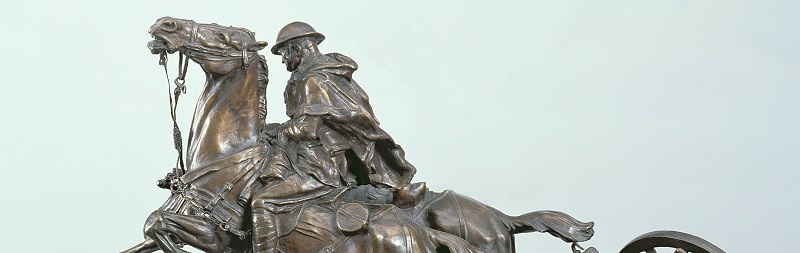
In 1919 there was an open competition to design the war memorial for the town. The museum has what is thought to be a bronze cast of one of the unsuccessful entered by H H Martyn & Co. This bronze cast was designed and created by the company’s head sculptor Robert Lindsey Clark. Entitled ‘The Limber-A Broken Pole’ it shows a soldier of the Royal Horse Artillery trying to get an Eighteen Pounder gun limber out of the mud. The cast itself is ‘No. 4 Replica’ and was made along with other copies in 1924. The design was greatly admired for its realistic execution and craftsmanship when one was exhibited at the Royal Academy in 1924.
Share this article
Follow us
A quick overview of the topics covered in this article.