
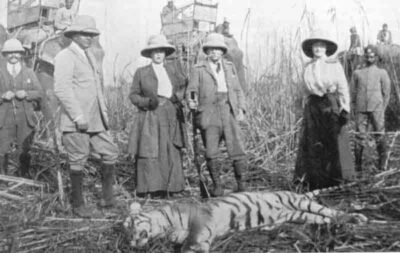
Shooting tigers was a popular leisure activity in India in the 19th and early 20th centuries. The Indian nobility, colonial administrators, and military officers organised shooting parties for honoured guests. Afterwards the best of the kill would be taken to local taxidermists to mount.
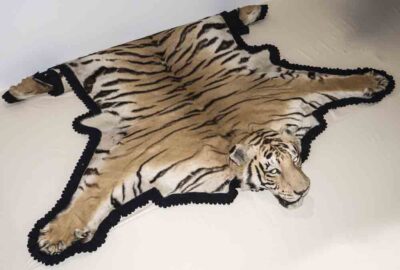
This tiger was shot by James Somerville (1884 -1950), an Irish army officer serving in India. He worked with the Indian army artillery becoming a Lieutenant Colonel by 1931. In common with many in his position he retired to Cheltenham. His widow gave the rug to Cheltenham Art Gallery & Museum in 1957.
The Rug’s Story
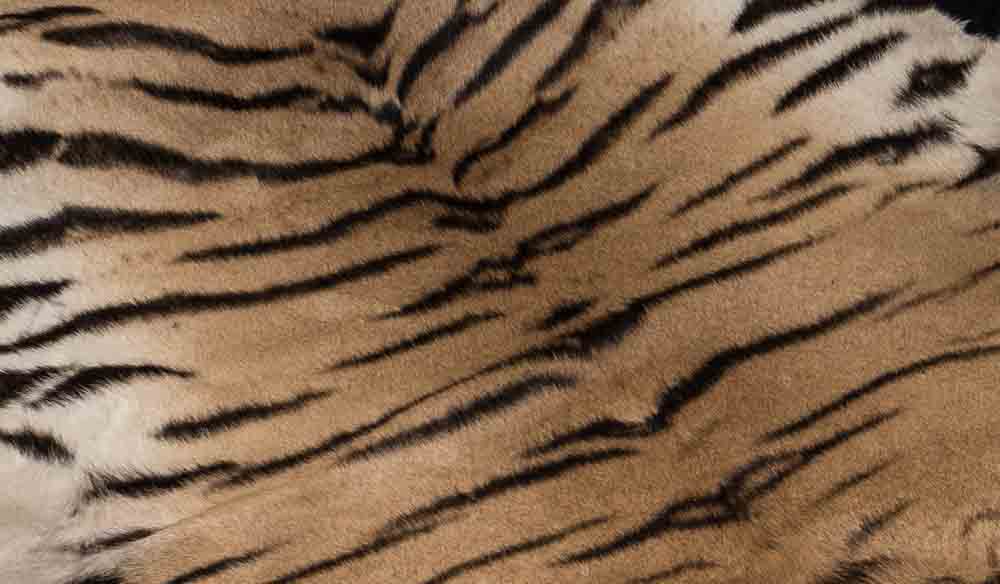
The tiger was shot from an elephant back. The carcass was one of four taken to Van Ingen & Van Ingen of Mysore on 21 April 1935. There it was cleaned, pinned on to a board, preserved, the head prepared and the backing stitched on. It was a very skilled job, especially in the extreme heat, as the carcass could deteriorate very quickly. The head is filled with wet sand, and capped with a block of concrete. The eyes are made of glass, hand painted. The mouth is also hand painted, but the teeth are original. On 15 August 1935 the completed rug was shipped by Curtiss & Sons to Portsmouth, and finally via the Great
TigerSkin-7
From unknown item to special exhibition
The information above took three years to uncover, and involved the work of a number of people and institutions. The trail started with a paper label on the back of the tiger skin reading Van Ingen & Van Ingen Mysore. 5 21703. A Google search found Pat Morris, a researcher tracing the history of taxidermists. He came to look at the rug, and was able to tell us that it was ‘an exceptionally large adult male in the full snarl position’. He faxed India, and a researcher rode on donkey back to look at the Van Ingen records. She matched the number on the skin to the order book, the delivery of the carcass by Lieutenant Colonel Somerville, and its subsequent dispatch on ship to England. Mick Kippin, a local military historian, traced the history of James Somerville. The Southampton Record Office tracked down the arrival of the skin by Curtiss & Sons and its onward transmission to Cheltenham.
CopyprintTiger-hunt-1
Big game hunting was a popular activity among Indian nobility and was extended as part of the hospitality offered to guests.
Share this article
Follow us
A quick overview of the topics covered in this article.