
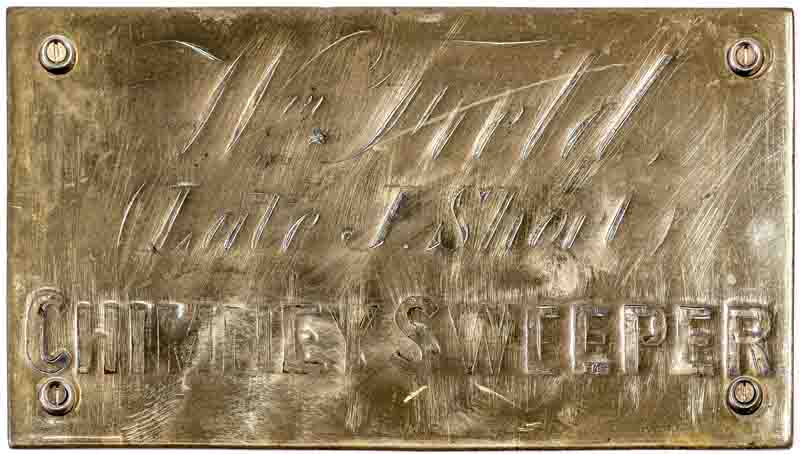
The sign was sold to the Museum in 1950 by Frederick Field, the last in a succession of sweeps to live in the house, following his retirement in August of that year. Also on display is a late 19th-century brass doorplate with the inscription ‘Wm Field (late J Short) chimney sweeper’, and a set of sweep’s brushes. Both of these were given to the Museum by Fred Field’s son, Arthur, in 1979 -1980.
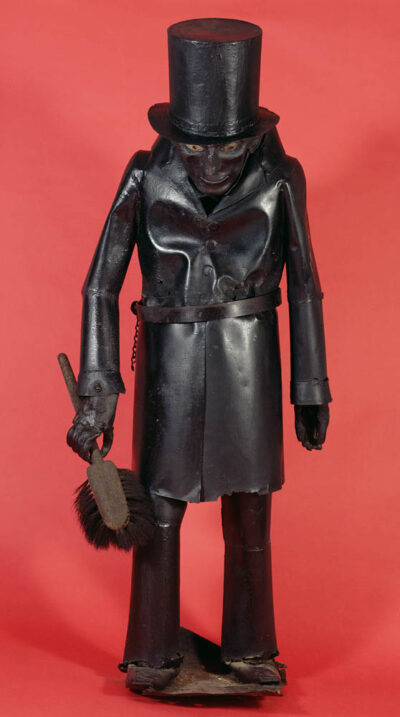
The sign is made of zinc, and shows a master sweep in his frock coat, bow tie and top hat. Its exact date is uncertain, but it probably dates from some time during the middle decades of the 19th century.
The Short Family
A number of chimney sweeps are recorded as living and working in Sherborne Street during the 19th century, of whom the earliest who may have been associated with the sign was John Russell (1805 –1843), who established his business at no.15, on the west side of the street, in about 1825. On his death, his widow Ann (nee James, 1809–1870) continued the business and engaged as her foreman a Bristol-born sweep named James Short (about 1815–1869), who had previously worked for another Cheltenham sweep, James Taylor. James Short and Ann Russell soon married, and when Ann was widowed for a second time, she once again continued the business on her own.
It is possible that either John Russell or James Short (or possibly Ann?) had the trade sign made, and that it originally hung outside 15 Sherborne Street. In about 1856, however, James and Ann Short moved their business to a larger, three storey house on the opposite side of Sherborne Street: originally no.39 Sherborne Street, its number was later changed to no. 43, which it remains today.
Both John Russell and James Short employed young ‘climbing boys’, whose job was to climb inside the chimneys and to clear them of soot. The climbing boys often ‘lived in’ with the sweep and his family, and according to a family tradition, they slept in wooden ‘coffins’ in the back kitchen of 43 Sherborne Street; these are said to have survived until 1950, when they were burnt following Fred Field’s retirement. The back kitchen also contained the zinc bath in which everyone bathed after a day cleaning chimneys.
1950_178
Tradesman's sign in the form of a Master Sweep, around 1830. Displayed above 15 and later 43 Sherborne Street, Cheltenham until 1950.
The Field Family
In 1851, one of the Shorts’ neighbours was a Charlton Kings shoemaker named William Field (1813–1864), who was living at 13 Sherborne Street with his wife Elizabeth (nee Yates, 1817-1854) and their four children, including their six year old son William (1845-1901). He became one of James Short’s climbing boys and eventually took over the business from Ann Short, presumably after her death in 1870. He was certainly living at 39 Sherborne Street in December 1861, when he and another resident of the house, Charles Dando, appeared as witnesses in the prosecution of a 14 year old boy accused of stealing six pigeons, which he had sold to Field and Dando.
William was still living at 39 Sherborne Street on 8 November 1863, when he married Ellen Keylock (1844 -1903), the daughter of a Winchcombe gamekeeper. By then his mother Elizabeth had been dead for nine years, and his father was to die in the Cheltenham Union Workhouse the following year.
Birth and death certificates for William and Ellen’s first three children (only one of whom, Agnes Alice (born 1869) survived infancy) record them at two different addresses after their marriage: 2 York Court in 1865 and 15 Mount Pleasant (now part of Fairview Road) in 1867-1869. By August 1870, however, when their next child (a son, who also died in infancy) was born, they had moved back to 39 Sherborne Street, perhaps to support an ailing Ann Short, who died in December of that year.
William and Ellen Field lived at 39 Sherborne Street for the rest of their lives, and had nine more children, one more of whom also died in infancy. These included their eldest surviving son, Frederick William (1871-1955), who was working with his father by the age of 12. He took over the business on his father’s death, and ran it until his retirement in 1950, by which time he is said to have been the oldest working chimney sweep in Britain.
Both William and Frederick Field were well known local characters, and could often be seen transporting bags of soot back to the house, in a small cart drawn either by a donkey, a pony or a horse, although after his long-serving Shetland pony, Tommy, had to be put down in around 1920, Fred Field used a bicycle instead, balancing the bags of soot on the handlebars. At Sherborne Street, the soot was sieved and bagged in the ‘soot house’ at the rear of the house (reached, as was the stable, by a narrow passageway on the north side of the house), and then sold to local farmers for use as a fertilizer. William Field is said to have been so strong that when the farmers’ carts came to collect the soot, he would unhook the horses and turn the cart around in the street by hoisting the front of the cart onto his shoulders.
The Sweep and the Museum
The sweep’s sign was clearly held in high regard by the Field family, by whom it was known as ‘the old man’. On his deathbed, William Field is said to have told his son Frederick ‘never to get rid of the old man’, and the sign was occasionally decorated to mark important events, such as VE Day in 1945. It also succeeded in scaring generations of local children, with its staring eyes, and on at least one occasion a startled night-time passer-by is said to have contacted the police in the belief that someone had hanged themselves from the outside of 43 Sherborne Street. Family tradition has it that Fred Field was offered considerable amounts of money for the sign, but he refused to sell it, as he wanted it to remain in Cheltenham.
Fred Field’s eldest son, William Frederick (1900 -1967) worked with his father for a time but later pursued a career in the Post Office, and as none of Fred’s younger sons wished to continue the chimney sweeping business, he eventually decided to sell the sign to the Museum, where he would often pop in ‘to have a chat with the old man’ in the years following his retirement.
Frederick Field’s widow, Agnes (nee Birt, 1877–1965) continued to live at 43 Sherborne Street for two or three years after her husband’s death, but later moved in with relatives, following which the house was sold to a builder and leased to tenants; it was at around this time that the top storey of the house was removed.
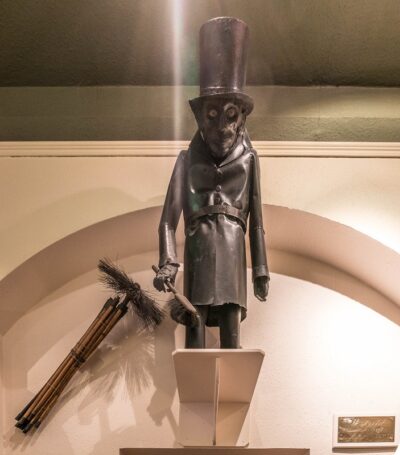
1950_178-in-the-galleries
The sweep sign on display in the local history gallery, alongside brushes and the brass name plate.
Share this article
Follow us
A quick overview of the topics covered in this article.