
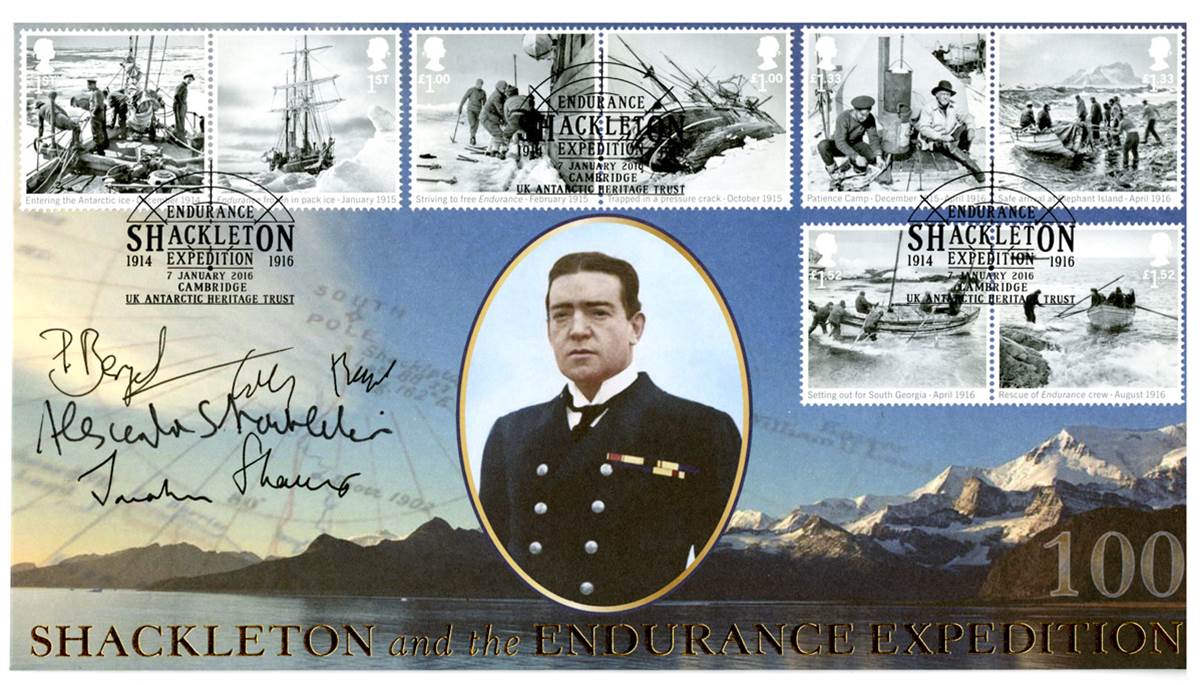

In 1914 Shackleton made his third trip to the Antarctic with the ship Endurance, aiming to cross Antarctica from the Weddell to the Ross Sea.
Shackleton spent most of 1913 and 1914 preparing for this journey, which was officially known as the Imperial Transantarctic Expedition. He had to hiring the team, equip the ship and endeavour to raise funds to support the trip. The Endurance left London on 1 August 1914, and on 4 August docked at Eastbourne. At midnight England declared war on Germany. Shackleton was in turmoil. He had poured the greater part of the last two years into preparations. If the ship did not sail immediately the team would miss the summer season ice in the Antarctic. But there was a duty to the country too. He consulted his men. Four decided to enlist, the rest opted to follow Shackleton’s lead and ask the Admiralty for orders. A one word telegram was received from Churchill: ‘Proceed’.
The ship sailed via Buenos Aires to South Georgia, the final stop for refuelling before entering the Antarctic seas. It was also the last place where the men could hear news of the war in Europe. One man, Daniel Gooch on learning that his house had been requisitioned as a hospital, returned to Essex, but the remaining 26 men under Shackleton’s leadership, sailed south to the Antarctic. The rest of the story is well known: Endurance was crushed in the ice, but, after some extraordinary experiences, Shackleton brought every one of his men out alive. Shackleton’s first words on reaching the whaling station in Stromness after 18 months in the ice were, ‘My name is Shackleton. Tell me when was the war over?’ The reply: ‘The war is not over … millions are being killed.’
Making the furniture in ebony was very expensive, so Gimson had to get it right first time. To ensure he did, he made a prototype chair, finished to every detail, in the much cheaper wood, walnut. This is now in the collections held by The Wilson. It was bought by Robert Weir Schultz, and lived in his house in Hartley Wintney in Hampshire. When Sidney Barnsley’s son, the furniture maker Edward Barnsley, got married, they had the wedding reception at Schultz’s house, and the clergy chair was the bride, Tania Kellgren’s seat!

Shackleton found it much more difficult to rescue the other half of his expedition, the men that had travelled in Aurora and were stuck in the Ross Sea. The Admiralty in London were not interested in a few explorers’ lives when so many thousands were being killed in the war in Europe. The Australian and New Zealand governments took much the same line. Shackleton had to exert all his charisma to win over sufficient help to mount the rescue. Once achieved, he embarked on a frantic round of lectures, giving all the money raised to the Red Cross.

Shackleton had achieved remarkable things in the Antarctic but Europe had changed while he had been away. He was too old to enlist and was not a well man (though he never admitted this). He begged the Government for a suitable job. He had good standing in Argentina and Chile: the people there had lined the streets in their hundreds to welcome the polar explorers back from their ordeal in the ice, and Shackleton had been lauded wherever he went. So he was sent on a mission to South America to promote Britain’s interests, and find out exactly how Britain was regarded. He returned in April 1918, but it is doubtful if his report was ever acted on.

His next posting was to prospect for mineral wealth in Spitsbergen on behalf of the Northern Exploration Company, a job that in peacetime would have appealed to the treasure hunter in him. He was given shares in the company as an incentive and allowed to have some of his former comrades join him, and they set off to Norway to investigate. The real reason for the trip was undoubtedly to preserve mineral assets for the allies; Russian exploitation was believed to be a real danger. But Shackleton had only reached Tromsø in Norway when the War Office recalled him for a more urgent job.

The War Office thought Shackleton was the ideal man to equip allied troops with suitable clothing and equipment for overwintering 150 miles north of the Arctic Circle. Murmansk in North Russia was the only port in the area to remain open throughout the winter, and the Government wanted to ensure it was available for the allies to use. The troops were also deployed to assist the counter revolutionary White Russians. Shackleton was delighted as he could at long last hold a military post, with the associated uniform – he was appointed a Major – and the posting held the prospect of danger, sledging and possible fighting. He was also able to recruit some of his former crew and also Scott’s. But the posting was not needed long, two weeks after his arrival in Mumansk the armistice was signed. He returned to London in December and resigned from his role in February 1919.
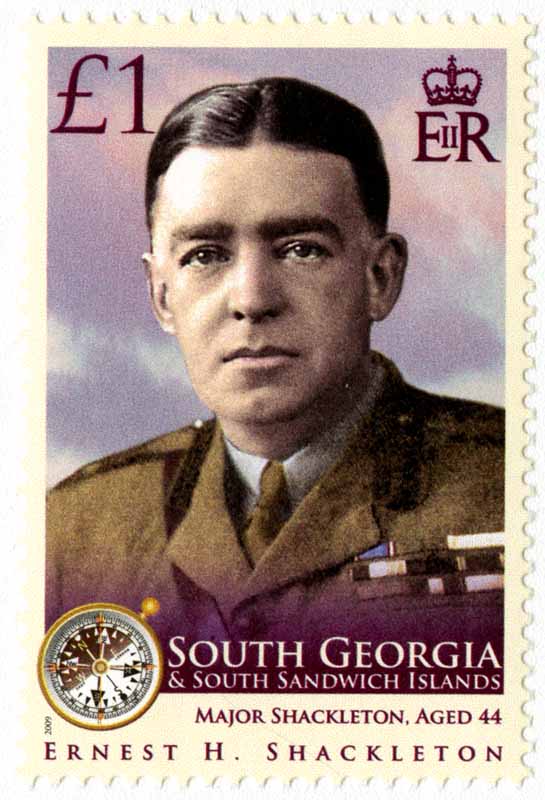
Shackleton-aged-44
A commemorative stamp bearing the image of Shackleton in military uniform.
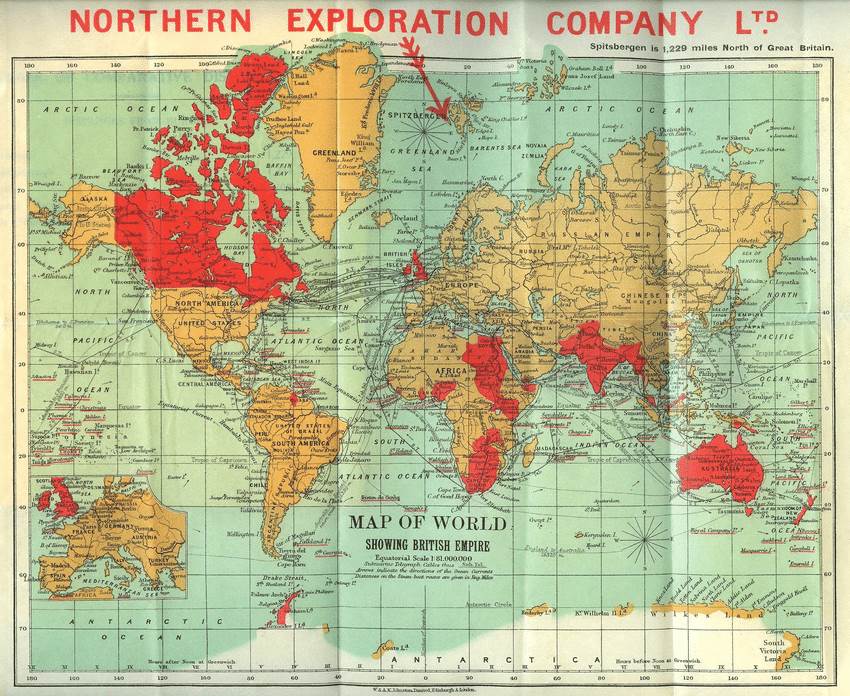
Spitsbergen-Northern-Exploration-Company
A map of the world showing the British Empire and its interests
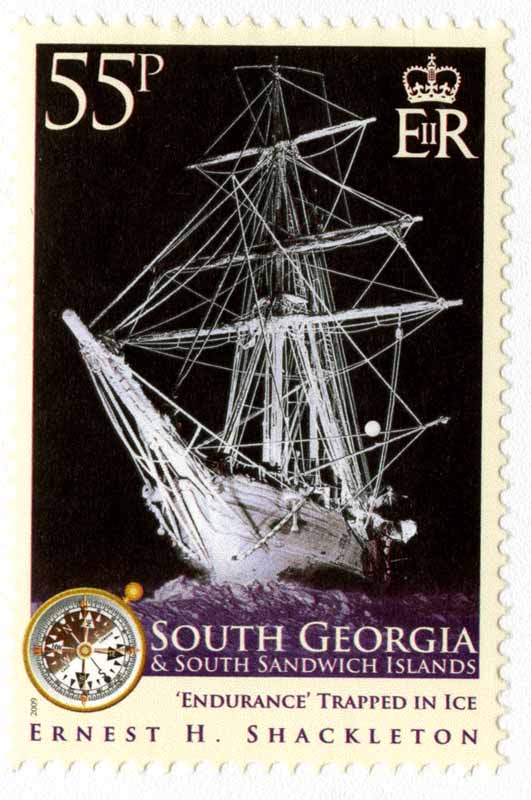
Endurance-trapped-in-ice
A commemorative stamp of Endurance trapped in ice.
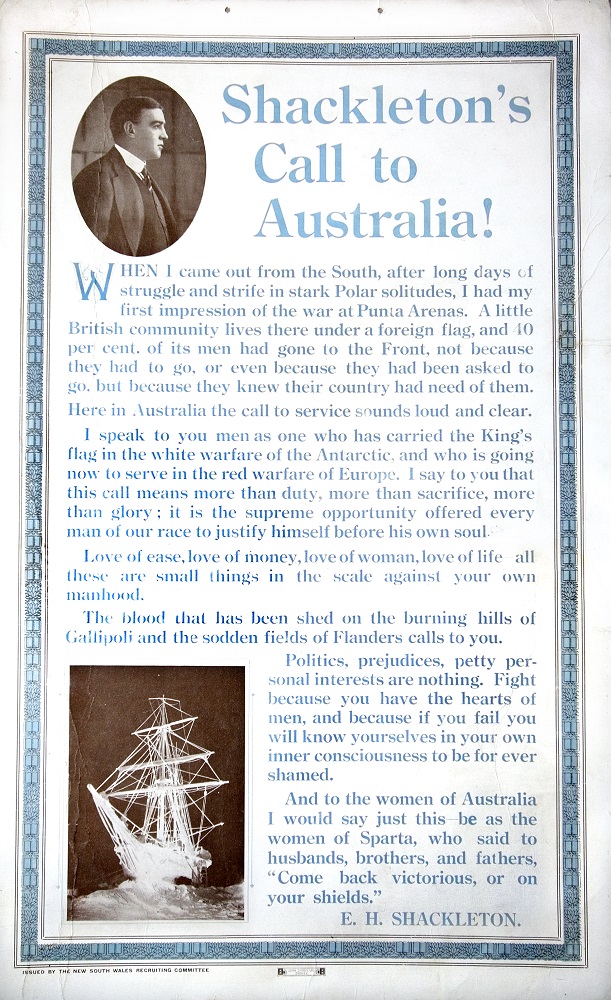
KossowShackleton.10
A call to arms to Australia from Shackleton
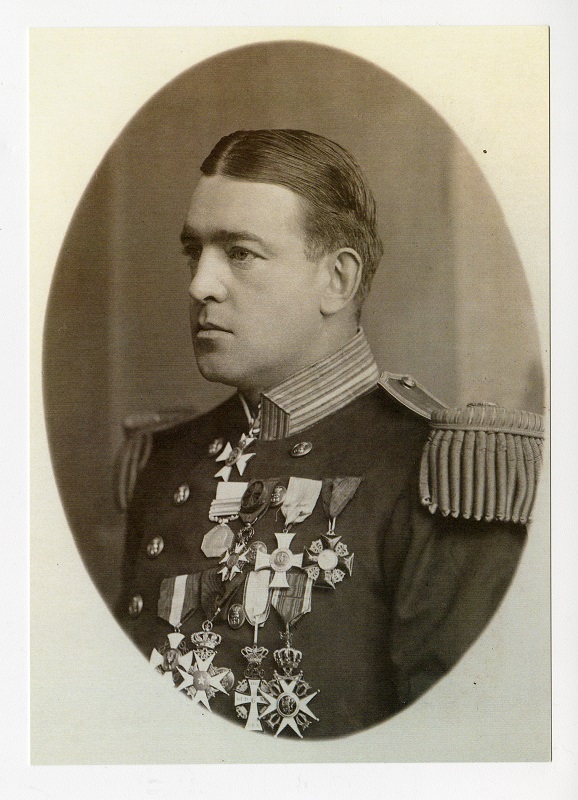
Shackleton_medals006
A portrait of Ernest Shackleton decorated with a variety of medals.
Share this article
Follow us
A quick overview of the topics covered in this article.