

After the First World War ended there was a demand in communities for memorials for those who had died during the war. These memorials are to be found in virtually every village, town and city in Gloucestershire, even the three ‘Thankful Villages’, Coln Rogers, Little Sodbury and Upper Slaughter, where no men or women were lost. We usually naturally focus on the men and women who gave their lives, but each of these memorials had a designer and a maker. Indeed, after the war, certain firms, like HH Martyn and Boultons gained a lot of contracts for the memorials. It’s no surprise that there are a number of memorials, from stone crosses to stained glass windows, designed by the Arts and Crafts Movement architects and designers who lived and worked in the county.
The Wilson holds a rich and varied decorative art collection ranging through furniture, metalwork, ceramics, glass, woodwork and jewellery from the 17th to 21st centuries. Significant collections include an important collection of Chinese ceramics collected in India in the late 19th and early 20th centuries, a collection of studio pottery, which focuses on important local potteries such as the Winchcombe Pottery, and a collection of 17th and early 18th pewter and treen.
Further information about our decorative art collections will be coming soon.

The architect designed only one war memorial erected in the county. By 1919 Gimson was terminally ill. He would die on 12 August that year. His design for Fairford’s memorial was his last recorded design, and is a memorial with delicate oak leaf carving on the cross. The memorial was paid for by voluntary public subscription and a committee was set up to manage the project. Gimson’s assistant, the architect Norman Jewson, supervised the stonemasons, Farmers Brothers. Gimson died shortly after the memorial was completed. It was dedicated on 21 October 1920. Jewson went on design a number of memorial tablets for Gloucestershire villages himself, at Dumbleton, Hill and Maiseyhampton.

Gimson’s close colleague Sidney Barnsley designed two war memorials in the county, at Minchinhampton and Poulton. At Minchinhampton, the money was again raised by public subscription, including support from the Australian Flying Corps based at the nearby air field. The Wilson holds a number of designs for Minchinhampton, which show that Barnsley’s initial ideas were quite elaborate. One of the designs shows a carving of pelican pecking her breast to feed her young, a symbol of sacrifice, on the base of the cross. In the end, a simpler memorial with a Celtic cross fashioned of oak leaves for the cross itself, representing strength and determination, was erected in a prominent position in the market square, and the names of the fallen were carved onto tablets within the Market House close by. The monument at Poulton also has a Celtic cross, recording the 14 people who fell in the war from the village.

Griggs is best known as a printmaker, not a designer, but he had originally trained as an architect. His friendship with Gimson and Jewson led him to put his skills to good use. He was responsible for a number of memorials: Snowshill, Painswick, Winchcombe (Gimson was approached, but was too sick to take it beyond a first sketch), a lych gate at Weston-sub-Edge, and tablets at Blockley and Chedworth. His crosses are not only inspired by the work of Gimson and the Barnsleys, but also his observation of medieval crosses in his work doing illustrations for the Highways and Byways series of guide books. He also designed the memorial cross for his home town of Chipping Campden. However, it wasn’t a simple process. The townsfolk were divided as to whether they wanted a cross or something more practical, and local politics and concerns over Griggs Roman Catholicism meant that the debate became acrimonious. Nonetheless, the memorial was erected, and Griggs considered it his finest
There are a whole range of memorials by Arts and Crafts designers in the county. One of the most elaborate is at Stanway, a collaboration between the architect Sir Philip Scott, sculptor Alexander Fisher, and Eric Gill who did the lettering. It depicts St George killing the dragon in bronze. Why not see if you can find them all? The memorials listed above and the ones below aren’t comprehensive, but will give you a start:
Berkeley – painted reredos by Henry Payne; Didbrook – tablet by Alexander Fisher; Duntisbourne Abbots – stone cross by Alfred Powell; Gloucester All Saints – stained glass by Morris & Co.; Moreton-in-Marsh – stone cross by Guy Dawber; Saintbury – stone cross by Alec Miller.
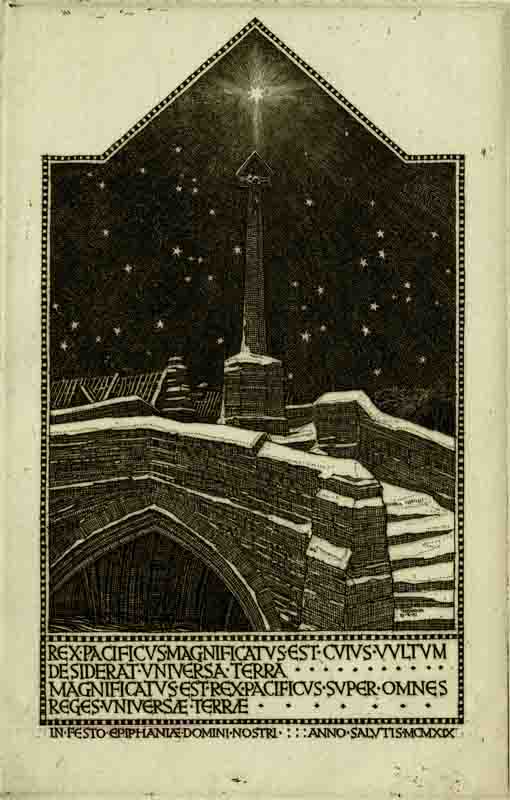
1990_132
Griggs' 1919 print, Epiphany, serves as a model for his memorial crosses.

Fairford-memorial-Portrait-5in-x-7in-225×300
The war memorial in Fairford, designed by Ernest Gimson.

1972_186_51-portrait-8.5in-x-11in
Preliminary design for Minchinhampton memorial by Sidney Barnsley
Share this article
Follow us
A quick overview of the topics covered in this article.