
The Arts and Crafts Movement was one of the most important design movements of the 19th century. However, there isn’t one fixed Arts and Crafts style. There are certain key themes. Simple forms, inspiration from nature and the past, and truth to materials are all characteristics of the Arts and Crafts Movement. Those involved, whether designers or makers, professionals or amateurs, were bound together by a conviction that it was important to make beautiful things, and make them well.
The emphasis on the domestic decorative arts, furniture, textiles, metalwork and the like, put the house at the centre the Arts and Crafts Movement. For William Morris a beautiful house was ‘. . . the most important production of art and the thing most to be longed for’. The Arts and Crafts home was both a reflection of society and a sanctuary providing physical comfort, visual inspiration, and spiritual and mental well-being.
Simplicity: Arts and Crafts interiors
“I have never been in any rich man’s house which would not look the better for having a bonfire made outside of nine-tenths of all that it held.â€Â William Morris ‘The Art of the People’ 1879
5
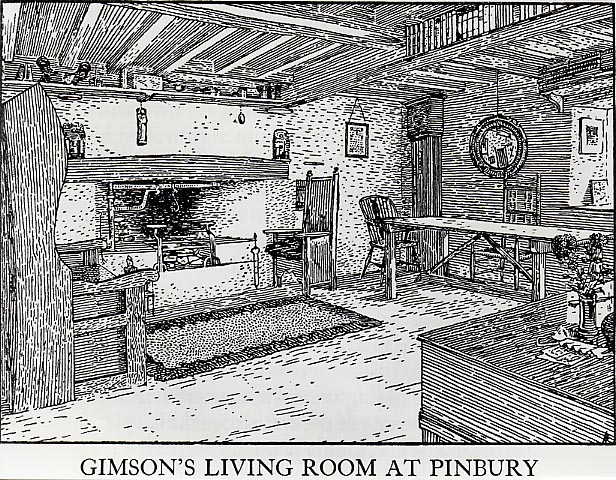
Ernest Gimson's living room at Pinbury, Gloucestershire engraved by Alfred Powell, about 1900. Note the fireplace and settle suggesting a warm friendly welcome and the beam incorporating a bookshelf.

Voysey-Ward-Higgs-dining-room-incl-heart-dining-chair-625×484
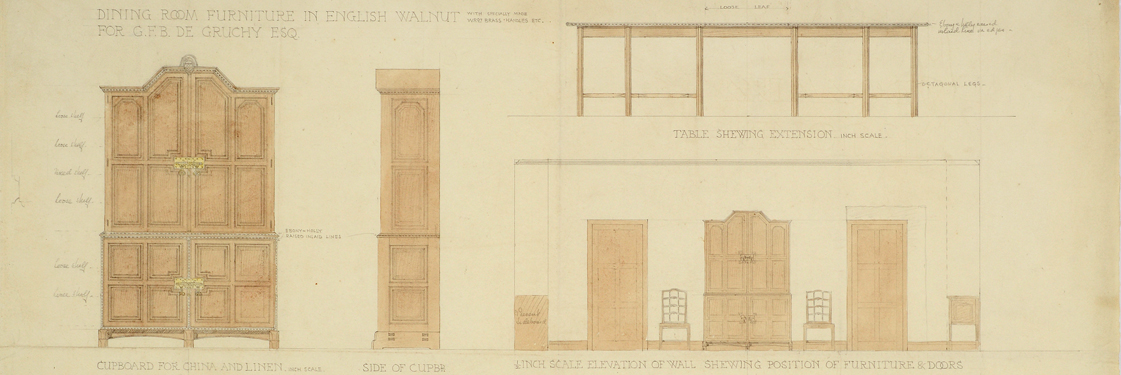
The core of Arts and Crafts style is simplicity. Architects, designers, makers and consumers aimed for simplicity because it provided a practical and clean environment. The use of built-in furniture such as cupboards and large settles became more common. Dining room designed for Mr and Mrs Ward Higgs by C F A Voysey, with built in furniture, late 1890s.
1995.578-625×908
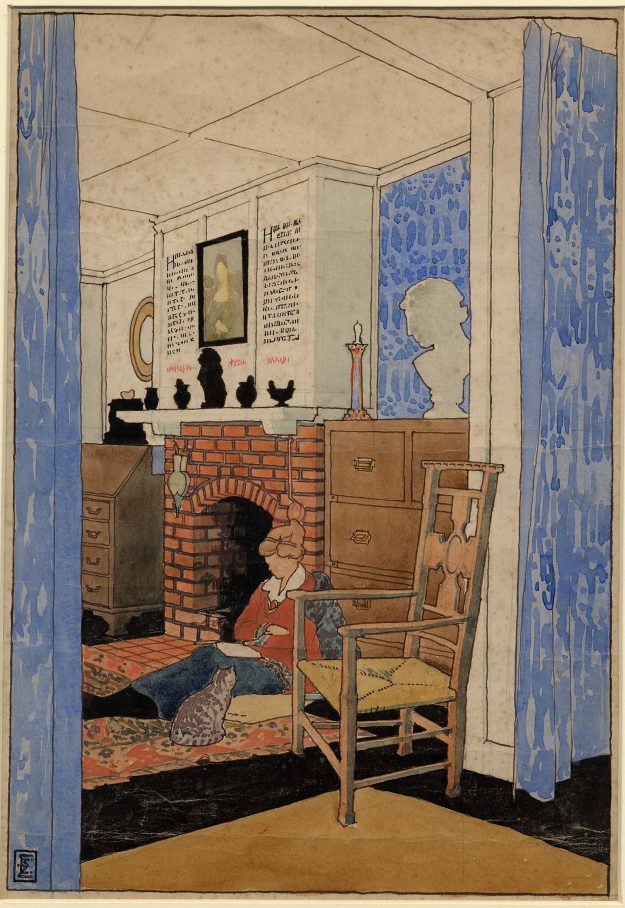
Visual simplicity in the home produced a restful setting. This was achieved by a concern for proportion and detail as well as the removal of clutter. Eric Sharpe's watercolour of his living room at Brewery Cottage, Christchurch, Hampshire, 1921.
2
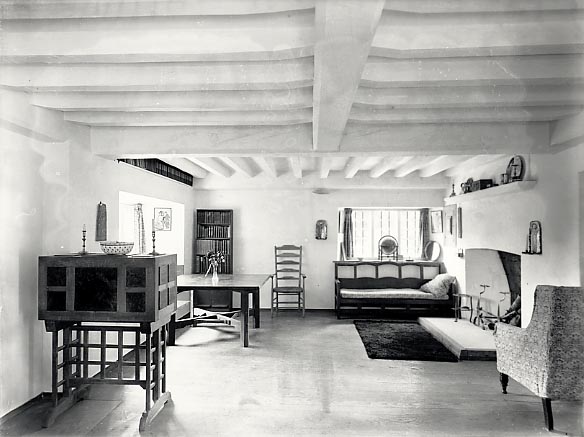
Arts and Crafts architects who also designed furniture and metalwork such as Ernest Gimson were able to create a simple but coherent look for a home. This is the living room of Gimson's close friend and colleague Sidney Barnsley, in Sapperton, 1904.
Splendour
“The great advantage and charm of the Morrisian method is that it lends itself to either simplicity or splendour.â€Â Walter Crane ‘The English Revival in Decorative Art’ 1911
1984.51-625×628
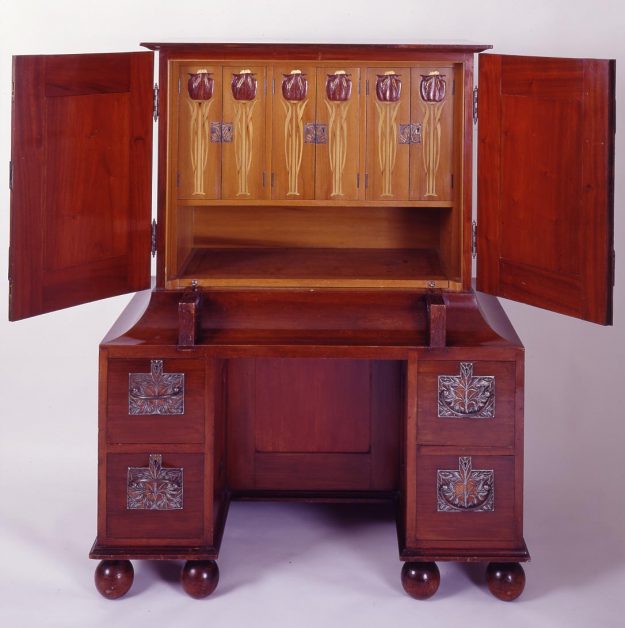
William Morris encouraged designers to look not only at simple forms for furniture, but also to create 'state' furniture, saying: "we need not spare ornament on these, but may make them as elegant and elaborate as we can with carving, inlaying, or painting". This writing desk by C R Ashbee and the Guild of Handicraft from 1899 shows off many of the techniques the Guild could offer.
1983.199
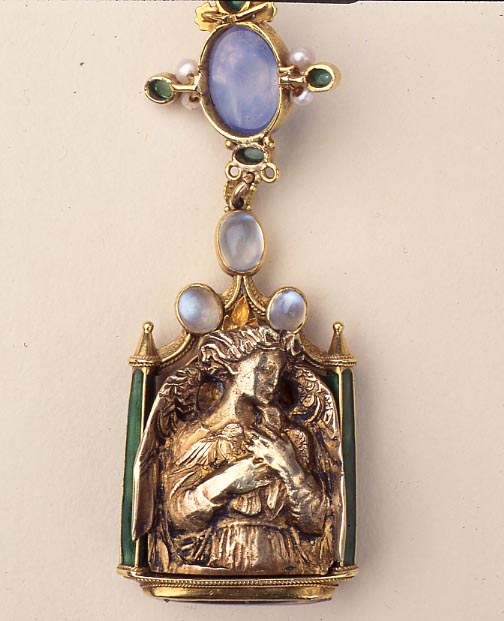
Influential Art and Crafts architects such as Henry Wilson emphasised the importance of the crafts in building. His metalwork and jewellery designs such as this double-sided pendant, about 1907-10, are rich in colour, texture and imagery.
1981.318-625×168
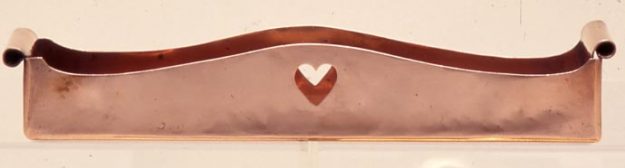
Splendour in the Arts and Crafts could come from the enthusiasm for making things. C F A Voysey understood that making something for yourself or knowing who made the objects you own adds an emotional level of appreciation. He designed this pen tray in about 1900 to be made simply from folded sheet copper.
1982.1194
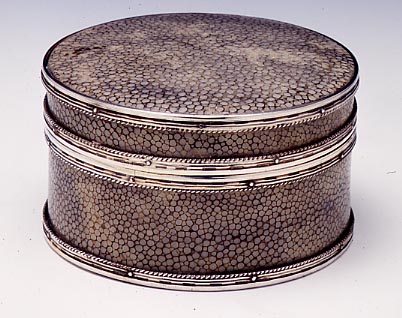
Splendour in the Arts & Crafts came from the interest in experimenting with different materials and new techniques. Arts & Crafts designers such as John Paul Cooper developed a distinctive style working with unusual materials such as gesso (a mixture of plaster and glue). He is best known for his shagreen (sharkskin) boxes with silver mounts. This example dates from the 1920s.
Nature
“I, as a Western man and a picture-lover, must still insist on plenty of meaning in your patterns; I must have unmistakeable suggestions of gardens and fields, and strange trees, boughs, and tendrils.â€Â William Morris ‘Some Hints on Pattern-designing’ 1881
2010_185-625×779
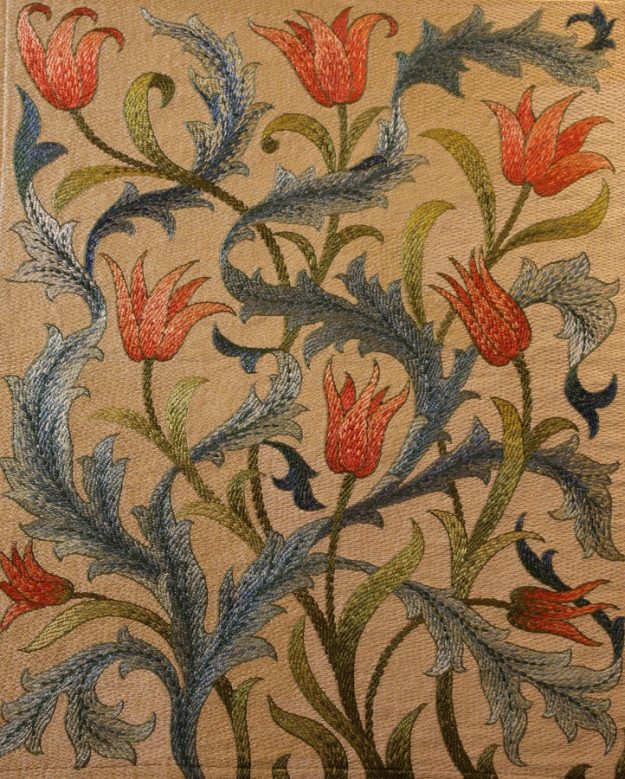
For William Morris and the Arts and Crafts Movement, nature was the source of all pattern. The inspiration of the natural world, 'the outward face of the earth', was chosen for its uplifting qualities. This embroidered panel was designed for Morris & Co. by Morris's daughter, May, in the early 1890s.
1952_106-625×807
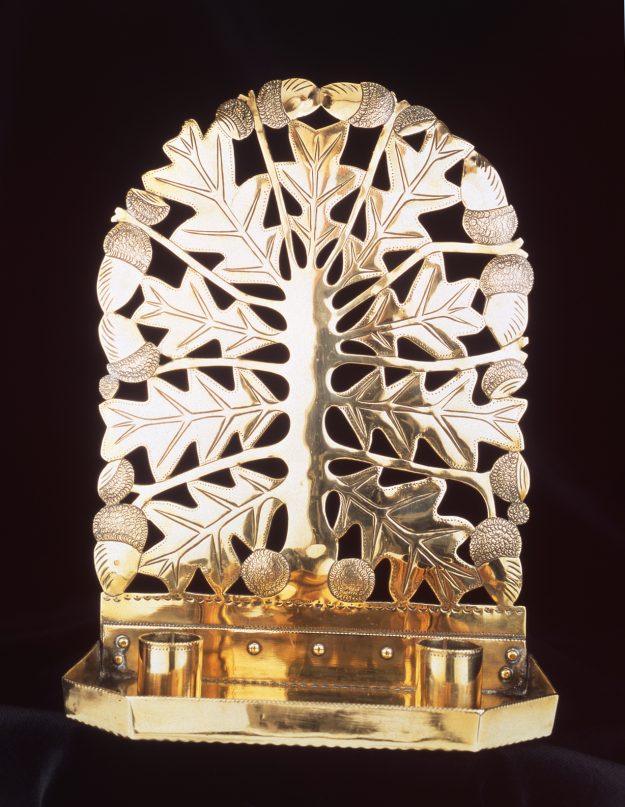
The natural rhythms and patterns of plants and flowers were a reflection of a purity of approach. This candle sconce designed by Ernest Gimson with its pattern of oak leaves reflects his love for the natural world he saw around him in rural Gloucestershire.
1983.197
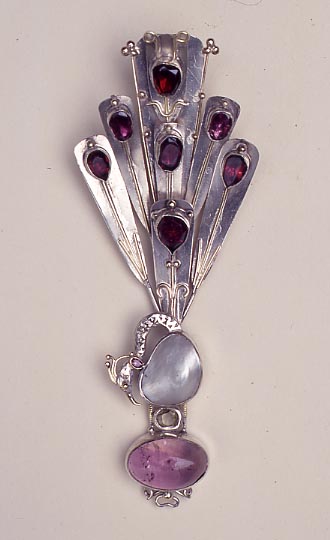
Arts and Crafts designers reacted violently against the distortion of natural forms adopted by Art Nouveau in continental Europe. Natural forms were adapted, like in this peacock brooch designed by C R Ashbee about 1902, but never unrecognisable.

the-conservatory-at-emery-walkers-house-7-hammersmith-terrace-london_5489395606_o
An important part of the Arts and Crafts home was the garden. It was often laid out as a series of outdoor rooms becoming wilder and closer to nature as one went further away from the house. This is the conservatory at Emery Walker's house, 7, Hammersmith Terrace, London.
Colour, texture and symbolism
“She saw in a window in Regent Street a number of Bokhara hangings very nobly displayed. They were splendid pieces of needlework, particularly glorious in their crimsons and reds, and suddenly it came to her that it was just one of these, one that had ruby flowers upon it with dead-blue interlacings, that was needed to weld her gay-coloured scheme together.â€Â H G Wells ‘Marriage’ 1912.

the-hall-of-ernest-barnsleys-house-at-sapperton-gloucestershire-about-1904_5488799091_o
Arts and Crafts architects and designers preferred natural materials: stone, wood, wool, and linen, and materials which were available locally. This is Ernest Barnsley's hall, with plaster by Ernest Gimson.

c-r-ashbeeguild-of-handicraft-box-1901_6028533541_o-625×584
Rich materials, highly-decorated surfaces, and strong colours tended to be concentrated in small areas. Enamelled silver box by C R Ashbee and the Guild of Handicraft, 1901.
1982_1216-copy-2500×1158
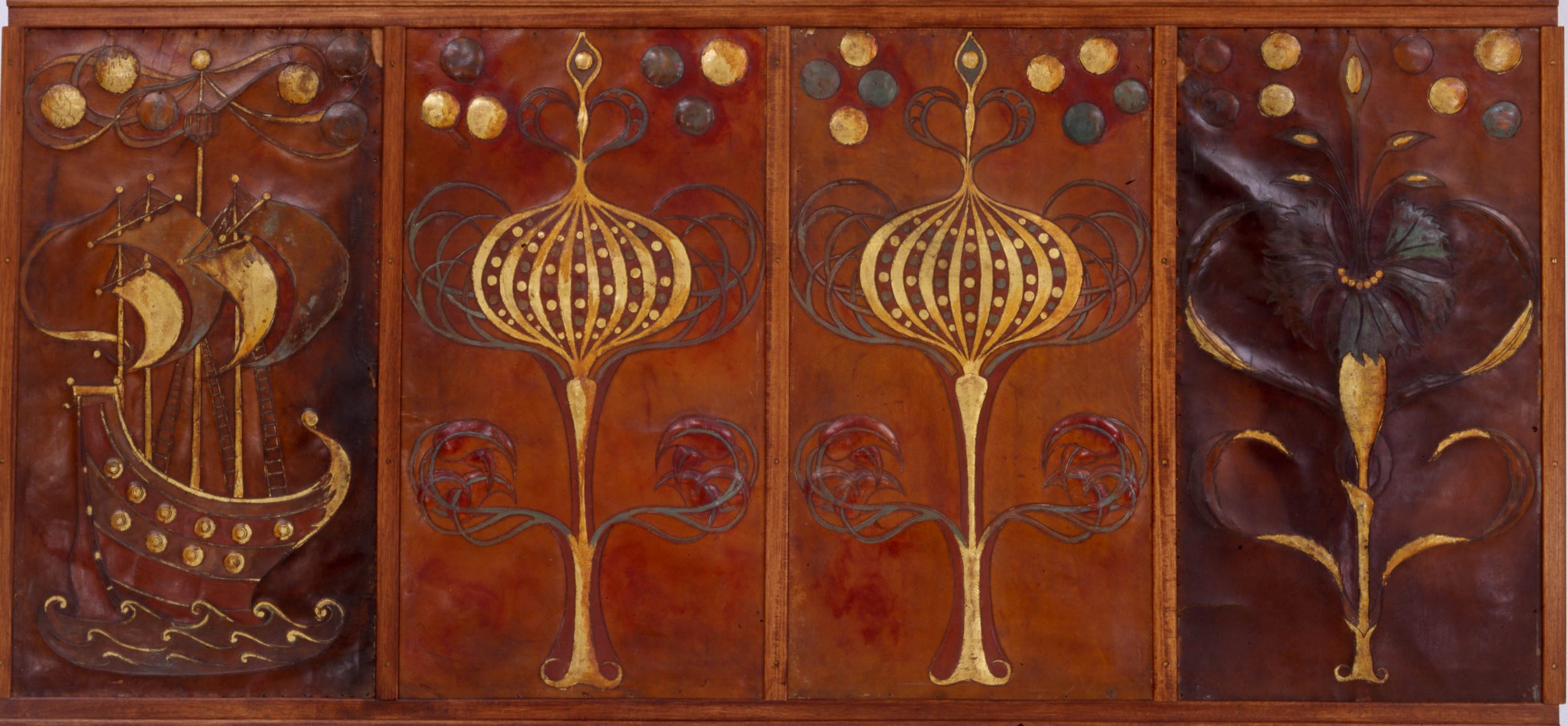
Symbolism played as important a role in Arts and Crafts style. Motifs such as the heart symbolising friendship or the sailing ship representing the journey of life into the unknown reappear with regularity throughout the Arts and Crafts community. These leather panels are by C R Ashbee and the Guild of Handicraft, 1892.
joseph-cribb-inscribed-stone-1920_6029130190_o-625×272
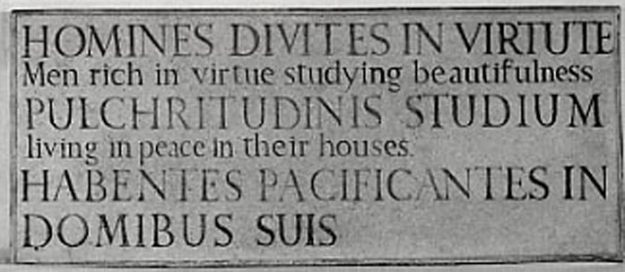
The Arts and Crafts Movement was much more than a style, it had a strong social and moral purpose. The written word was important to express and popularise the ideas of the Movement.
Share this article
Follow us
A quick overview of the topics covered in this article.