
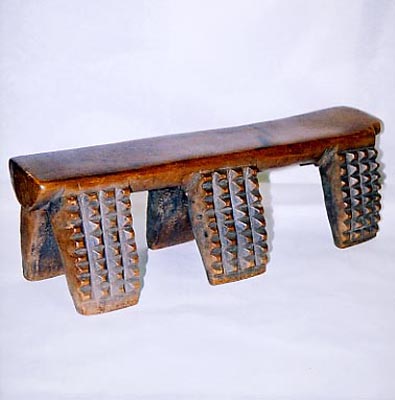
2001-67-6
Wooden Head-rest, Zulu, collected in 1879
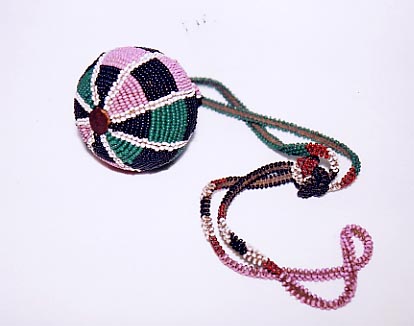
2001-67-14
Beaded snuff container, Zulu, collected in 1879 news
The Boers, South African descendants of European settlers, in Transvaal and the British in Natal, both sought new territory at the expense of the Zulu people. Cetshwayo was a capable and intelligent political leader. This meant that he was considered a threat to British colonial interests. The British began a propaganda campaign against Cetshwayo and the Zulu people. This culminated in an ultimatum from the British which was impossible for Cetshwayo to accept.
Cetshwayo was a skilled military leader and had a well-trained and well-organised army of around 40,000 men. In January 1879 the British attacked Zululand. The British were overconfident and dismissive of the military skill of the Zulu people. This resulted in an entire British regiment being destroyed at Isandhlwana.
Fighting between the Zulu army and the British continued throughout 1879, including at Rorke’s Drift. The British Government was shocked at these humiliations and sought revenge. In July 1879 a reinforced army finally defeated Cetshwayo at Ulundi, after burning the capital city to the ground. But Cetshwayo escaped. Cetshwayo was finally captured on 28 August 1879 in the remote Ngone Forest. He was marched out into exile between two captains of the Dragoon Guards.
In 1882 Cetshwayo travelled to London to speak with Queen Victoria, in the process he became a celebrity among the British public. Cetshwayo was granted permission to restore the Zulu monarchy, but it would operate in a much-diminished capacity. Cetshwayo returned to Zululand in 1883. The impact of British colonial expansion had destabilised the country resulting in an internal power struggle and civil war. The outcome of this war was the end of the Zulu Kingdom with Cetshwayo fleeing to the British Zulu Nation Reserve and dying of a heart attack in 1884.
Share this article
Follow us
A quick overview of the topics covered in this article.