
In the 19th century, both men and women fought for the right to vote and stand in elections. Until 1918 women were excluded from the vote. Activism for women’s suffrage began in the area in the 1830s and 40s. In 1839 500 women attended a meeting in Cheltenham about suffrage, and there was a female sit in at St Mary’s church that August. Women’s suffrage became a big issue again from the 1890s, with ‘suffragettes’ becoming increasingly vocal and militant in their fight to gain the right to vote.
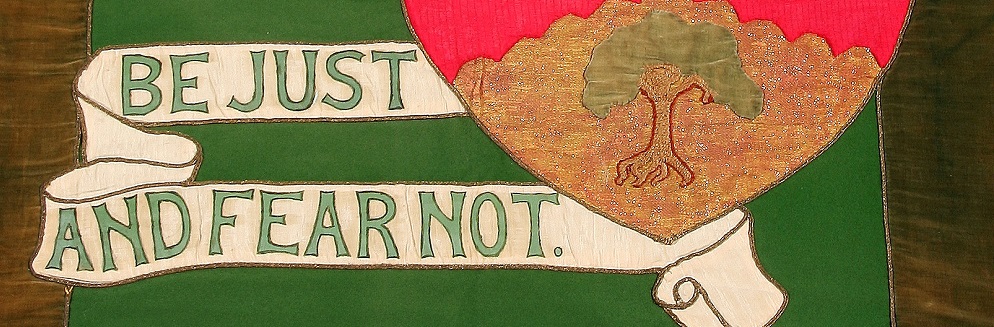
This banner was made and used by the Cheltenham Women’s Suffrage Society in the early years of the 20th century. The Cheltenham branch was founded in 1871, and 1896 became one of many societies across the country affiliated with the National Union of Women’s Suffrage Societies (NUWSS), an organisation committed to achieving the vote through democratic, non-militant means. There were also branches of the more militant organisations.
The Artists Suffrage League
The banner was designed by the Artists Suffrage League, who designed many of the banners used by the suffrage societies up and down Britain. Their mission ‘was to further the cause of Women’s Enfranchisement by the work and professional help of artists by bringing in an attractive manner before the public eye the long-continued demand for the vote’. The League was founded in 1907 in preparation for a major march in 1908. Mary Lowndes, the stained glass artist who founded the League, wrote a booklet on banner making and designing, saying, ‘The divers [sic] colours of needlework, handwrought, are coming into play again, and now for the first time in history to illumine woman’s own adventure.’ The League also produced postcards and pamphlets.
1931_28_001-sm
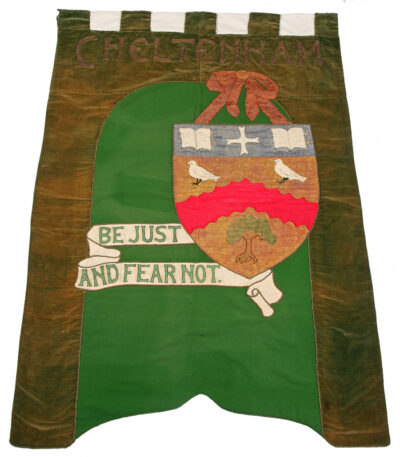
Banner of the Cheltenham Women's Suffrage Society.
The Cheltenham banner
The Cheltenham banner was commissioned and made by Mary Theodora Mills (1878–1958). She was the President of the Cheltenham Woman’s Suffrage Society in 1902 and 1913, and also the Secretary from 1903 to 1918. A Leckhampton woman, she was also an active anti-vivisectionist. She wrote children’s book, and a number of suffrage songs, including the Women’s Battle Song, which was set to the tune of Onward Christian Soldiers. She promoted and defended the suffrage cause all her life, and was described at her death as being ‘as forthright in her writing as she was in her utterances’. She gave the banner to the museum in 1931.
The Cheltenham banner is typical of the work of the Artists Suffrage League in that the design is based around the town’s crest. The colours are symbolic, with green for long cherished hopes, red for courage, gold for ambition and white for purity. The League only provided the design. Mills says that the fabric was collected by the members of the Cheltenham society, and she herself made it. It isn’t all sewn; some of the details on the crest, such as lines in books and the pigeon’s feathers, have been painted.
1931_28_002-crop-sm
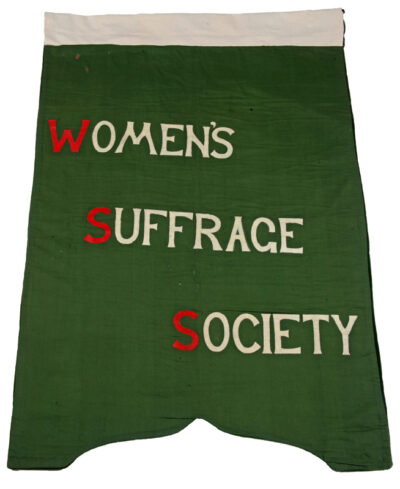
The reverse of the Cheltenham Woman's Suffrage banner, hand painted.
The 1913 Suffragette Pilgrimage
The suffragettes were often feared and mocked by the establishment and the media. Feeling ran high on both sides. In the summer of 1913 the NUWSS organised what became known as the Suffragette Pilgrimage, with marchers coming from all over the country to protest in London. The marchers travelled from town to town, collecting new marchers at a rally at each stop. In Cheltenham, as the banner was raised and they marched to the meeting point in Clarence Street they were ‘were subject to disgraceful treatment at the hands of gangs of hooligans’; pelted with eggs and rotten vegetables, jeered at, mobbed and pulled from their bicycles. This happened not only in Cheltenham but also as the suffragettes marched on through Cirencester and Swindon. However, about 50,000 women from all over the country ended up in Hyde Park on 26 July. Soon, however, the cause had to be partially put aside with the start of the First World War in 1914, but in 1918, after the war, some women were granted the vote.
Share this article
Follow us
A quick overview of the topics covered in this article.