
Life and Death in the Neolithic
Shortly after 4000BC, fundamental changes in lifestyle came about. People’s dependence on gathering and hunting gave way to the cultivation of arable crops and to the rearing of domestic animals. Settlements became more permanent and the population expanded. Society became more complex with a range of massive stone-built monuments and enclosures providing the focus for ritual and settlement.
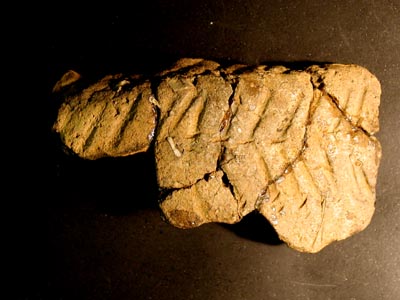
1978-697-1
Six joined sherds from the shoulder of a Peterborough ware bowl, dated to the Late Neolithic.
Shortly after 4000BC, fundamental changes in lifestyle came about. People’s dependence on gathering and hunting gave way to the cultivation of arable crops and to the rearing of domestic animals. Settlements became more permanent and the population expanded. Society became more complex with a range of massive stone-built monuments and enclosures providing the focus for ritual and settlement.
Faced with the problem of disposing of the remains of their dead, many Neolithic communities chose to inter the bodies (or sometimes the cremated remains) in chambered tombs constructed inside distinctively shaped stone and soil mounds. These burial chambers and the access passages to them from outside were built of large slabs of stone (orthostats) and dry stone walling. The covering mound was usually pear-shaped or roughly trapezoidal, often with a shallow ‘horned’ forecourt at one end, the whole surrounded by a low dry stone wall. It has been estimated that each barrow could have taken 10 men some 7 months to build.
It is often difficult to be precise about the numbers of people interred in these barrows since, in most cases, when the mounds were excavated, it was evident that the bones had been disturbed, and it seems possible that there had been occasional clear-outs to make room for later burials. Furthermore, not all the interments were inside the burial chambers; in some cases, bodies had been buried, seemingly randomly, in the sides of the mound or even in the surrounding ground.
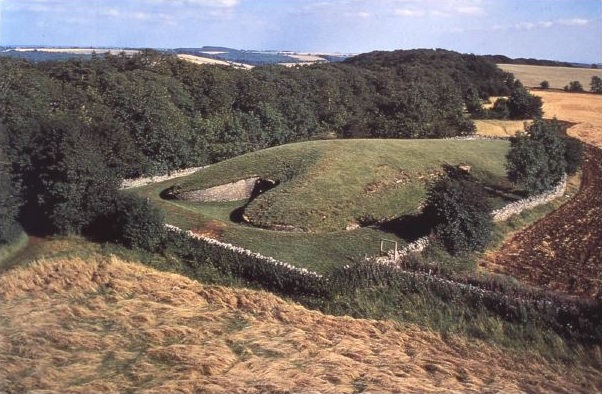
Belas Knap Long Barrow
This site, near Sudeley, was first investigated in 1863 and fully excavated between 1928 and 1930, in advance of its restoration. Aligned on a north-south axis, it is roughly trapezoidal in shape, about 54m. long and 18m. wide at its broadest (north) end where there is a horned forecourt. Three interior burial chambers are accessed from the longer sides, with a possible fourth being entered at the south end. At the forecourt end of the mound is a false portal entrance, possibly intended to mislead robbers.
The mound was found to contain human bones belonging to 30 or more persons, mostly in jumbled heaps on the chamber floors. Further human remains had been placed in the wall at the eastern end. Little in the way of pottery, personal ornaments or flint tools were found but among the human bones were four skulls which have been radiocarbon dated to the period 3900 – 3500BC.
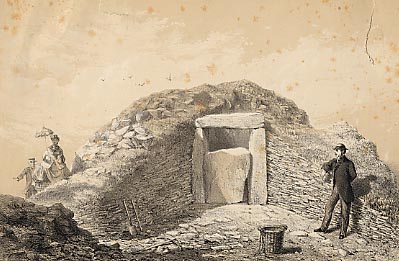
1997-1detail
Lithographic print showing the false portal or northern end of Belas Knap long barrow, after the excavations by Lawrence, Winterbotham and Chamberlayne 1863-65.
Notgrove Long Barrow
Located near Moreton-in-Marsh, the Notgrove barrow was initially excavated in 1880-1 by the eminent Gloucestershire antiquarian George B Witts, but was later thoroughly re-excavated in 1934-5 by Mrs Elsie Clifford. Aligned northwest-southeast, the barrow is almost rectangular in shape with a small horned forecourt at its east end. It is about 47m long and 23.7m wide at its broadest part. Much of the barrow has been eroded by modern ploughing but it still rises to 1.5m at its highest point and the remains of the internal structures are still in place. The mound was covered with stones and enclosed by a well-built wall of slate.
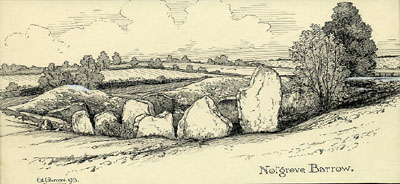
1923-4-15
Drawing in pen and ink of Notgrove Barrow, 1913 by Edward J. Burrow
Internally there is an 8m. long central passage entered from the forecourt end and leading to four burial chambers set out in a double cruciform, two chambers on each side.
Four of the five burial chambers contained an assortment of human bone amounting altogether to over 600 fragments, representing a minimum of ten adults and an unknown number of adolescents and children. There were also animal bones including those of a young calf seemingly placed in the barrow as a ritual offering. An unexpected development during the 1930s re-excavation was the discovery of an earlier circular (rotunda) stone mound located centrally inside the barrow and apparently sealed within it when it was built. This circular mound contained a slab-lined cist containing human bones apparently of a single adolescent; scattered over the top of the rotunda were more human bones apparently deposited around the time the main barrow was constructed. Radiocarbon dating of bone material from the main chambers and the rotunda produce dates around 3600BC.
Other finds included pottery, a bead of Kimmeridge shale and a quantity of flints including one fine leaf-shaped arrowhead.
West Tump Long Barrow
This barrow, located near Birdlip, was also investigated by George B Witts in 1880. Trapezoidal in shape and aligned southeast-northwest, it was built of limestone rubble and slabs with a surrounding low drystone wall, the whole measuring 45.8m. long, 23.4m. wide and up to 3.15m. high. Inside the mound is a single long burial chamber constructed of stone which was accessed through an entrance in the southwestern side. An apparent entrance at the barrow’s east end proved to be false.

1996-261-1-2
Photograph showing excavations at West Tump barrow, Gloucestershire by George.B. Witts in 1880. Showing the excavation of the passage and chamber.
When excavated, the burial chamber contained over 3000 dis-articulated human and animal bones randomly mixed together. At the far end of the chamber however was a largely intact skeleton, probably of a young adolescent, beside which was the skeleton of a small dog (possibly ritually buried with the human). This burial appears to have been treated differently from the other, possibly later, burials in the barrow and ‘respected’ during the rest of the monument’s use. Altogether, up to seven partial skeletons were recovered but modern re-analysis indicates that the barrow probably contained the remains of up to 23 persons. Radiocarbon dating of the intact skeleton (the earliest date of samples from this site) produced a date of around 3700BC.
How can we learn from this?
Apart from revealing the funerary practices of these very early people, this collection of human bone has always attracted scientific interest. Subjects recently investigated include diseases suffered by Neolithic humans (tuberculosis, arthritis and scurvy apparently being common) and their dietary deficiencies; death and funerary practice; DNA analysis and genetic profiling. Â In addition, microscopic analysis of flint tool cut marks on some of the human bone points to the possibility of ritual dismemberment of bodies, including possibly decapitation, at or around the time of death.
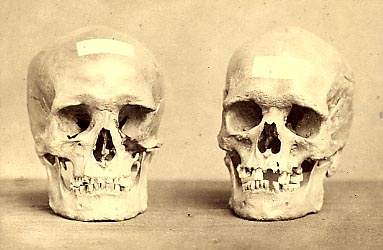
1978_715_1_5
A print showing a front view of two human skulls from Belas Knap long barrow
Share this article
Follow us
A quick overview of the topics covered in this article.