

The Life and Death of Edward Wilson
Wilson’s medical and scientific skills were matched by his artistic talent. It was this combination that led to his appointment, in 1901, as second medical officer, vertebrate zoologist and artist on Captain Scott’s National Antarctic Expedition, which set sail in the Discovery in August 1901.
During the expedition, Wilson undertook important scientific work and began to create the superb series of Antarctic drawings and watercolours that are his main artistic achievement.
Following his return to England in 1904, Wilson undertook various scientific projects and prepared illustrations for books on British mammals and birds. In 1909, he accepted Captain Scott’s invitation to act as Chief of Scientific Staff on a second Antarctic Expedition, which set sail in the Terra Nova in June 1910.
A principal aim of the expedition was to reach the South Pole, which no one had ever done before. Wilson was one of five men chosen to make the journey. They set out from the Antarctic coast in November 1911, and arrived at the Pole on 17 January 1912, only to discover that the Norwegian explorer, Roald Amundsen, had reached it a month before.
Their journey back was dogged by terrible weather, food and fuel shortages, and sickness. By mid-March, two of the party had died, and the remaining three, including Wilson, were marooned in their tent by a nine-day blizzard. There they died, during the last days of March 1912, their bodies being discovered eight months later, on 12 November 1912.
Edward Wilson and Cheltenham
Members of Edward Wilson’s family had lived in Cheltenham since the 1850s, and continued to do so for more than a century. His birthplace, 6 (now 91) Montpellier Terrace, has an inscription on its exterior, recording his birth there, although the house in which his family lived from 1874 until the 1930s, Westal in Montpellier Parade, has been demolished; its site is now occupied by part of the Eagle Tower car park. Still to be seen though is the house known as The Crippetts, on the slopes of Leckhampton Hill, where Wilson’s mother Mary farmed from 1885 onwards, and where the young Edward Wilson developed his love of nature.
Following Wilson’s death, a public subscription for a permanent memorial to him was launched, and on 9 July 1914, a bronze statue, designed by Captain Scott’s widow, Kathleen, was unveiled in the Promenade. Its Portland stone base bears this inscription –
Edward Adrian Wilson B.A. M.B. CANTAB. F.Z.S. Born in Cheltenham 1872. Chief of the Scientific Staff. Artist and Zoologist of the British Antarctic Expedition 1910-1913. He reached the South Pole January 17 1912. And died with Capt. Scott on the Great Ice Barrier March 1912. ‘He died as he lived. A brave true man. The best of comrades and staunchest of friends.’ (Letter from Capt. Scott)
Dr Wilson is also commemorated at Cheltenham College. In 1924, his portrait, dressed in Antarctic clothing, was included in a new stained glass window representing the Christian virtue of Fortitude in the College chapel, and in 1936, part of the old Junior School was converted into a new Biology Department as a memorial to him; there, in 1937, a bronze plaque with a profile of Wilson based on a bas-relief by Lady Scott was erected. It bears the inscription –
Edward Adrian Wilson M.B. Biologist and Explorer From boyhood a lover of nature He died with Scott on the return from the South Pole March 1912. “Strong in Will To strive, to seek, to find and not to yieldâ€
– the quote, being the last line of Tennyson’s Ulysses, being the words inscribed on the wooden cross erected to the memory of Wilson and his four companions on Observation Hill in Antarctica, looking across to the Great Ice Barrier where the five men had perished.
From 1926 onwards, a number of individuals, including Wilson’s widow, Oriana, donated paintings, photographs, documents, objects and scientific specimens relating to Wilson and the two Antarctic Expeditions to Cheltenham Art Gallery & Museum, while others were acquired by purchase. A significant addition to the Collection, from the Wilson family in 1995, was a large archive relating not only to Dr Wilson, but also to other members of his family, to which archive additions are still made by the family. Amongst the most historically significant items in the Museum’s collection are a watch found on Wilson’s body in 1912 and the prayer book used by Dr Edward Atkinson at the funeral service of Scott, Wilson and Bowers in November 1912.
The Wilson has a small Gallery devoted to Dr Wilson, and his life and art are explored in our changing Paper Store exhibtions. There are also Wilson collections in London’s Natural History Museum, and at the Scott Polar Research Institute in Cambridge, whose museum has extensive Polar displays. A number of books have been written about Dr Wilson, including three by George Seaver, all published by John Murray of London: Edward Wilson of the Antarctic (1933), Edward Wilson Nature Lover (1937) and The Faith of Edward Wilson (1948). More recent books include Cheltenham in Antarctica: the Life of Edward Wilson, by David Wilson and David Elder (Reardon Publishing, Cheltenham 2000) and With Scott in the Antarctic. Edward Wilson. Explorer, Naturalist, Artist, by Isobel Williams (The History Press, Stroud, 2008). A website devoted to Dr Wilson is www.edwardawilson.com.

1941_225_116-detail-625×570
Gimson sketched this carved stone in the Museum of Torcello, near Venice, in 1889. He reused the design for one of the roundels in the clergy seats.
1945_017-detail-625×709
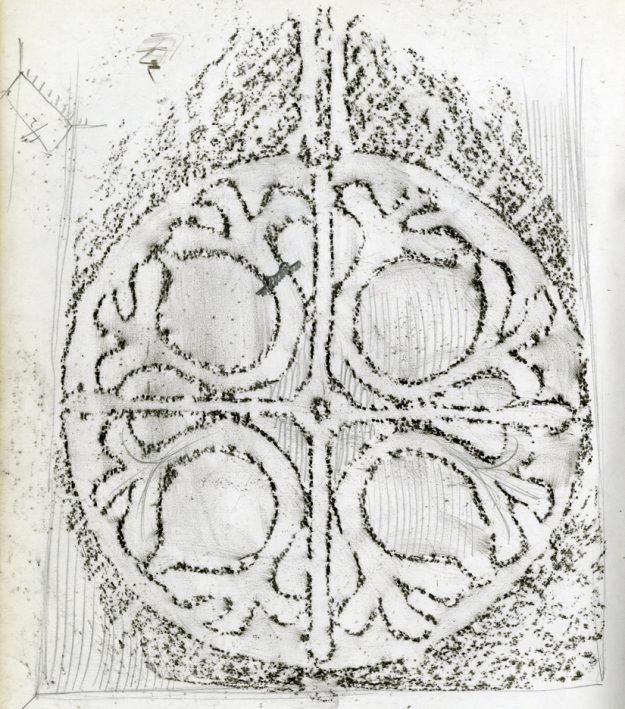
He also took inspiration from nearer home - this rubbing of metalwork from a door in Durham Cathedral, sketched in 1888 also appears to have inspired him.
1941_222_059-625×469
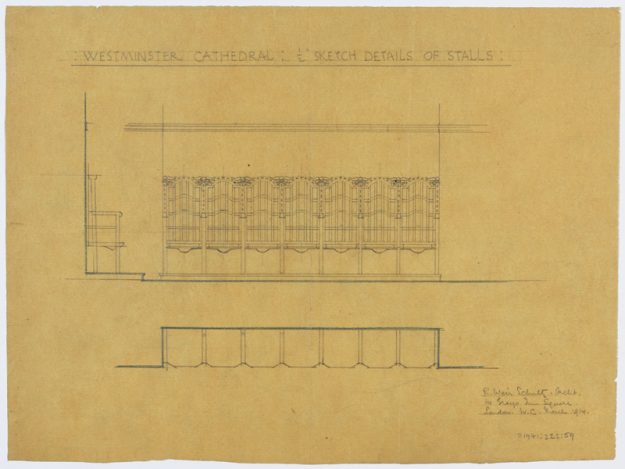
This design by Robert Weir Schultz was done in March 1914, and shows his initial ideas for the chairs.
1941_225_118_008-1-625×503
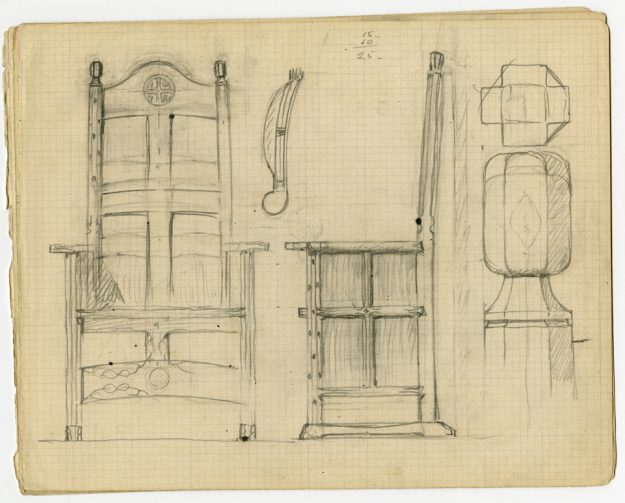
Gimson sketched this rough idea for a clergy chair in his working sketchbook - it may relate to his design process for the Westminster chairs.
1941_222_11-625×519
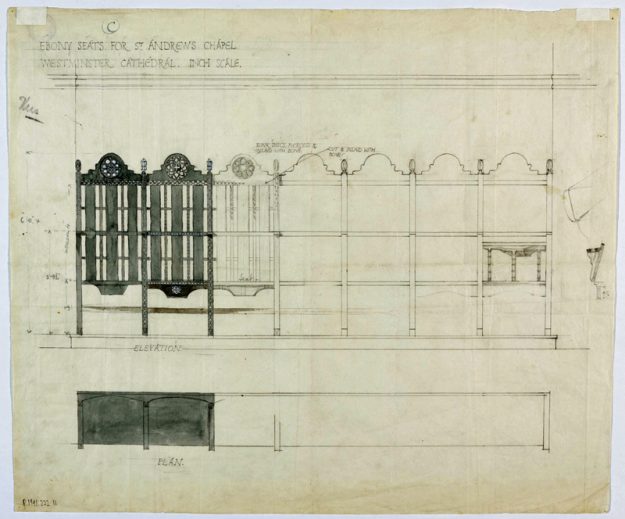
This is Gimson's worked up design for the clergy seats. You can see it is rather different to Schultz's initial design, but there are still similarities.
1941_222_11_001
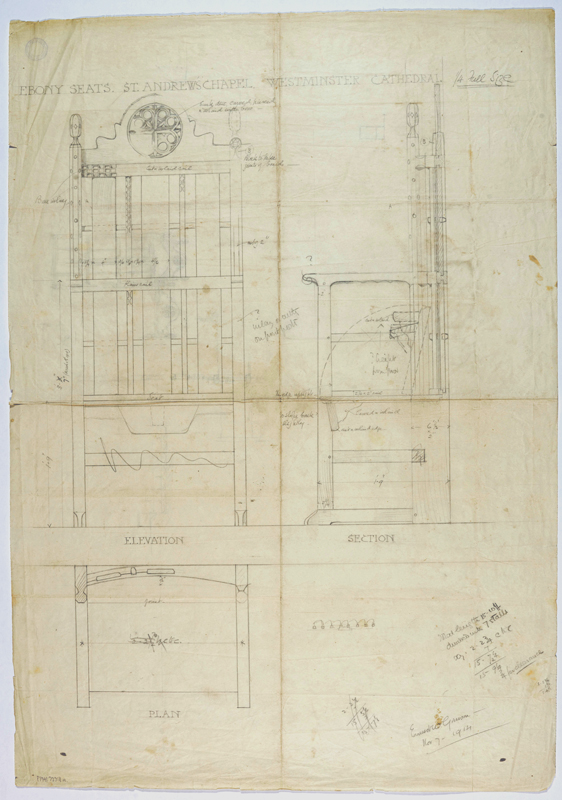
This measured drawing, a quarter of full size, shows all the details of the chair complete by 7 November 1914.
1970_47-625×1258
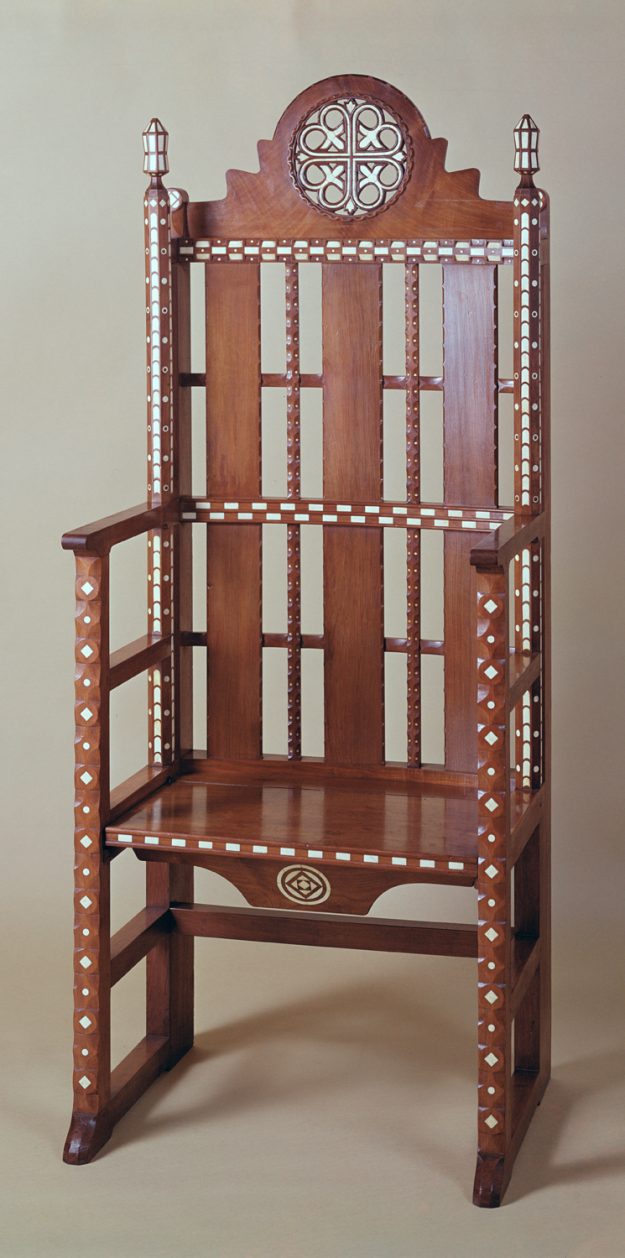
This is the prototype chair. Work started on this in November 1914, once the measured drawing was done.
1941_225_121-625×449
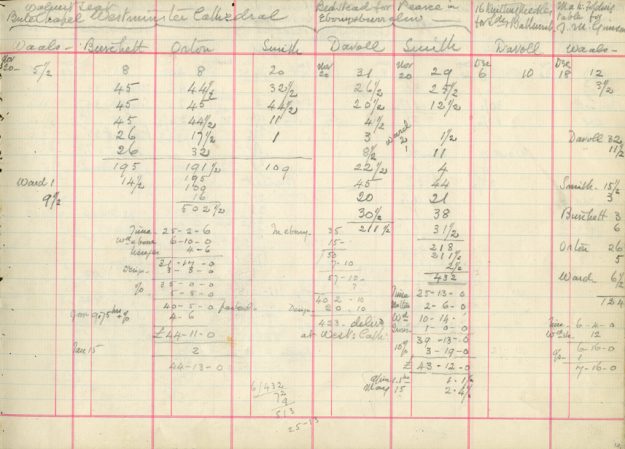
This is the page from the job book that shows the calculations per maker, of the time spent on the prototype chair. Gimson then worked out how much it would cost.
Clergy-Stalls-625×410
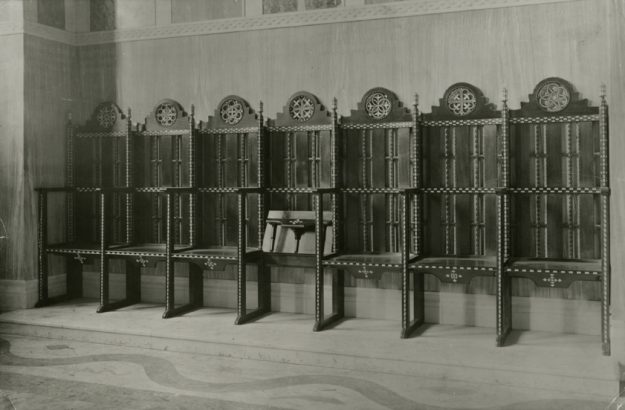
These are the chairs installed in St. Andrew's Chapel, Westminster Cathedral in 1915. They are still there today.
Share this article
Follow us
A quick overview of the topics covered in this article.