
The Museum holds around 200 Ancient Egyptian objects. They represent a small but comprehensive collection of material, almost all from Pre-Dynastic (roughly 5000 to 3050BC) and Dynastic (3050 to 332BC) sites.
The first objects donated to the Museum were given in 1907 by the Committee of the Egypt Exploration Fund, later known as the Egyptian Exploration Society. This body was founded in 1882 to explore, survey and excavate ancient sites in Egypt and it rapidly became the foremost learned society in the United Kingdom promoting the field of Egyptology. The Fund’s donations to the Museum came from the collection of its then President, F G Hilton Price.
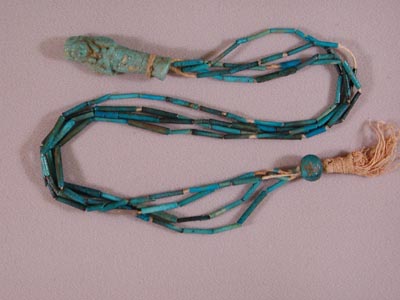
1936-216-2
Bead necklace with amulet pendant in the shape of a mummy, 1300 – 30 B.C
Since then, private donations from Cheltenham residents, made mostly during the 1920s and 1930s, and comprising objects bought at sales and auctions, have enabled the Museum to develop the collection to its present level.Sites excavated by the Egypt Exploration Fund and represented in thecollection are Deir el Bahari, Abydos, Behmesa and Oxhyrynchus. Other ancient sites featuring in the collection are Alexandria, Amarna, Giza, Luxor, Memphis, Taharqa and Thebes.
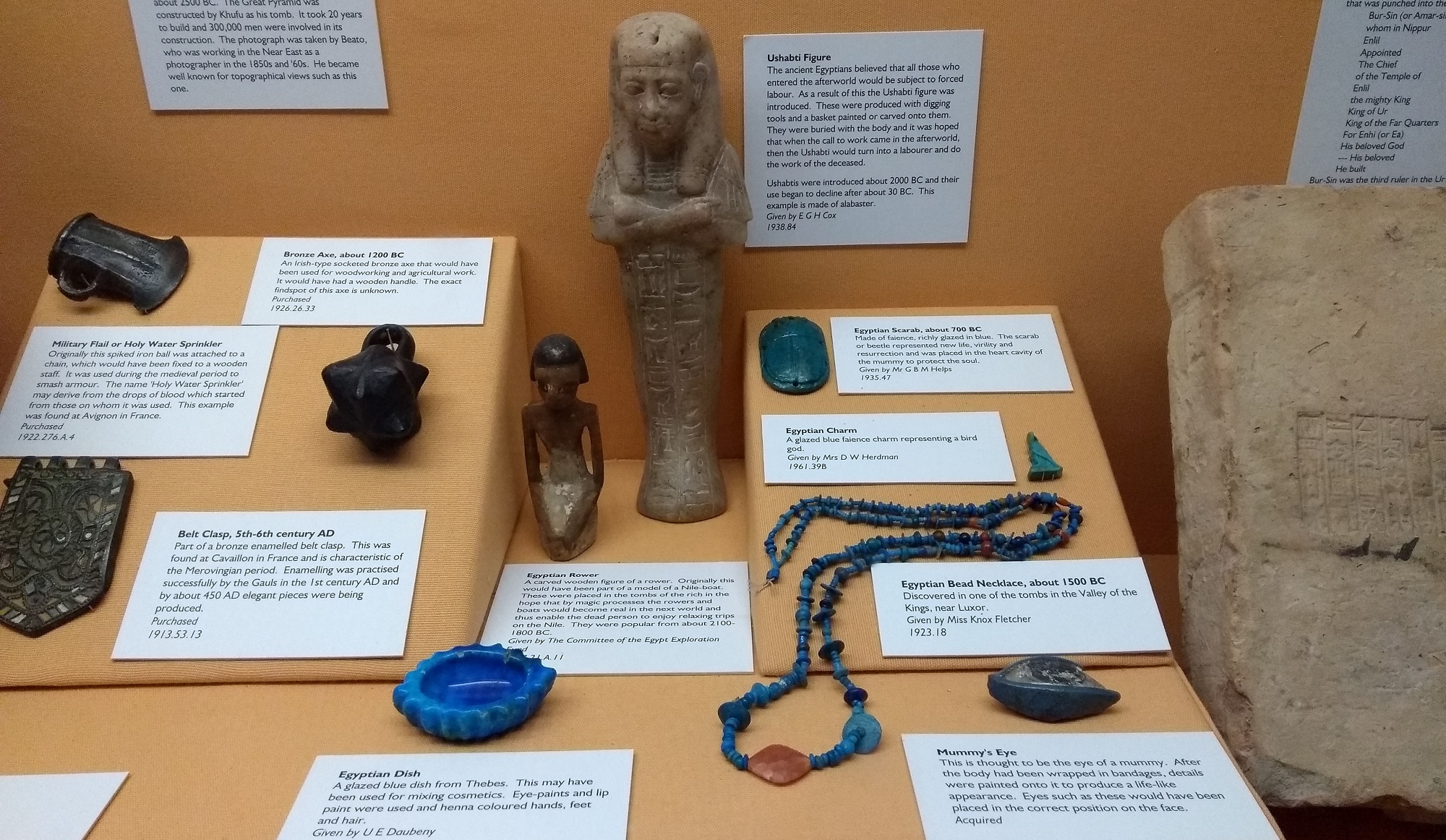
These objects are available to us today because of the distinctive attitude the Egyptians had towards death. They believed that death was an extension of life and this led them to furnish their tombs with the many everyday things thought indispensable for the afterlife.Consequently, there are a number of domestic pottery and glass vessels, clay oil lamps and funerary objects such as ushabti figures, amulets, pottery funerary cones, scarabs and stone stelae.
For many people, Ancient Egypt conjures up images of mighty stone monuments, aloof statues and lifeless mummies such as are represented in the museum’s collection of 19th-century photographic prints of ancient sites. Thanks to the collection we have in the Museum from this period however, we are offered an insight into the more intimate and everyday aspects of Ancient Egyptian life and, in particular, their beliefs about the afterlife.

These small mummiform figures, usually of coloured faience or glazed pottery, represented field labourers, complete with their hoes and baskets, which were placed in tombs to work for the tomb owner in the afterlife. Many also carry hieroglyphic inscriptions. They were found in the tombs not only of the Pharaohs and other major figures but also of ordinary Egyptians.
Carved wooden figures and objects were also placed in tombs and the collection contains several, including two painted figures of seated rowers, one having arms attached with wooden pins, which would have been part of a model funerary boat placed in the tomb.

about 700 B.C.
The Ancient Egyptians believed that preservation of the body was essential if a person’s soul was to continue to exist after death. These small decorative ornaments, usually made of faience, were placed in mummy wrappings to give protection to various parts of the body. Some display the wadjet falcon’s eye design representing the god Horus. The scarab beetle, normally made of blue faience, was particularly important since it represented the heart, which was believed to be the seat of thoughts and emotions. It was usually placed in the heart cavity of the deceased.

Tomb offerings of inscribed stone stelae were made to the gods, particularly to Osiris, God of the Underworld. One describes a woman offering the god food, water and flowers in return for which she asks for life, prosperity and health.
Other funerary objects include small alabaster jars used to hold ritual oils used in burial ceremonies, various charms and decorative ornaments and, from the tomb of 1st Dynasty king Djet at Abydos, a slate palette on which eye paint would have been mixed. There is also a well-preserved mummified foot dating from approximately 800BC and the remains of a small carved wooden cat-shaped coffin still containing bone fragments.
Share this article
Follow us
A quick overview of the topics covered in this article.