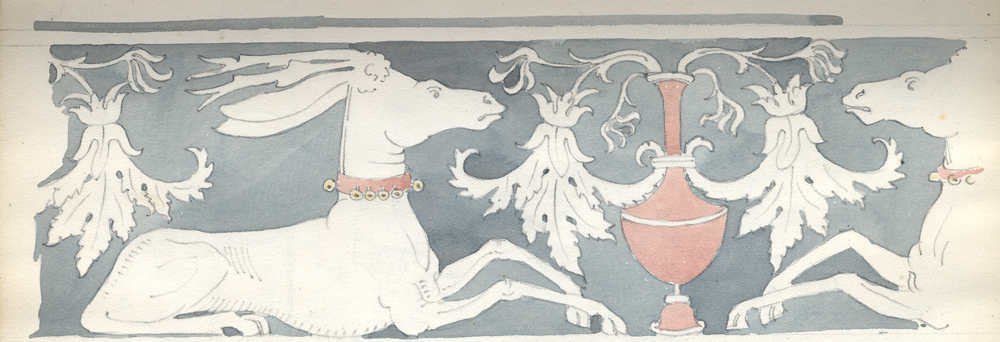

Gimson wrote to his friend Ernest Barnsley about his trip to Italy, charting bedbugs in Torcello, a island in the Venetian Lagoon, and his delight in Ravenna:
‘The loveliest week of my tour has been spent at Torcello. … I stayed in a little cottage there. There was an old couple, their children and grandchildren! We sat round a jolly open fireplace with them in the evenings and made tea and played with the youngsters. We lived on Maccaroni, Polenta, Salami. Eggs and wine. The bed was the most unsatisfactory part of the proceedings as it had a considerable population of its own which rigorously resented our intrusion. I’ve the marks on me yet! From Torcello we went back to Venice for two or three days and then on to Ravenna. Ravenna’s the place! Our time there was for me complete happiness.’
He was greatly inspired by the Byzantine style art and architecture he saw in Venice and Torcello. This would inspire his designs for church woodwork, such as lecterns, altar crosses and clergy chair. You can follow the story of the Westminster Cathedral clergy chair here.
When Gimson visited Venice he sketched a number of things in St Mark’s, the cathedral of Venice. This marble peacock went on to inspire a letter cabinet with a peacock in mother-of-pearl and lapis luzuli.

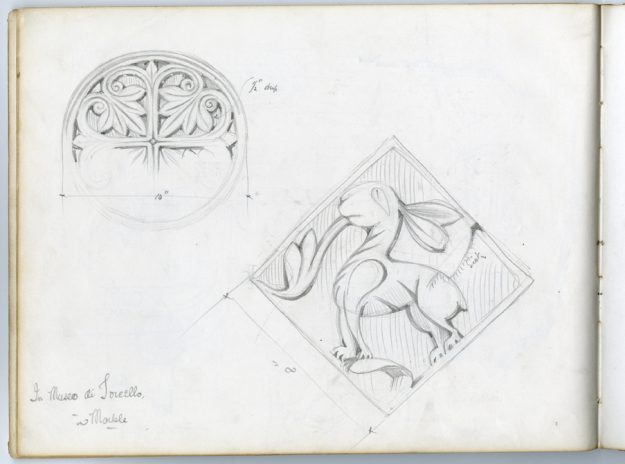
The panel in the museum at Torcello went on to inspire Gimson’s designs for the clergy chairs he designed for Westminster Cathedral in 1914. The rabbit was just for fun!
Gimson has annotated this quick sketch of a mosiac floor in St. Mark’s, Venice. He notes, for example, the different levels of mosaic tesserae used for outlining animals and plants.

Gimson was fascinated by details. Geometric patterns like these details of a mosaic floor in St. Mark’s, Venice, would go on to inspire furniture inlays in his later career.

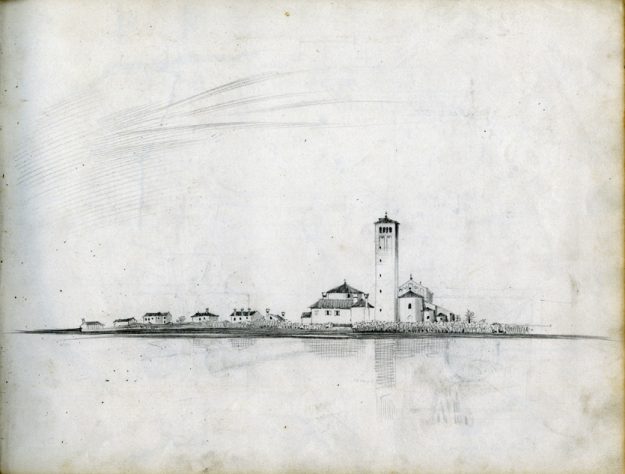
Gimson didn’t often do landscape sketches, but he was moved to sketch the island of Torcello from the boat.
Share this article
Follow us
A quick overview of the topics covered in this article.