
On 29 August 1914 Lady French, the wife of General Sir John French, the commander of the British Expeditionary Force, set up a campaign to provide ‘comforts’. She wrote in The Times ‘There is a great need for knitted socks, etc, for our troops … I would ask those who have leisure to knit, or are willing to employ others to do so, to send parcels as soon as possible …’
Women responded with a tsunami of knitted goods. Knitting clubs were set up in every town and village; social rules were relaxed to allow knitting on buses, in queues, at shops, at the theatre, even at dinner parties and between courses at restaurants. Children were taught to knit from a very young age, and everyone from the elderly and infirm to wounded soldiers in hospitals was set to work winding wool into balls from skeins, making garments or packing the ‘comforts’ to send overseas. These homemade gifts not only provided warmth but raised morale at home and on the front.
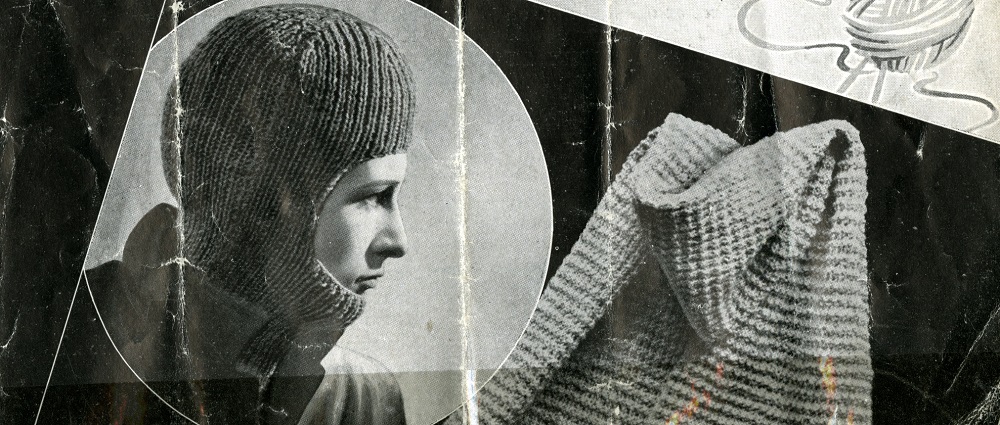
 By January 1915 Lady French was asking for mufflers. ‘As they are needed as soon as possible, no time should be lost in setting to work … these mufflers are the easiest things in the world to knit, making the minimum of demand alike upon the skill, time, eyesight, or energy of the worker.’ Then the War Office requested belts, mittens and balaclava helmets, in fact anything that could be knitted was made for the troops overseas. Some items had double uses, like a chequered waistcoat that doubled up as a chess or drafts board! Others were a special design, for example the rifleman’s glove, a type of mitten with two fingers.

Mabel Wilson, a cousin of the Cheltenham Wilsons, notes that she helped at her local hospital and the soldier’s huts with ‘wools’, ‘knitting’, and ‘socks’. Her husband Francis writes home to thank her for the parcels of knitting that ‘have been much appreciated by his men’. Bernard Wilson writes of ‘comforts’ and thanks his mother, Mary Agnes Wilson, for her support in producing ‘so many warm garments’ from her friends in Cheltenham. Comments like this show how much value was placed on the knitting support from home.

Garments were not always perfect, and writers and cartoonists soon latched on to the comic potential of the misshapen sock or too long scarf. Countless postcards and cartoons in papers such as Punch and The Tatler lampooned the well-meant but ill-made garment. There were even letters to the problem pages asking how to tell someone their garments were not good enough!
 Knitting wool was much thinner in the First World War. It was mainly 4 ply thickness (double knitting had not yet been developed), and it came on skeins or hanks which had to be wound off into balls for use. The yarn was pure wool, supplied from New Zealand and Australia as well as Britain, and was much harsher than we would expect to use today. ‘And of course, khaki is THE colour’(The Queen magazine 1915), though the writer did admit that it was not always possible to obtain the right shade and ‘it may be well to mention that different tones of darkish greys do quite well.’ Needles were made of steel, sold in sets of 4, 5 or 6, and were usually double ended. Knitting bags, especially ones that hung on the arm, were de rigueur and came in all shapes and sizes.
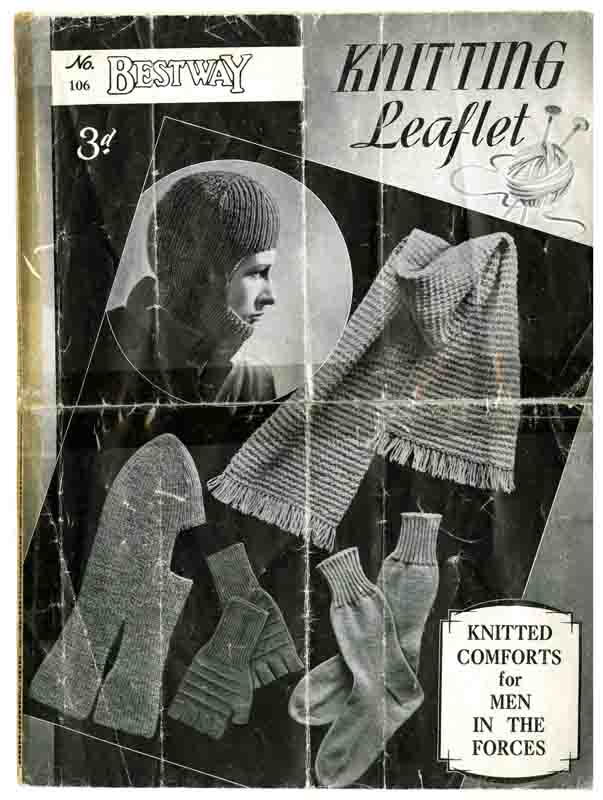
Knitting-leaflet
January 1915, Lady French was asking for mufflers
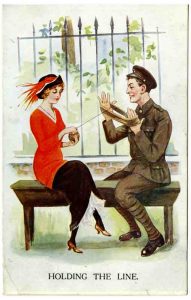
LOAN-Postcard-Holding-the-line-191×300
‘Holding the Line’ postcard.
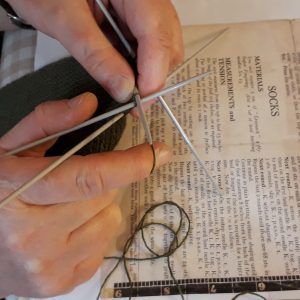
20180529_221931-300×300
Knitting wool in the First World War style
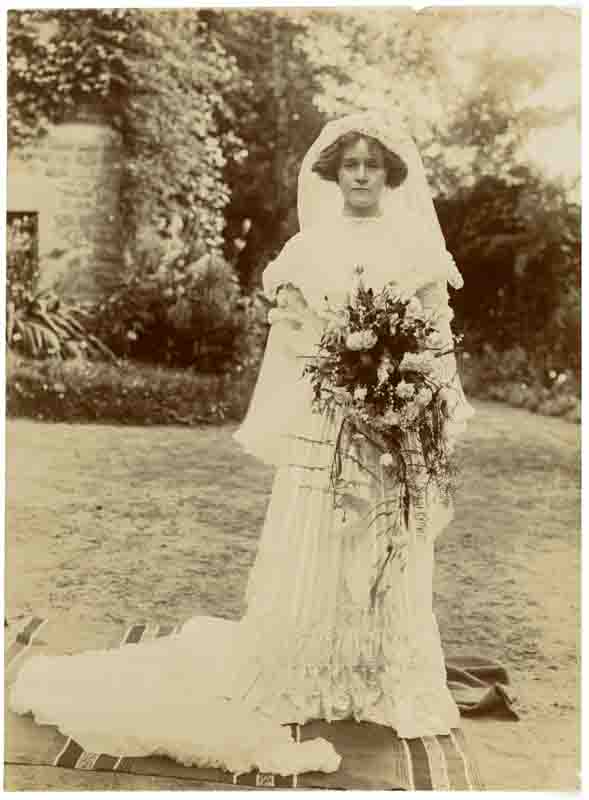
14.059-wedding-photo
Mabel Wilson at her wedding in 1903.
Share this article
Follow us
A quick overview of the topics covered in this article.