

The Sinking Of The Lusitania
The Lusitania sailed from New York on 1 May 1915, bound for Liverpool with nearly 2000 passengers and crew. At the time of sailing, a war zone existed in the waters surrounding Great Britain. The German embassy in America duly published adverts warning that any ship crossing under the flag of Great Britain or her allies was liable to attack by U-boat. This did not deter many of the passengers, who believed that the Lusitania, being able to maintain a speed of 25 knots, could outrun any pursuer. They also thought that the presence of high-profile names on the passenger list such as philosopher and writer Elbert Hubbard and wealthy businessman Alfred Vanderbilt ensured the safety of the ship.
The ship was nearing its destination on 7 May, when at 14:09pm she was struck by a torpedo. This was followed by a second explosion from within the ship, though no other torpedo had been fired. The Lusitania sank in just eighteen minutes.

1986_64_001
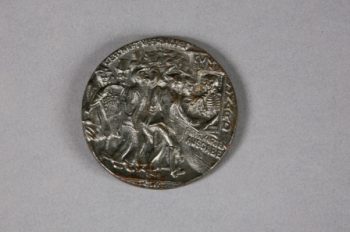
British replica of the Lusitania medal, in a commemorative box. This side of the medal shows the sinking ship, and bears the legend 'No contraband' in German. It shows the liner carrying weapons.
The Original German Medal
The original medal was struck in Germany by a medallist, Karl Goetz. It was designed to show that Britain and America had been irresponsible sending passenger shipping across the Atlantic when the Germans had expressed their intention to use U-boats in the waters around Great Britain. It also sought to justify the German attack on the grounds that the Lusitania had been carrying small amounts of ammunition – a contraband cargo during the war. This in fact caused a second explosion, adding to the speedy sinking of the ship.
Unfortunately, when he struck the medal, Goetz used the wrong date. To the British this was a sign that the attack was premeditated, an idea that increased anger against an event already considered outrageous. However, Goetz later explained that there was no controversial reason for the mistake – he had simply seen a newspaper account giving the wrong date.
1986_64_003-350×232
The obverse shows passengers buying tickets from a Cunard Line office – manned by a skeleton
The Sinking Of The Lusitania
Following the original production of the medal British Intelligence seized on its existence and imagery for their own propaganda purposes. Production was started on copies of the medal, and soon the British copies vastly outnumbered the German originals.
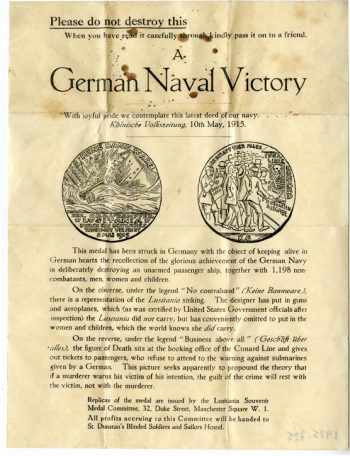
Each medal was presented in a commemorative box, and included a sheet outlining the ‘reason’ for the copy. It included a request to readers asking them to ‘give it on to a friend’, i.e. pass on the anti-German messages. The commemorative box claimed the medal indicated ‘the true feeling the War Lords endeavour to stimulate.’
The British had successfully turned the propaganda on its head. The medal now came to symbolise the supposed atrocities of the Germans and their probable celebration over the deaths of innocent people.
The profits from the replica medals were donated to St. Dunstan’s Blinded Soldiers and Sailors Hostel, which gave them yet another meaning. Not only were they effective pieces of anti-German propaganda, but any questions to the government could be shrugged off by stressing the charitable benefit of the medals.
We hold several of these medals at the museum. One is a gold-plated version, given by Mayor Thomas Rees-Jones, who held office during the First World War. He gave several objects to the Art Gallery and Museum to record the war.
1985_725-350×456
Each medal came with this printed sheet detailing the British view of the German medal.
Share this article
Follow us
A quick overview of the topics covered in this article.