
Every effort has been made to trace the copyright of these images. We would be happy to hear from anyone who believes their copyright has been infringed.
Hugo’s Life
Hugo was born in Holland, but moved with his family to Barry in South Wales in about 1900. His father, a keen amateur photographer, opened a photographic studio in Cardiff in about 1911, where he was soon joined by Hugo, who went on to become a Fellow of the Royal Photographic Society in 1919.
By 1923, Hugo was a regular visitor to Whiteway, between Cheltenham and Stroud, where his brother Jakob had a ‘holiday home’ in a converted railway carriage, and where Hugo later built himself a house out of asbestos sheeting.
No longer working for his father, Hugo joined H. J. Whitlock & Sons in 1926, who had a chain of photographic studios across the country. In 1933, however, he had decided to set up his own business in Cheltenham, and three years later opened ‘Studio Hugo’ at 79 Promenade, where he also lived when he was not at Whiteway. The house, which became part of the Municipal Offices in 1956, now has a Cheltenham Civic Society blue plaque commemorating Hugo’s time there.
In 1956, Hugo moved his studio to 34 Rodney Road, but spent much of his time at Whiteway, as his health and eyesight deteriorated. He died in Cheltenham General Hospital on 1 March 1959, aged 67.

Hugo-self-portrait
A self portrait taken via a mirror.
Hugo’s Photography
Hugo’s photographs fall into two major areas – portraits and landscapes, in both of which he was something of a pioneer, and on both of which he wrote books for the Focal Press, namely Photographing People (1939) and Wayside Snapshots (1947). He also contributed to the Focal Press’s Photo Guide series, and his work influenced many contemporary photographers.
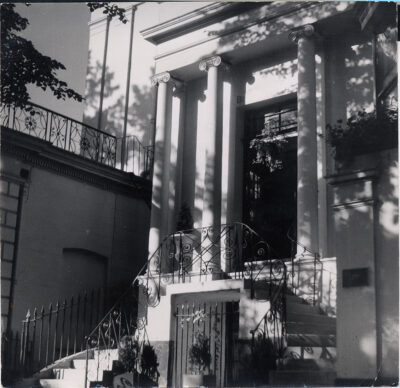
1991_333
Black and white photographic print of Belgrave House, Imperial Square, Cheltenham, by Hugo van Wadenoyen, about 1950.
Portrait Photography
A major part of Hugo’s commercial work involved taking portraits of paying clients and their families, either at his studio or in their own homes; his photographic portraits, particularly of children, are characterised by their relaxed informality. Hugo also took many photographs of his friends and associates, including Whiteway residents and contemporary artists and craftsmen.
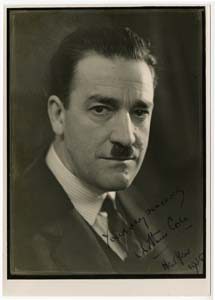
2010_119_1-215×300
Portrait of Arthur Cole, black and white by Hugo van Wadenoyen, early 20th century.
Landscape Photography
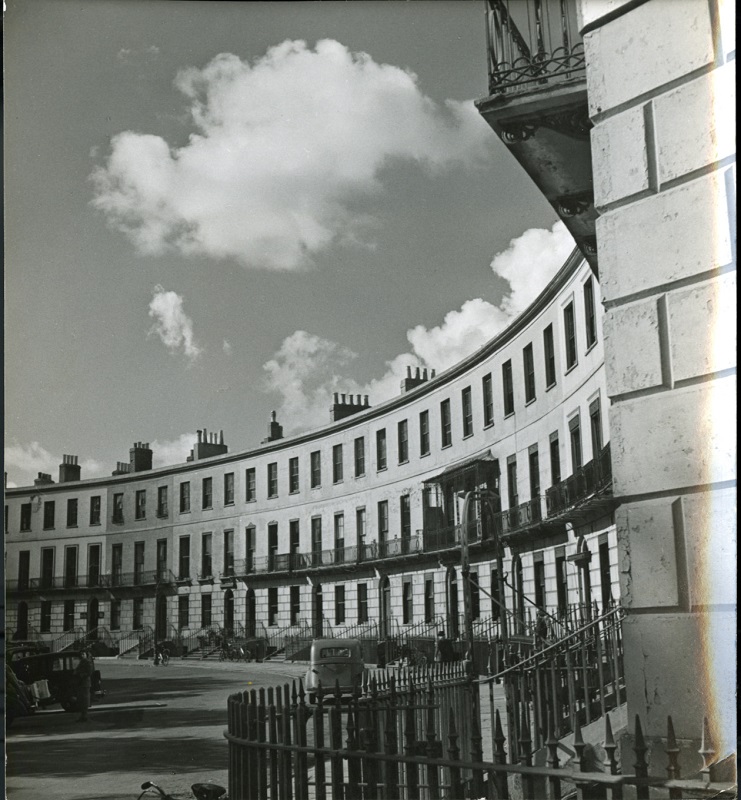
Hugo’s early landscape photographs followed a traditional ‘pictorialist’ approach, in which the photograph was intended to resemble an engraving or impressionist painting in black and white, using ‘soft focus’ or ‘touching up’ by hand to create the desired image. Hugo later rejected this approach in favour of a more direct ‘photo realism’, in which he let the camera, which he once described as ‘an extension of the eye’, speak for itself and record exactly what it saw. This resulted in many fine, almost abstract, photographs, including his evocative views of Cheltenham and the Cotswolds.
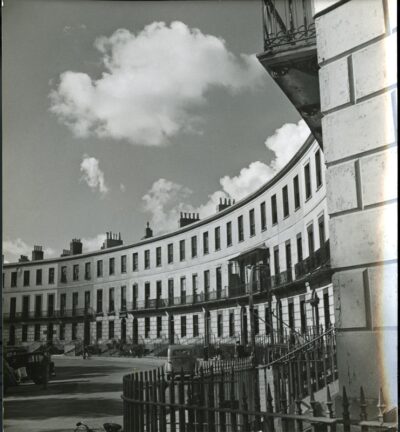
1994_492
View of Royal Crescent, Cheltenham, about 1950.
Share this article
Follow us
A quick overview of the topics covered in this article.