
Jurassic Cheltenham
In the time of the dinosaurs, known as the ‘Mesozoic’, between 252 and 65 million years ago, the world would have looked very different. Not only would there have been animals and plants that would look strange to us, but even the shapes of the continents were different. So different was this world that for much of the Jurassic period Cheltenham – and much what would become southern Britain – was submerged under a warm shallow sea. This explains why the fossil record in the Gloucestershire area is dominated with the remains of marine reptiles like the ichthyosaur, and various forms of shellfish such as ammonites and belemnites.
F1595-and-F1617
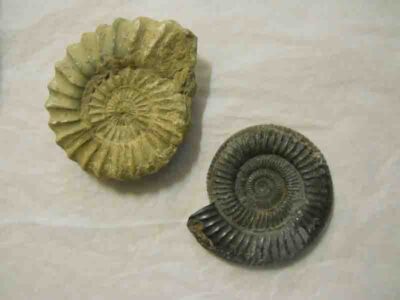
Two ammonite fossils, a favourite food of ichthyosaurs
Ichthyosaur
As a consequence of their sharp teeth and predatory nature, ichthyosaurs have often been referred to as ‘sea dragons’. Despite this, ichthyosaurs do have striking similarities to an animal that we are much more familiar with today: the dolphin. From looking at both the fossils and subsequent reconstructions you can see a distinct similarity in their shape as they are both streamlined effective swimmers. These similarities have meant that we can learn a little about what life for the ichthyosaur may have been like by studying dolphins. Evidence suggests that the ichthyosaur could reach speeds of 15mph in the water. The ichthyosaur had no gills: it had to come to the surface regularly to breathe. The sight of these creatures poking their heads out of the sea or even jumping from the waves would have been a common sight in Jurassic Gloucestershire.
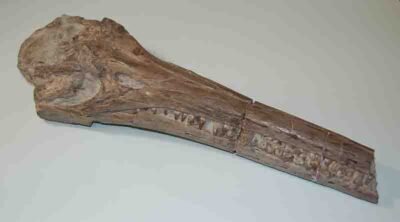
Icthyosaur-Skull
An ichthyosaur skull, note the long jaws full of sharp teeth used to break down shellfish.
The word ‘ichthyosaur’ literally means ‘fish lizard’. It derives from the Greek words ‘ichthys’ meaning fish and ‘sauros’ meaning lizard. Ichthyosaurs lived in the world’s oceans at the same time that dinosaurs lived on the land. They evolved about 280 million years ago in the Triassic period, and died out about 90 million years ago. They were particularly prevalent in the middle period of the Mesozoic, the Jurassic (201-145 million years ago). Jurassic fossils are relatively common in Gloucestershire, so creatures from this time are well-represented in the collections held by The Wilson.
There were a number of different species of ichthyosaur. They ranged from 1 metre long to over 7.6 metres. From a human point of view the larger species would have been fearful creatures with which to be in the water! All sizes of ichthyosaur were predators. The smaller species ate shellfish such as ammonites or belemnites, larger species could hunt bigger creatures. They had long, thin jaws packed with teeth. These teeth had to be sharp and strong for cutting through the shells of crustaceans and for crunching the bones of fish. Although they were powerful predators, ichthyosaurs ranked somewhere in the middle of the food chain as there were still bigger hunters than them in the ocean such as plesiosaurs.
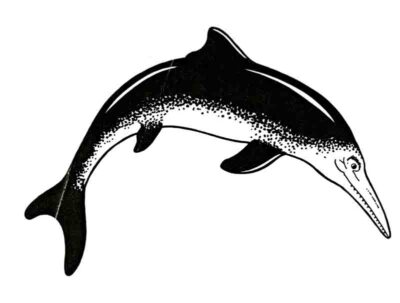
Icthyosaur-Reconstruction
A reconstruction of how an ichthyosaur may have looked
The Bristol cast
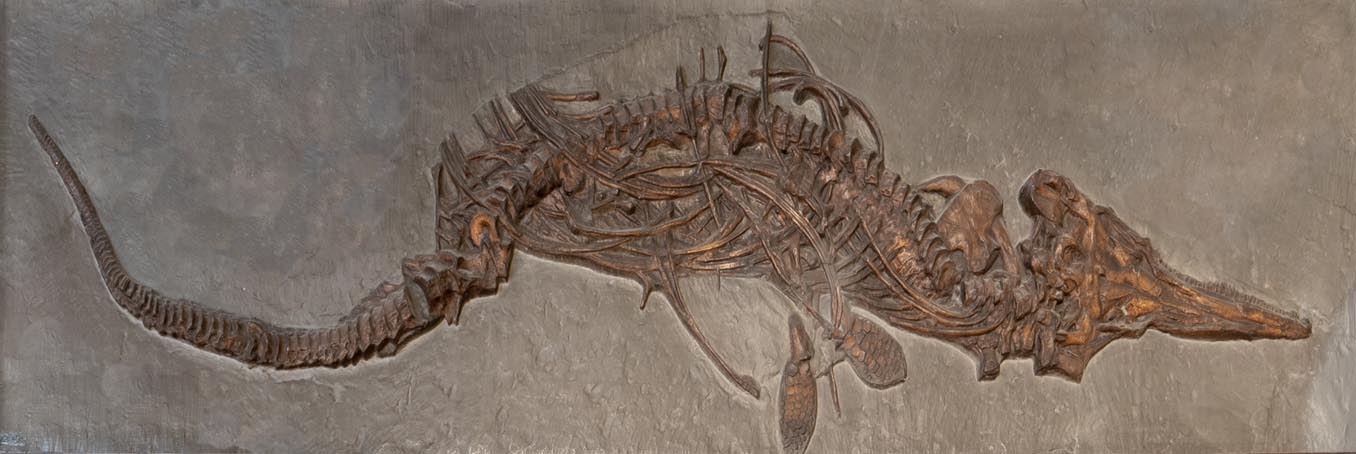
In the collection we hold a number of fossils from ichthyosaurs, including a skull, a paddle, (a type of flipper) and a variety of vertebrae. These fossils were recovered from various locations in Gloucestershire, and are representative of a number of specimens rather than constituting one singular individual.  The Wilson does, however, hold a plaster cast of a whole ichthyosaur. This cast, pictured here, is currently on display in the archaeology galleries and is the cast of an original specimen given to Bristol City Museum. Unfortunately, the real fossil was destroyed in an air raid during the Bristol Blitz in 1940, so this cast and a number of other copies dotted around the country are the only record of this individual ichthyosaur.
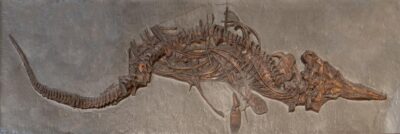
Cast-of-an-ichthyosaur-cropped-2
A plaster cast of a complete ichthyosaur skeleton
Share this article
Follow us
A quick overview of the topics covered in this article.