
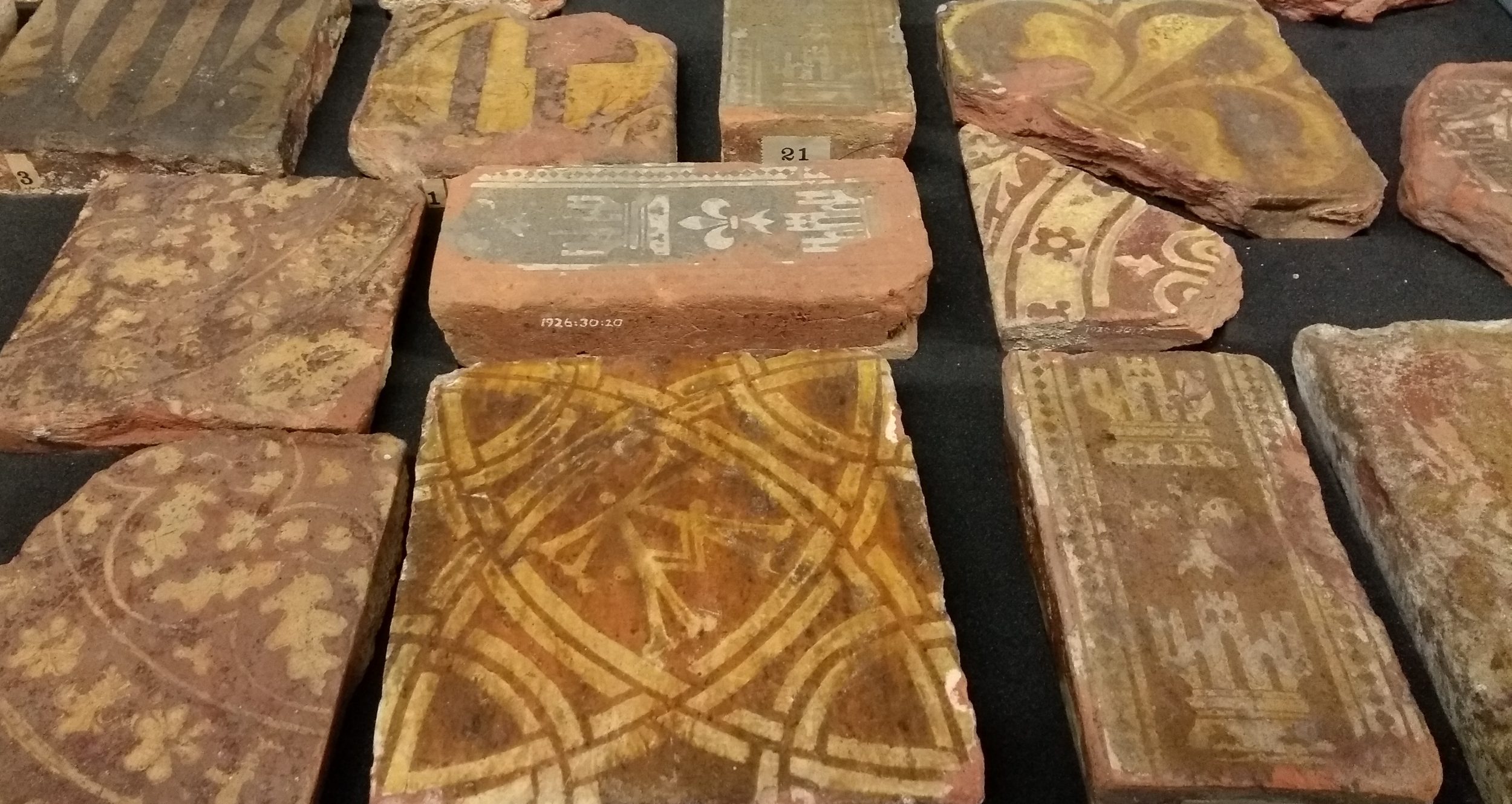
The Wilson’s medieval collection has around 200 ceramic floor tiles, some nearly complete and in excellent condition. They mostly date from the 13th century, with some from the 14th to 16th centuries, and are reliably associated with the medieval Cistercian abbey at Hailes near Winchcombe.

Hailes Abbey was founded in the 1240s by Richard, earl of Cornwall and was completed around 1251. In 1270, Richard’s son Edmund, presented the abbey with a tiny glass vessel reputed to contain a relic of the Holy Blood, which Edmund had bought from the Count of Flanders. Hailes very soon became a major pilgrimage destination, calling for the building of a new shrine to house the relic. As a consequence, the eastern arm of the abbey was rebuilt and dedicated in 1277. Excavations of this part of the abbey in 1968 revealed the existence of an area of tiled pavement.

There is little doubt that the earlier period tiles in the collection were designed for this pavement. Their heraldic designs show the power that Hailes obtained through the patronage of the earls of Cornwall. The various emblems depicted are all connected with the earldom of Cornwall and its links to royalty and other baronial families. Apart from the arms of the English monarch and of Cornwall, other families whose arms appear include:
Clare            (Gilbert de Clare, earl of Gloucester, was related to the Cornwalls)
Warren         (William de Warren, earl of Surrey, was also related)
Provence      (for Sanchia de Provence, Richard’s second wife
Falkenburg    (for Beatrice von Falkenburg, Richard’s third wife)
Ferrers         (William de Ferrers, earl of Derby, whose estates were acquired on forfeiture by Cornwall)
Peveril          (for Margaret Peveril, wife of William de Ferrers)
Stafford        (related to Ferrers)
Abbots of Hailes represented on the tiles are Thomas Stafford (1483-1503), Anthony Melton (1509-1527) and the last abbot Stephen Sagar (1527-1539). The tiles appear to have been made around the time of Abbot Sagar’s rule at Hailes. It remains unclear however whether they came from a floor actually laid at the abbey and removed some time after the Dissolution or were surplus to the abbey’s requirements from the beginning.

The designs were inlaid on to the tiles using two techniques: incised tiles, the design was scored into wet clay by hand with a sharp tool; line-impressed tiles the same effect was possible by using a carved wooden stamp. The depressions were then filled with wet clay and the design glazed over prior to firing. Only a limited range of colours, mostly yellows or green, were available. Some of the later tiles were hand painted.
The exact sites of the kilns is not known, but they are likely to have been near the Abbey. The generally high quality of designs and coloured glazes place them among some of the finest products of the medieval tile-making industry.
 The tiles have been brought together from a number of different sources. The majority came through the bequest of W St Clair Baddeley of Painswick and as a donation by the owners of the former Manchester Hotel in Cheltenham (where strangely a large quantity of the tiles were found discarded in a cellar!). Others were received from the Bazeley Collection and from the owners of Dixton Manor.
The dissolution of the abbey in 1538 ended pilgrimages to the shrine and the buildings became partly ruined, eventually inspiring artists to produce romantic images of the remains, such as that depicted in this 1732 print by Samuel and Nathaniel Buck.
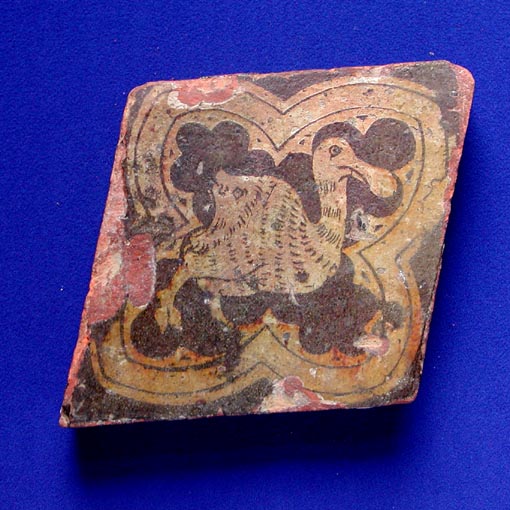
1926-30-1
Tile with a mythological creature, a duck-like bird with a tail in the form of a boar’s head, within a quatrefoil with tracery.
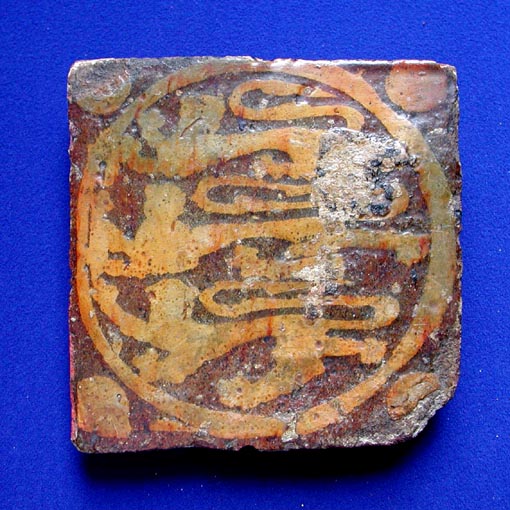
1926-30-11-1
Tile showing three lions passant within a circle: The Arms of England, about 1270-77.
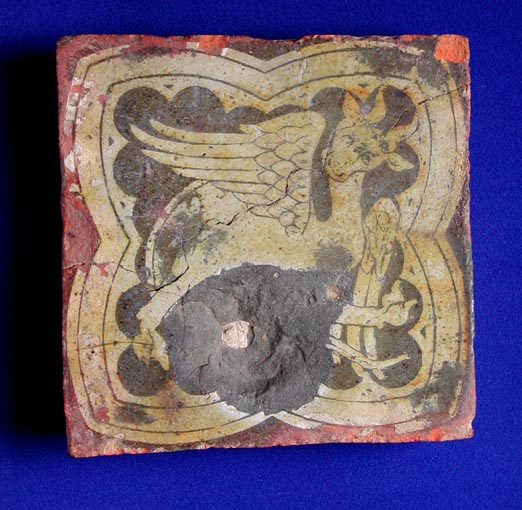
1926-30-16
Tile showing a mythological beast with cow’s head, wings, tail and cloven hooves. within quatrefoil tracery.

S-and-N-Buck-300×212
Tile showing a mythological beast with cow’s head, wings, tail and cloven hooves. within quatrefoil tracery.
Tile-banner-2500×1330
Share this article
Follow us
A quick overview of the topics covered in this article.