
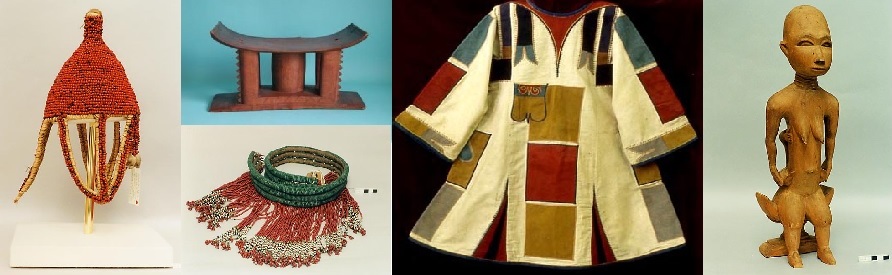
Contact with Europeans at the Atlantic ports opened up trade routes across the world for the Asante, who received manufactured metal goods, firearms, cloth and slave workers, in return for their natural resources, in particular gold. Today the Ghanaian economy is based on commercial mining as well as crops like maize, plantain, yams and ground-nuts. Many Asante are Christian or Muslim, but also keep up traditional religious practices.
Nigeria is a vast country of about 122 million people coming from more than 250 ethnic groups, such as the Ibo, Ibibio, Yoruba, Tiv, Nupe and Jukun. The people are mostly Christian in the south and Muslim in the north, although many still maintain traditional religious practices. The two peoples best represented in the exhibition both come from the north of the country. They are the Hausa, Nigeria’s largest ethnic group who make up about 21% of the the population, and the Fulani who make up about 9%.
The Hausa are an agricultural people, who for much of their history have relied on the trans-Saharan trade routes. The Fulani are part of one of the world’s largest nomadic groups. The Hausa and Fulani peoples’ contact and trade with the Arab world since the Medieval period, led to a gradual conversion to the Islamic faith. In the 19th century Hausaland was part of a Fulani Empire which was divided into smaller units, each ruled by a local Emir. It was the Emirates who opposed British attempts to impose their rule at the beginning of the 20th century.
Share this article
Follow us
A quick overview of the topics covered in this article.