
Robert Wild was born in 1882, he attended Repton School, and then the Camborne School of Mines in 1902; by which time he was registered at a Cheltenham address. Following graduation he worked at various Cornish mines before his career was interrupted by the First World War.
Wild joined the Gloucestershire Regiment and fought in France, until 1916 when he was wounded. He went on to become a staff instructor for the army based in Ireland. In 1920 Wild was appointed as Inspector of Mines in the Gold Coast, now part of Ghana. His duties involved monitoring the extraction and export of gold from mines in the Asante region, particularly at Tarkwa and Obuasi. It was a time of great change for the country as railways were built to link the mines with the port of Sekondi, allowing winding gear and machinery to be brought in, and gold to be shipped out.
The miners tended to be local men who had learnt the old ways of finding and removing gold. The concession at Obuasi was held by the Ashanti Goldfields Corporation (AGC) which had its roots in the enterprise of two indigenous men Joseph Ellis and Joseph “Tarkwa†Binney. By the 1930’s the Asante goldfields were producing annual exports worth £1.2 million. AGC is now one of the world’s most successful mining companies and a vital part of the Ghanaian economy.
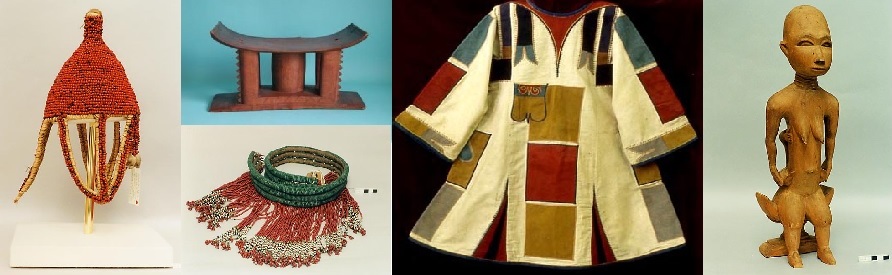
Wild realised there was more to the Gold Coast than just gold. He was fascinated by the people and their crafts. He purchased baskets, wooden figures, leather goods and textile equipment and also acquired archaeological specimens which he carefully labelled.
Wild’s objects can now be found in some of the world’s best museums, but he did not forget his home-town museum. Robert Wild had a long connection with Cheltenham museum, he wrote a geology catalogue in 1920, and started donating African objects soon after. He also gave geological specimens, local crafts and decorative art objects. He died in 1946.
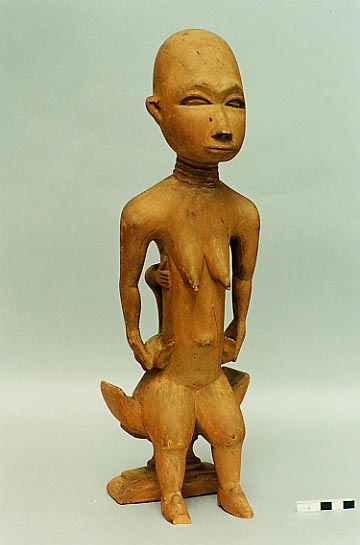
1923-2-5
Wooden female Asante figure donated by Wild in 1923
Share this article
Follow us
A quick overview of the topics covered in this article.