
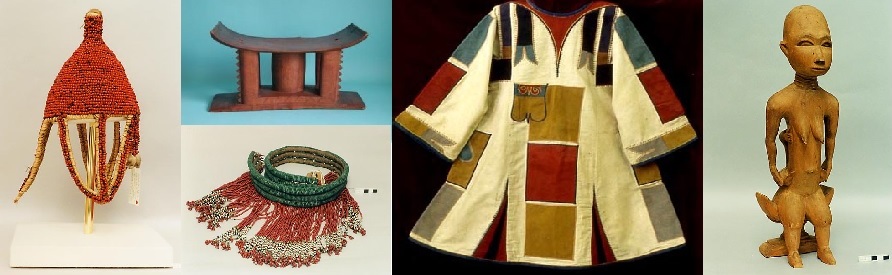
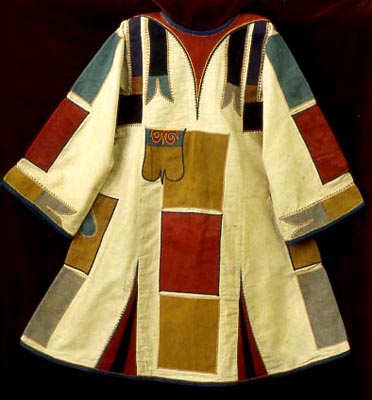
The story starts in 1881 with the rise of the Mahdi, a Muslim leader who united the people of Sudan to overthrow their government which was run by Egyptians and Turks, backed by Britain. In 1885 the Mahdi seized Khartoum and his troops killed the British hero General Charles Gordon. The troops of the Mahdi, and his successor, the Khalifa, were known as Ansar, ‘helpers’. They wore a particular type of patched cotton tunic, or jibbeh, based on the ragged clothes worn by the Dervishes or darawish meaning ‘poor men’. It signified their holiness.
The fall of Khartoum had given the British a thirst for revenge; by 1898 an Anglo-Egyptian force was advancing on Omdurman to face the Khalifa and his Ansar. The battle that took place at Karari was disastrous for the Sudanese who lost about 11,000 troops compared to less than a 100 from the Anglo-Egyptian force. The Khalifa escaped with his son, named ‘Uthman Shaykh al-Din, and some of his troops, but he was tracked down by Sir Reginald Wingate. In November 1899 the Khalifa was killed and his son was captured and later died in an Egyptian prison cell.
Most of the Sudanese artefacts in the exhibition were donated by Dr Curling Hayward MBE. In a letter written to the museum in July 1933, he explained that the artefacts came from Wingate, the man who had captured Shaykh al-Din. It seems likely that Wingate had given the jibbeh, along with the other artefacts, to Dr Hayward who passed them to the museum in the 1930s. Its significance has only recently been recognised.
2002-36
Patched cotton tunic, or jibbeh, worn by the Mahdist forces
Share this article
Follow us
A quick overview of the topics covered in this article.