
Traditionally pots were built using coils of clay which were drawn up to form thin walls. The pot was dried to a leather-hard consistency, then decorated and burnished, before firing in a bonfire-type kiln.
The pioneer potter Michael Cardew first became interested in African ceramics after a chance encounter with a Ghanaian potter in Cheltenham in 1936. By the 1950s he was working in Nigeria for the Government reporting on the decline of the local pottery industry. People were ignoring traditional pottery preferring imported factory-made wares which were glazed and more waterproof. In 1951 Cardew visited the Emir of Abuja who introduced him to the best of the local potters, a woman called Ladi Kwali. She was born in 1921 in the Gwari village of Kwali, northern Nigeria. In common with many west African women she had learned to become a skilful potter, and rather than raise a family she had chosen to continue making pots.
Cardew established workshops at Abuja to train local potters in new techniques to help them compete with the imports. Instead of abandoning the traditional styles, Ladi Kwali managed to adapt the motifs of reptiles, fish and birds on flat-bottomed jars with glazes. This pottery became the most sought after of the Abuja products.
International exhibitions were organised, and in 1962 Ladi Kwali visited Britain, demonstrating her techniques at Cardew’s own workshop at Winchcombe Pottery. During her lifetime she won much acclaim, being honoured with an MBE in 1963 and the Nigerian National Order of Merit in 1980. Ladi Kwali died in 1984.
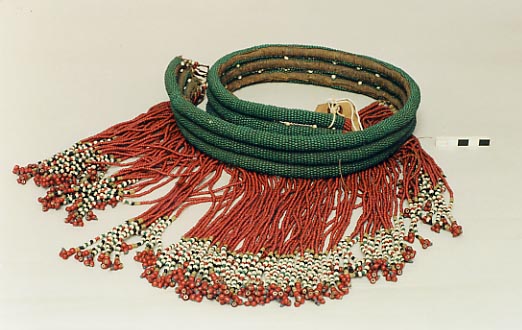
1933-46-1
Fringed waistband, isiheshe, Zulu people, about 1900
Share this article
Follow us
A quick overview of the topics covered in this article.