
What deposits might once have existed were generally believed to have been destroyed by the Regency re-building of the town and the deep cellarage that accompanied it. Now, thanks to the increase in modern developer-led, mostly professionally carried out, archaeology, this is changing. The findings of these excavations may vary in their nature and in the quantity of finds but the resultant reports and archival records deposited in the Museum provide much new, and sometimes exciting, evidence about the town’s origins.
Prehistoric Cheltenham
The earliest significant material in the Museum’s collection relates to the Neolithic (or Early Stone Age) period (4,000-2,000 BC) and consists largely of stone implements (including a slate spearhead from Leckhampton and quantities of flints found at scattered sites across Cheltenham. Pottery from as early as the Neolithic period was also found at Sandy Lane and a beaker vessel found in Leckhampton appears to date from the late Neolithic/early Bronze Age. Less reliable, but not to be ignored, is the evidence from a painting of 1832, backed up by certain contemporary documents relating to Cheltenham (Goding), that a possible Neolithic (or Bronze Age) barrow may once have stood in St James’ Square in the town; within it were reportedly found “broken urns, stone implements and personal ornamentsâ€. The precise location of this monument is not clear but, if it ever did exist, it seems to have been destroyed during railway construction.
The following Bronze Age (2,000-700 BC) is notably represented by finds from a burnt mound site at Sandy Lane which included a fragment of a clay mould for a socketed spearhead and tools and pottery dating probably from the late Bronze Age.
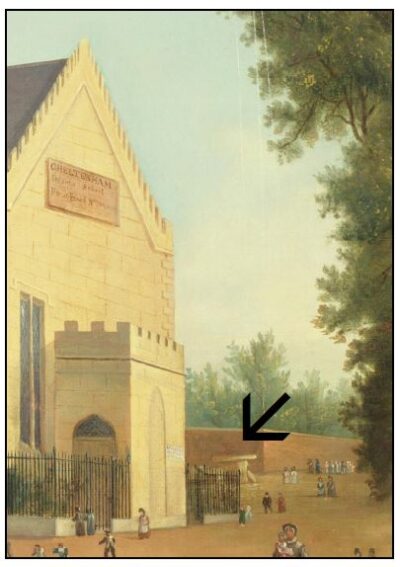
1968_127-detail
Oil painting on canvas, entitled St James' Square Infants' School', by J. Westall, dated 1832
With hillforts close by upon Nottingham, Cleeve and Leckhampton hills, at least some activity by Iron Age (700 BC – 50 AD) peoples lower down the slopes could be expected but evidence for actual settlement in the Cheltenham district is limited. In recent excavations at the Junior Library site on Chester Walk, boundary ditches containing Iron Age material were uncovered. None of this however suggests more than small- scale rural occupation in the area.
Roman Period Cheltenham
The arrival of the Romans into Gloucestershire around the middle of the 1st century AD led to the early establishment and later full development of the nearby Roman cities of Gloucester (Glevum) and Cirencester (Corinium). Numerous country estates and luxurious villas also developed in and around the Cotswolds, especially during the 3rd and 4th centuries. Roman influence spread throughout the surrounding countryside but it is only relatively recently that archaeological discoveries have provided us with a clearer understanding of Cheltenham itself during the Roman period.
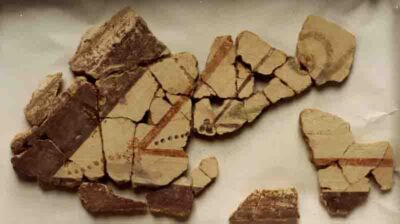
Vineyard-farm-Wall-plaster-Room-B
Plaster fragments excavated at Vineyards Farm.
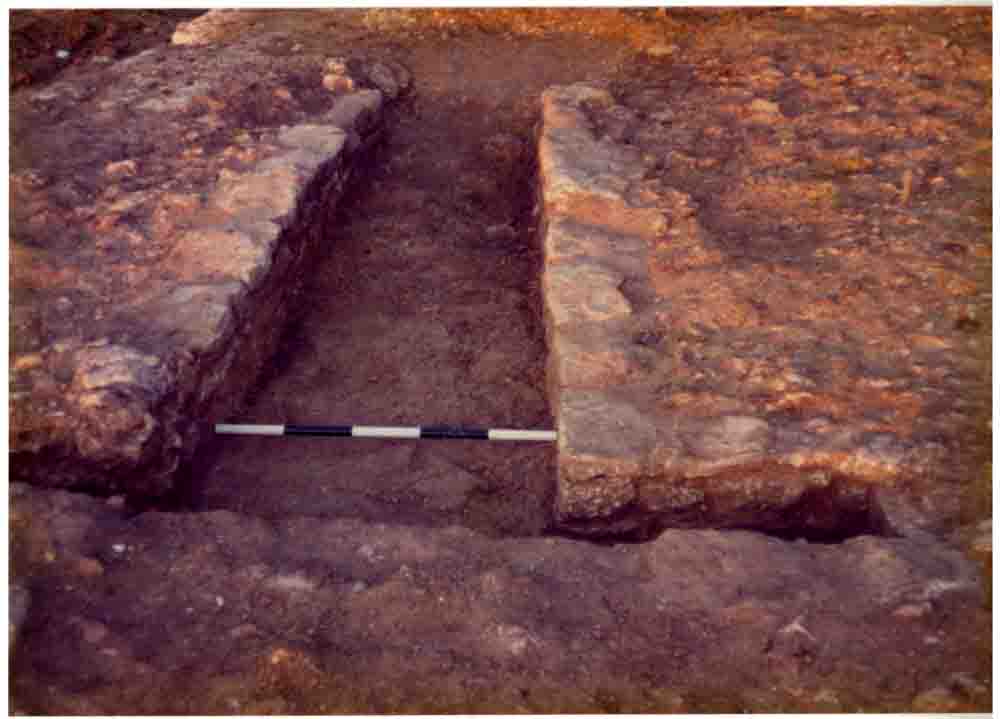
The first significant record of Romano British settlement in the centre of Cheltenham was provided by modest scale excavations in the late 1990s in the area of Evesham Road and Dunalley School, i.e. just north of the town centre bordering on to Wymans Brook. Here was found a rectilinear enclosure system with ditches and pits typical of a native rural settlement dating from the late 1st century AD. In 2005, similar evidence was found even closer to the town centre in St George’s Place. Perhaps the most important discovery however came from major excavations between 1999 and 2002 in the St James’ Square area of town prior to the construction of a new Waitrose store. At this site, in places beneath up to 6 metres of built-up soil associated with 19th/20th century railway station construction, archaeologists identified an original ground surface sloping gently down towards the nearby River Chelt along with elements of a Romano-British field system. Also found were two human burials and a quantity of pottery – mostly fragments of flagons and bowls or dishes from the 1st century to 4th century. The settlement associated with this site has yet to be found but it probably lies to the north or east, i.e. in the vicinity of the Lower High Street. Hence, there is clear evidence that the Cheltenham Sands attracted extensive settlement during Roman times but this was mainly in the form of inter-linked farmsteads; the possibility of a Roman villa actually in Cheltenham also cannot be discounted.
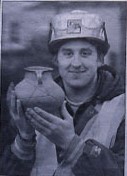
Newspaper-Article-St-James-Site_002
An archaeologist holding some of the pottery recovered from the excavation at the St James Square (Now Waitrose)
Saxon Cheltenham
Little is known about Cheltenham during the centuries immediately following the 5th century Roman withdrawal and during the period of Anglo-Saxon incursions into Gloucestershire starting in the 6th century. Important Anglo-Saxon settlement was confirmed at nearby Bishops Cleeve and this is fully represented in the museum’s collection, but it had long been thought that Cheltenham itself had not yet succumbed to Anglo-Saxon control. This theory has just recently been proved otherwise following developer-led excavations in 2009/2010 in the Hesters Way/Arle district of town, at the site of the former Kingsmead School (SO926240)), where evidence of a small Anglo-Saxon settlement dating to the 6-8th centuries was revealed. The site revealed Anglo-Saxon pottery, Saxon ditches and, most notably, traces of a timber hall. Two human burials possibly of Anglo-Saxon date were also found.
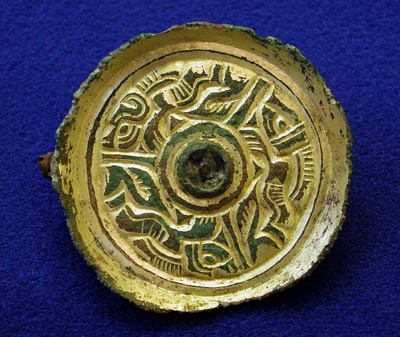
1996-95-10-2
Anglo-Saxon brooch from Bishop's Cleeve. Diameter 5 cm (1996.95.10.2)
Medieval Cheltenham
By this time, Cheltenham was part of the Christian kingdom of Mercia and ruled over by the tribe known as the Hwicce. Documentary evidence of settlement in Cheltenham occurs in 803AD when the Council of Cloveshoe dealt with a dispute between the bishops of Worcester and Hereford over who was entitled to the revenues from a minster church (monasterium) at Cheltenham. Domesday in 1086 records the existence of a royal manor of Cheltenham (Chinteneha) possessing 8 and a half hides of land (anywhere between 1000-2000 acres) and five mills, probably all watermills. Cheltenham had by then clearly become a settlement of some significance, now under Norman rule.

Plan-of-Prestbury-Manor-Moat-_002
Plan of Prestbury moated site
The museum’s collections contain some casual archaeological finds from this period mostly of pottery found at scattered sites around the town. The most notable discoveries though relate to three medieval moated sites, two in Prestbury and the third in Leckhampton. The first site in Prestbury (located about ¼ mile NW of the parish church) is of a substantial manor house belonging to the bishops of Hereford dating from at least the 12th century to the 16th century while the second site (in Noverton Lane) is of a smaller manorial site. Finds from these sites include quantities of pottery, building materials and glass, stone and iron objects. In Leckhampton (just north of the parish church) excavations in 1933 and more recent geophysical surveying have provided evidence for a small moated manor house occupied between the 12th century and the post-medieval period; especially interesting was the discovery of the timber supports for a bridge on to the moat island, lying on the bottom of the surrounding ditch.
Post Medieval Cheltenham
Leland, in his itinerary written in the 16th century, describes Cheltenham as “a longe towne havynge a Market†and he refers to it as “Cheltenham Streetâ€. John Norden’s Survey of the Manor of Cheltenham in 1617 depicts the lay-out of the town at that time, mainly along the line of the High Street. A feature of the High Street then would have been the pattern of narrow property strips or burgage plots fronting onto the street. Many of the buildings would have been of half-timber construction. Much of this was lost in the 18th and 19th centuries when, with the exploitation of the local mineral waters, the new spa town of Cheltenham emerged, setting the seal on subsequent development of the town centre. Remarkably little in the way of post-medieval pottery and other domestic artefacts from this period have been recorded.
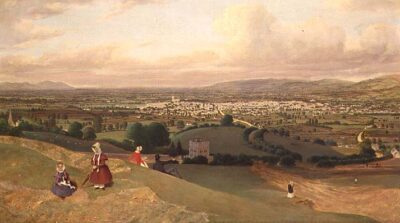
1969-48
Oil painting on canvas, entitled 'Cheltenham from Leckhampton Hill', by an unknown artist
Share this article
Follow us
A quick overview of the topics covered in this article.