
The protest became known as the first ‘Bloody Sunday’. Many of the socialists realised that their hopes of a revolution were unrealistic in the face of establishment opposition and force. Many started to look for a reformist, parliamentary way of making change for the nation’s poor and workers.
What was the protest?
In the 1880s Britain was deep in recession. This ‘long depression’, as it was known, caused mass unemployment. In 1886 and 1887 Trafalgar Square, the heart of London’s prosperous West End, became the centre of protests by the poor, many from the East End. Protesting alongside them were the Irish National League, who were against the government’s Coercion Acts aimed at suppressing the impetus for Home Rule in Ireland. Protests were outlawed in the Square, but still the people gathered. The protestors were assisted by new political groups in Britain, the socialists, the anarchists, the radicals, who all supported workers’ rights and the right to free speech.
13 November 1887
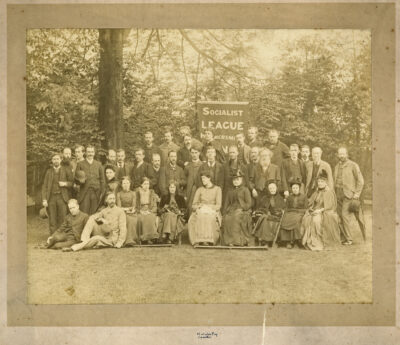
On Sunday 13 November more than 10,000 protestors marched towards Trafalgar Square. Waiting for them in the Square were 2000 police and 400 troops. William Morris and the Hammersmith branch of the Socialist League were there. There was a carnival atmosphere at first, Morris giving a rousing speech from a wagon, the band playing, banners waving. Afterwards, Morris, walking with playwright George Bernard Shaw, sensed trouble ahead. He saw their banner torn down and smashed. The whole protest was a rout, and the police used considerable force to break it up. Shaw and many others, in his words, ‘skedaddled’. Morris said he was ‘astounded at the rapidity of the thing and the ease which military organisation got its victory’. He went on to say, ‘I found myself suddenly alone … and, deserted as I was, I had to use all my strength to get to safety.’ Elsewhere, MP Cunninghame Graham was beaten and dragged away. Many were arrested, hundreds wounded, and several people died.
1991_1016_918
William Morris and the other members of the Hammersmith Socialist League, 1888.
The Aftermath: 20 November
The Times reacted to the protest, saying, ‘It was … no serious conviction of any kind, and no honest purpose that animated these howling toughs. It was simple love of disorder’. It described the protesters as ‘howling roughs’ and ‘criminals’. Those who were there told a different story. Walter Crane said ‘I never saw anything more like real warfare in my life – only the attack was all on one side.’ Undaunted, people gathered again the following Sunday. The mounted police attempted to disperse the crowd, and Alfred Linnell, standing near the edge of the Square, was knocked down and his thigh-bone smashed. He died in nearby Charing Cross Hospital three weeks later.
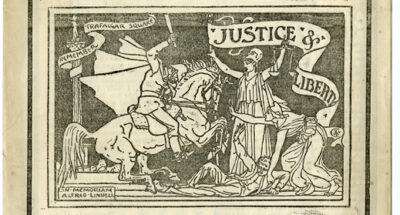
1991_1016_026-detail
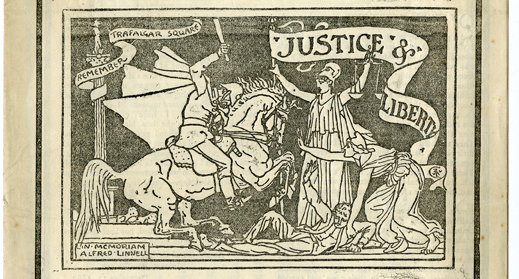
Walter Crane's propagandist illustration to the pamphlet raising money for Linnell's family.
The pamphlet and Linnell’s funeral
Crane and Morris came together to create the pamphlet. It includes Crane’s illustration, Morris’s song, and an account of Linnell’s life and death. Linnell copied out legal documents for a living, but was poor. After his wife’s death, his children ended up in the workhouse. The socialists planned a grand funeral. A huge procession walked from the West End of London to the East, swelling to tens of thousands. On that drizzly December 18, it was dusk by the time they reached Bow Cemetery. Speeches were read by lamplight. Morris gave an emotional eulogy, including the words, ‘let us feel he is our brother’, and his Death Song was sung.
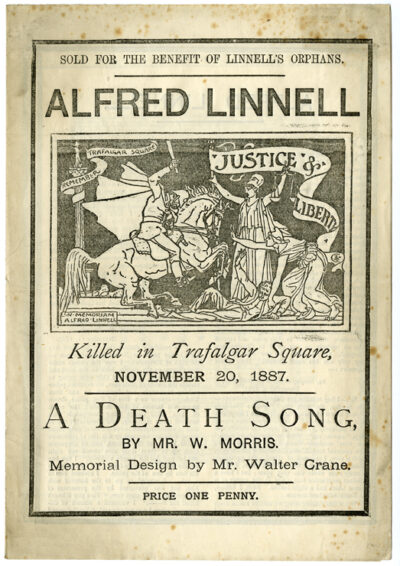
1991_1016_026
The pamphlet created by Morris and Crane.
Extracts from ‘A Death Song’ by William Morris
What cometh here from west to east awending?
And who are these, the marchers stern and slow?
We bear the message that the rich are sending
Aback to those who bade them wake and know.
Not one, not one, nor thousands must they slay,
But one and all if they would dusk the day.
They will not learn; they have no ears to hearken.
They turn their faces from the eyes of fate;
Their gay-lit halls shut out the skies that darken.
But, lo! this dead man knocking at the gate.
Not one, not one, nor thousands must they slay,
But one and all if they would dusk the day.
Here lies the sign that we shall break our prison;
Amidst the storm he won a prisoner’s rest;
But in the cloudy dawn the sun arisen
Brings us our day of work to win the best.
Not one, not one, nor thousands must they slay,
But one and all if they would dusk the day.
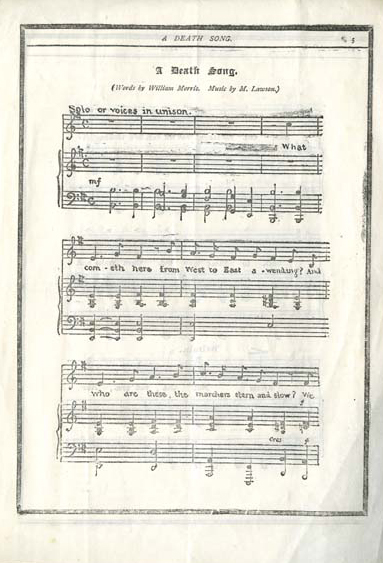
1991_1016_818_003-detail
The music to A Death Song in the pamphlet.
Share this article
Follow us
A quick overview of the topics covered in this article.