
The Wilson has a collection of 104 watercolours, drawings and prints by three members of this well-known family of caricaturists and portrait painters. All but three of them are by Richard Dighton (1796-1880), who lived in Cheltenham during 1828 and again between about 1832 and the late 1840s. Two others are by his father, Robert (1751-1814), and one by his second son, Joshua (1831-1908) The Museum also has a number of carte-de-visite photographs by Richard’s eldest son, Richard junior (1823-91), who was also an artist, but who later worked as a photographer, in Cheltenham, from around 1856 onwards.

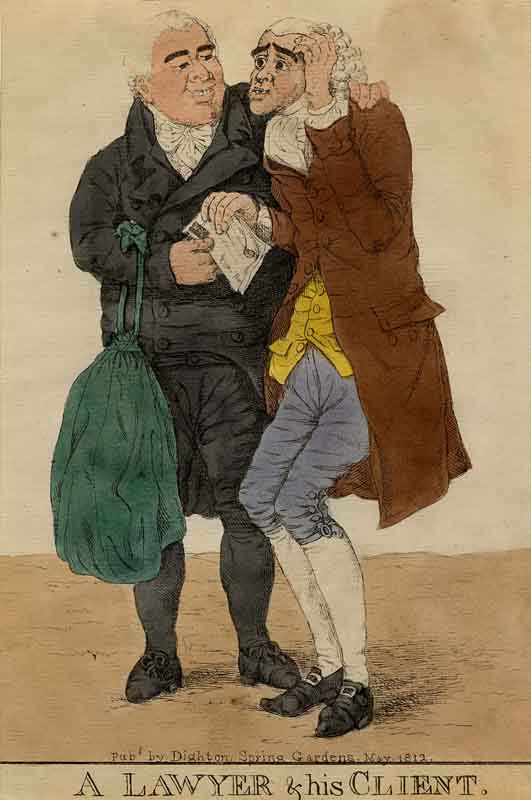
by Robert Dighton.
Robert Dighton, who attended the Royal Academy Schools, lived and worked in London for most of his life. He was well known for his irreverent caricatures of academics, actors, aristocrats, clergymen, lawyers, politicians, soldiers and sportsmen, as well as for satires on London life; one of the Museum’s two etchings by Robert Dighton satirizes a lawyer. His prints were published, often with witty titles, as hand-coloured etchings or mezzotints, and then sold in the capital’s many print shops. Dighton also worked as a drawing master and portrait painter, and as an actor and singer, frequently appearing at several London theatres until the late 1790s.
During the 1790s, Dighton was a regular visitor to the print room at the British Museum, from which he stole, and later sold, a number of valuable prints. The theft was eventually discovered in 1806, but the Museum decided not to prosecute Dighton, as he agreed to return most of the prints and co-operated in retrieving many that he had sold; the curator who had left him alone with the prints was dismissed!
In 1807, perhaps to escape his notoriety following the discovery of the theft, Dighton moved to Oxford, where he produced a series of caricatures of University dons, which he later continued at Cambridge. He also worked for a time in Bath, but by 1810 he was back in London, where he died in 1814.

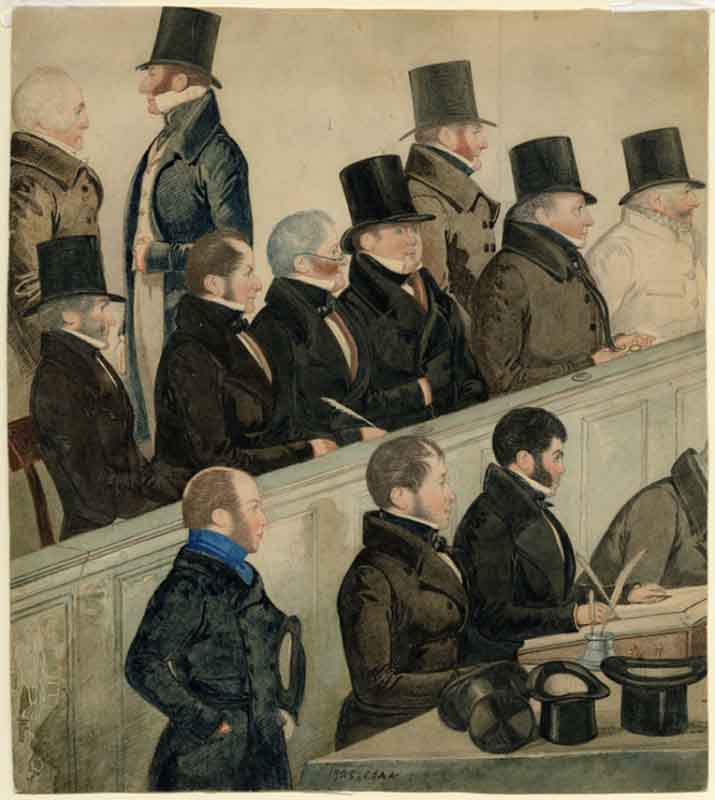
in a court, by Richard Dighton,
about 1835.
Richard Dighton probably began his career by working with his father and continued Robert’s series of portraits of Oxford and Cambridge dons; the earliest with Richard’s name on it is dated 1815. Between 1817 and 1828, he also produced over a hundred portraits of well-known London characters, all of them full length portraits, in profile. Like his father, he also worked as a portrait painter.
By 1828, Dighton had left London, and appears to have spent the spent the next 20 years in Cheltenham and Worcester. He was certainly at Cheltenham in November 1828, when he advertised his services as a portrait painter in a local newspaper, no doubt hoping to take advantage of the potential custom to be found in a popular spa town. He is recorded at Worcester from 1829 onwards, and may have divided his time between the two towns until at least the late 1840s.
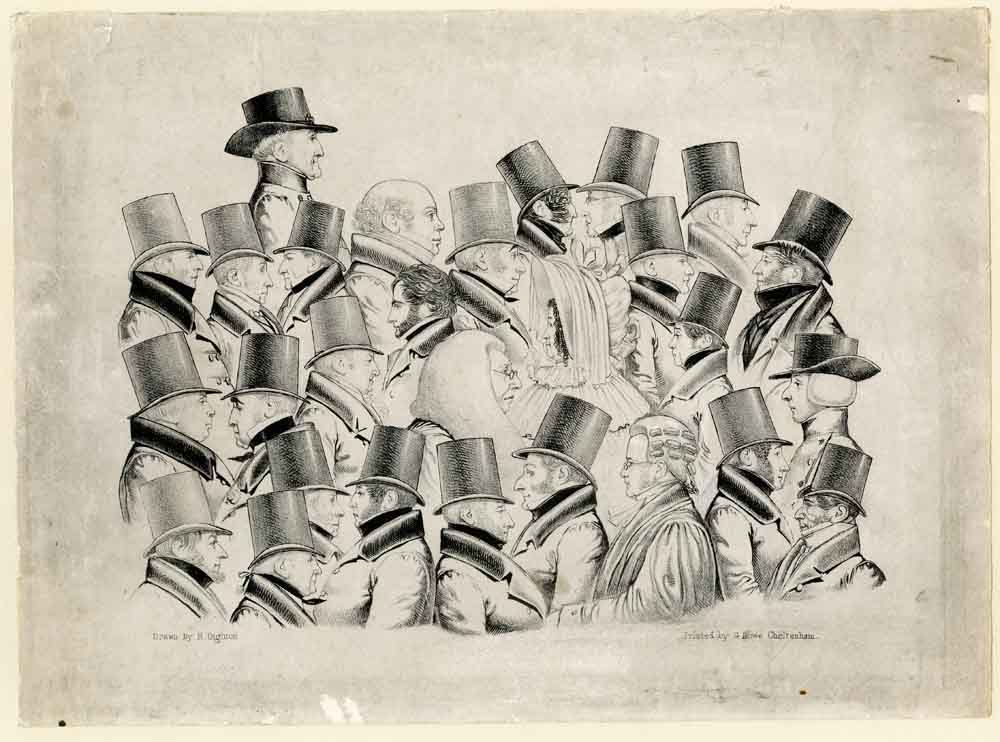
At both Cheltenham and Worcester, Dighton produced large numbers of full-length portraits in profile, many of which were published, as lithographs, either for sale, or for the sitter to give as gifts to family and friends. It is these portraits that make up the bulk of the Museum’s collection. Dighton also produced ‘groups’ of up to 20 figures, either standing in an artificial ‘streetscape’, or as head and shoulder portraits.
His portraits include many well-known figures in the life of early 19th century Cheltenham and provide good examples of contemporary costume. By 1850, Richard Dighton was back in London, where he lived for the last 30 years of his life, producing many portraits of well-known figures from the worlds of hunting and horse-racing.

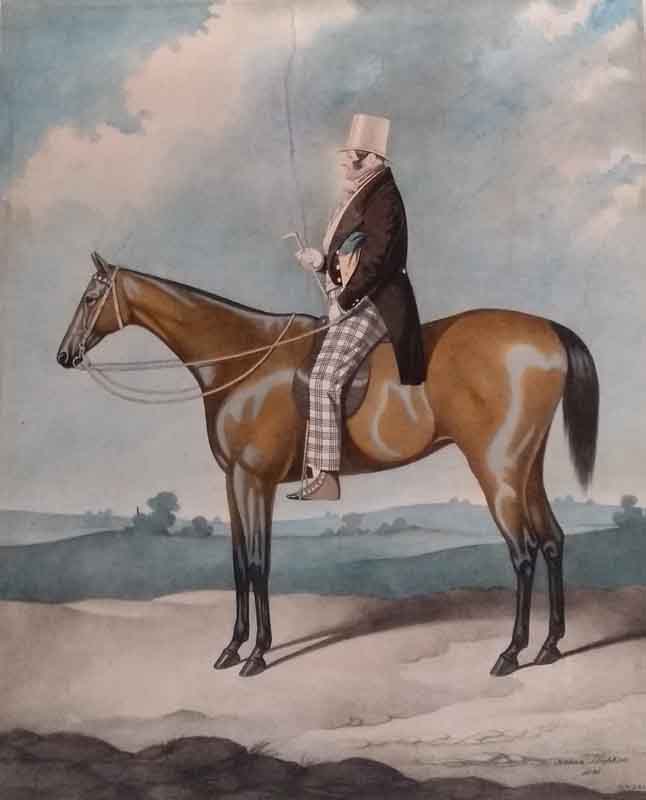
Craven of Brockhampton
by Joshua Dighton.
Joshua Dighton is best known for his equestrian and sporting portraits, which are very much like his father’s later works. The Museum has one example, which is his earliest known work – a watercolour, dated 1845, showing one of Cheltenham’s best-known sporting characters, Fulwar Craven of Brockhampton Park, on horseback.
1928_20
A watercolour showing gentleman in a court, by Richard Dighton, about 1835.
1987.244
A Lawyer and his Client by Robert Dighton.
1987.436
A portrait of Fulwar Craven of Brockhampton by Joshua Dighton.
Share this article
Follow us
A quick overview of the topics covered in this article.