
This was the intention of T J Cobden-Sanderson who set up the Doves Press.
Cobden-Sanderson was a friend of William Morris, and he was encouraged by William Morris’s wife, Jane, to become a bookbinder. He set up the Doves Bindery in 1893  which was named after the nearby Doves Tavern in Hammersmith. The bindery bound many of the Kelmscott Press books. The Doves Press was founded in around 1900 and was a joint venture between the bookbinder T J Cobden Sanderson and Emery Walker.
Cobden-Sanderson, like many Arts and Crafts Movement designers, was disturbed by industrialisation in the workplace. He believed that creativity, imagination and contentment were more important than profit, and his businesses reflected his ideals. Workers at both Both the Doves Bindery and the Doves Press benefited from comparatively high wages in the sector, had a 48 hour week, and enjoyed 14 days paid holiday a year, as well as paid time off at Christmas and bank holidays.
Walker managed the technical side of the business, and Cobden-Sanderson chose the books and had the final say in their design. Walker, Cobden-Sanderson and Sydney Cockerell created a new typeface for the Press based on Nicolas Jenson’s Roman type. Doves Press books look very different to most private press books of their time. The clear typeface and the lack of decoration give the books a very simple and austere look. The only decoration came from the calligraphers Edward Johnston and Graily Hewitt, who designed the capitals and sometimes added flourishes in ink to the printed books. Although most of the Doves Press books were simply bound in vellum, many of the bindings produced by the Doves Bindery were very ornate and elaborate.
The masterpiece of the Press was their five volume Bible, completed in 1905. It was set by hand and printed on a hand press, with the only decoration being printed red initial letters by Johnston. But while the books were successful, the partnership between Walker and Cobden-Sanderson soon became unworkable. It was dissolved in 1908, but the two men continued to argue about what would happen to the type. Walker was keen that it should be used commercially, but Cobden-Sanderson disagreed, and also failed to acknowledge Walker’s role in the Press.
In 1909 they drew up an agreement about the type. Cobden-Sanderson was allowed to continue to use it, and ownership would go to whoever outlived the other. But Cobden-Sanderson broke the agreement with a dramatic gesture. In 1916 he began to throw bits of the type into the Thames at Hammersmith Bridge. It was thought that only one specimen remained, a block created for a Christmas greeting in 1900 which remained with Walker and is now preserved in the Emery Walker Library. However, in November 2014, the Port of London Authority’s diving team, directed by typographer Robert Green, recovered 151 pieces of the metal type from the Thames, allowing Green to create a digital version of the typeface.
Why not explore some of the Doves Press books in the Emery Walker Library in the Virtual Library?
1991_1016_953
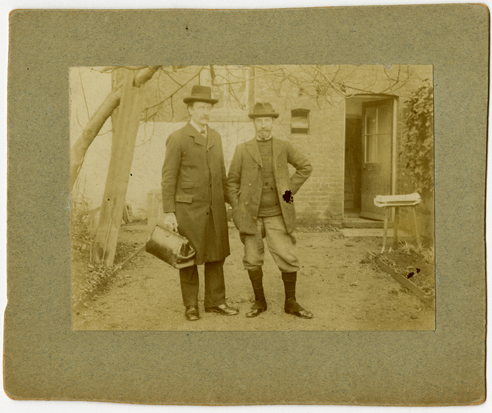
Emery Walker (left) and TJ Cobden-Sanderson outside the Doves Press in Hammersmith, about 1901-7

1991_1016_996_X2_010.jpg-625×443
In 1908, an edition of poet Robert Browning's Men and Women was produced. This is one of 13 copies printed on vellum, and hand-flourished by Johnston.
1991_1016_996_X41_005-625×433
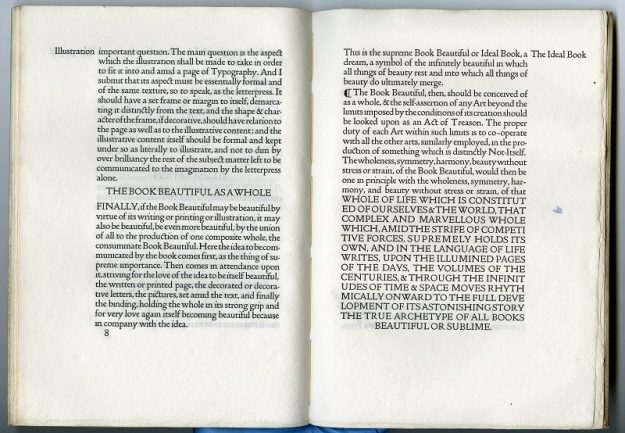
The Ideal Book, Or The Book Beautiful, A Tract On Calligraphy Printing And Illustration & On The Book Beautiful As A Whole by T.J. Cobden-Sanderson, 1900. This was one of the first books printed by the Press.

deed-of-dissolution-of-partnership-for-the-doves-press-between-emery-walker-and-tj-cobden-sanderson_5409736607_o-625×950
The Deed of Dissolution of Partnership for the Doves Press between Emery Walker and T.J. Cobden-Sanderson, 1909.
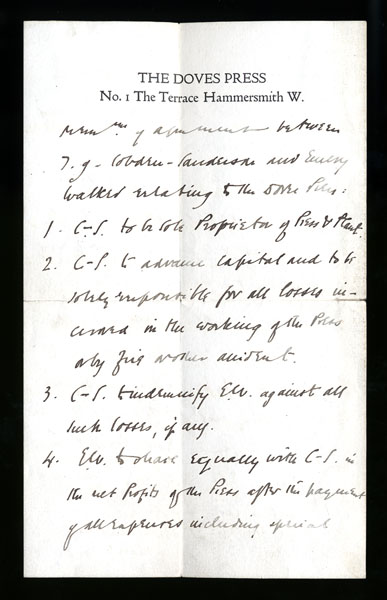
Doves-Partnership-Agreement_001.jpg
A hand-written draft of the Memorandum of Agreement between Cobden-Sanderson and Walker, 1903.
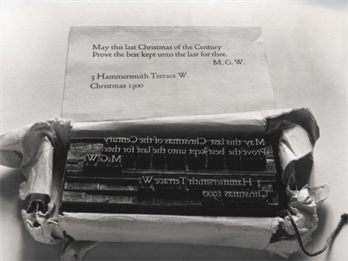
emery-walker-21_thumb
From 1913 to 1916, Cobden-Sanderson threw the Doves type into the Thames from Hammersmith Bridge. All that remained was this small block of type in Walker's possession, for a Christmas card from his wife Mary Grace in 1900.
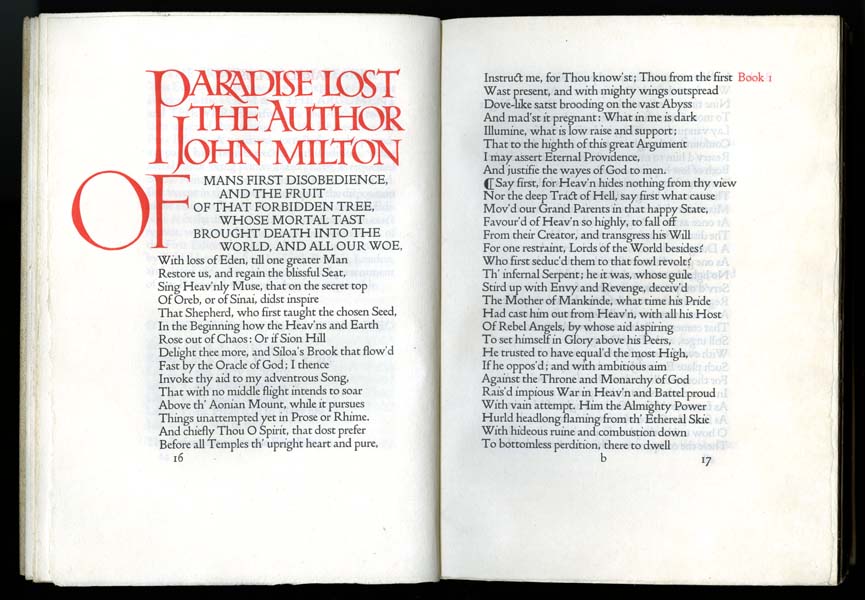
paradise-lost-by-john-milton_5409736693_o
Johnston also provided the calligraphy for this edition of Paradise Lost, 1902.
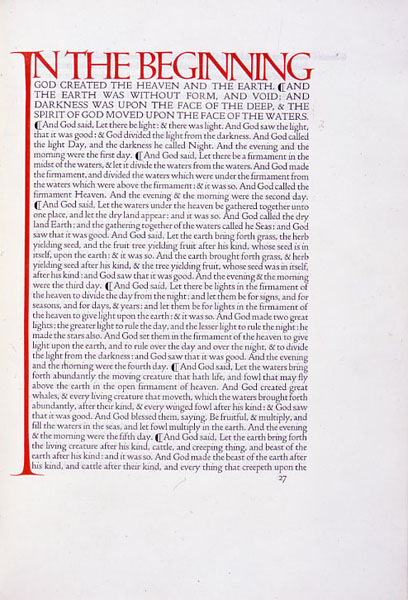
the-doves-bible_5410347798_o
The Doves’ Bible, 1903, is considered to be the masterpiece of the Press. The set was given by Emery Walker to his daughter Dorothy Walker for Christmas 1905. Shown is the first page of the 'The First Book of Moses Called Genesis' with the illuminated words ‘In the Beginning’ by Edward Johnston.

xxii-ballades-in-blue-china-binding-by-tjcobden-sanderson_5410347882_o
Unfinished book binding by Cobden-Sanderson, 1895. Inside it's inscribed to Emery Walker: 'To a perfect friend / an imperfect souvenir / To Emery Walker / from T.J. Cobden-Sanderson/ Jan. 1896'.
Share this article
Follow us
A quick overview of the topics covered in this article.