
These toys belonged to one family, the Jefferson family, who ran a post office at Charlton Kings. They sold toys and games alongside the postal services, so there was a wonderful resource for the Jefferson children to play with in their summer holidays!

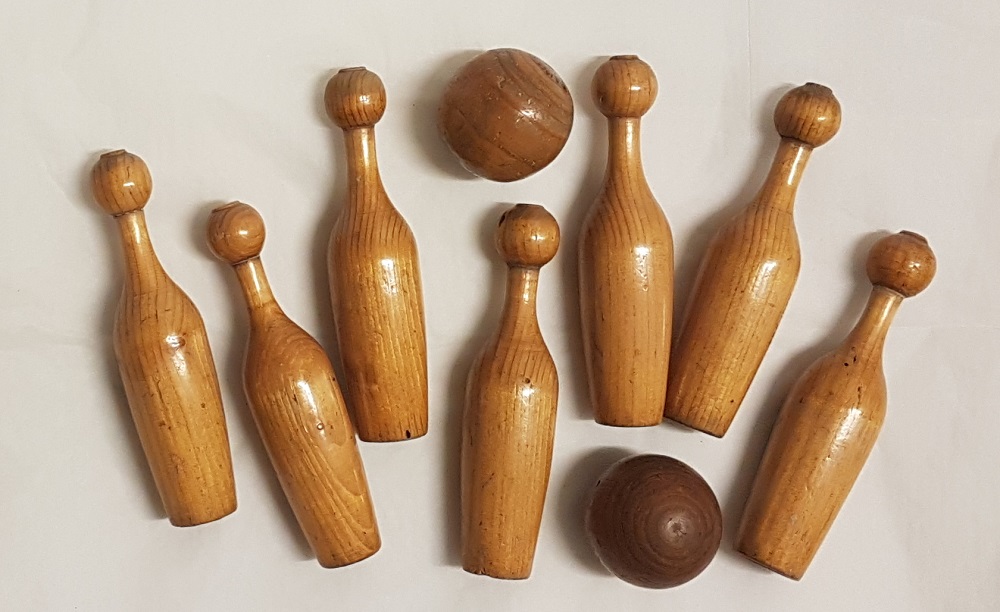
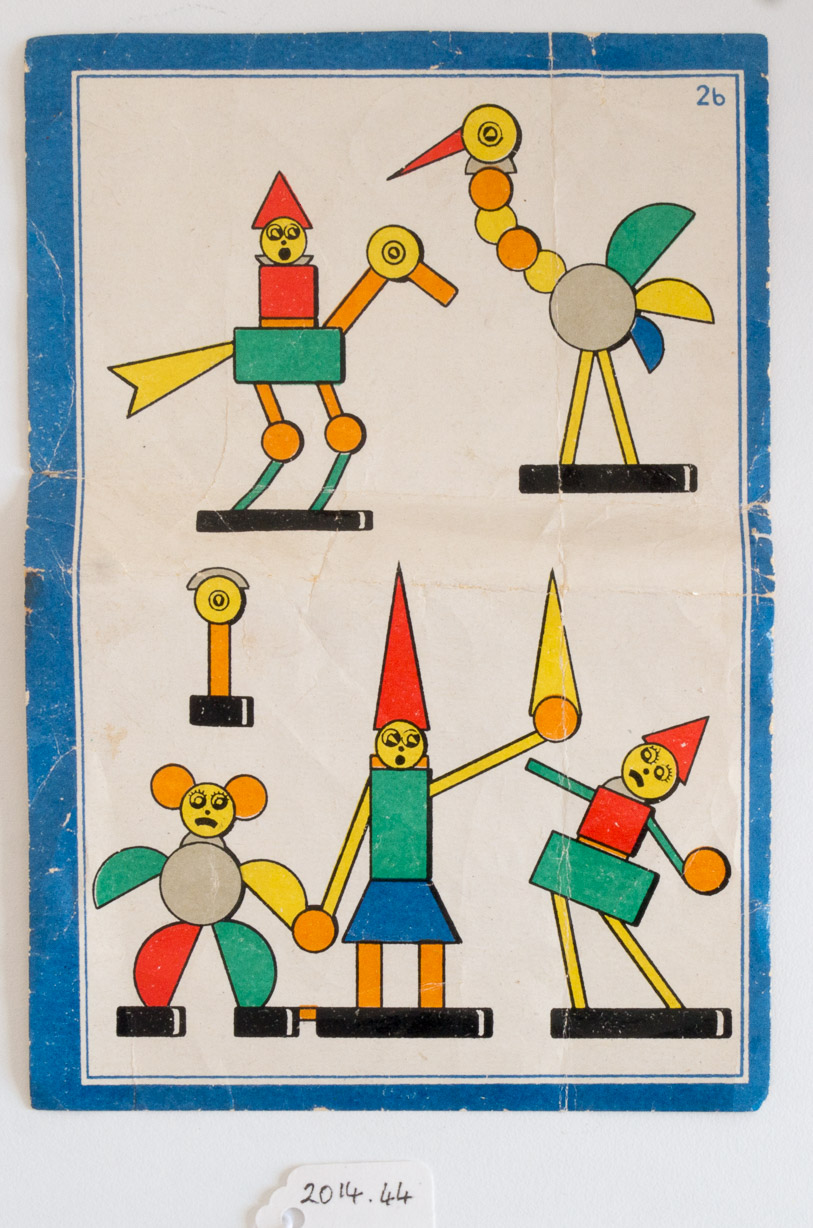
A number of toys from this collection were produced in the years before the Second World War. This simple construction toy was for a pre-school child to play with. It’s made of brightly coloured wood which was on the market in the 1930s. Not dated, but surely also meant for a young child, is a set of toy scales in painted sheet metal, complete with tiny brass weights, and probably made in France.
Some games can be dated by the illustrations on the packaging. A set of Tiddlywinks with numbered target board and wooden cup, comes in a box illustrated with a group of child players in 1930’s costume. It was produced in the UK by Spears, as was the Lotto set whose lid shows a happy family again in 1930’s dress.

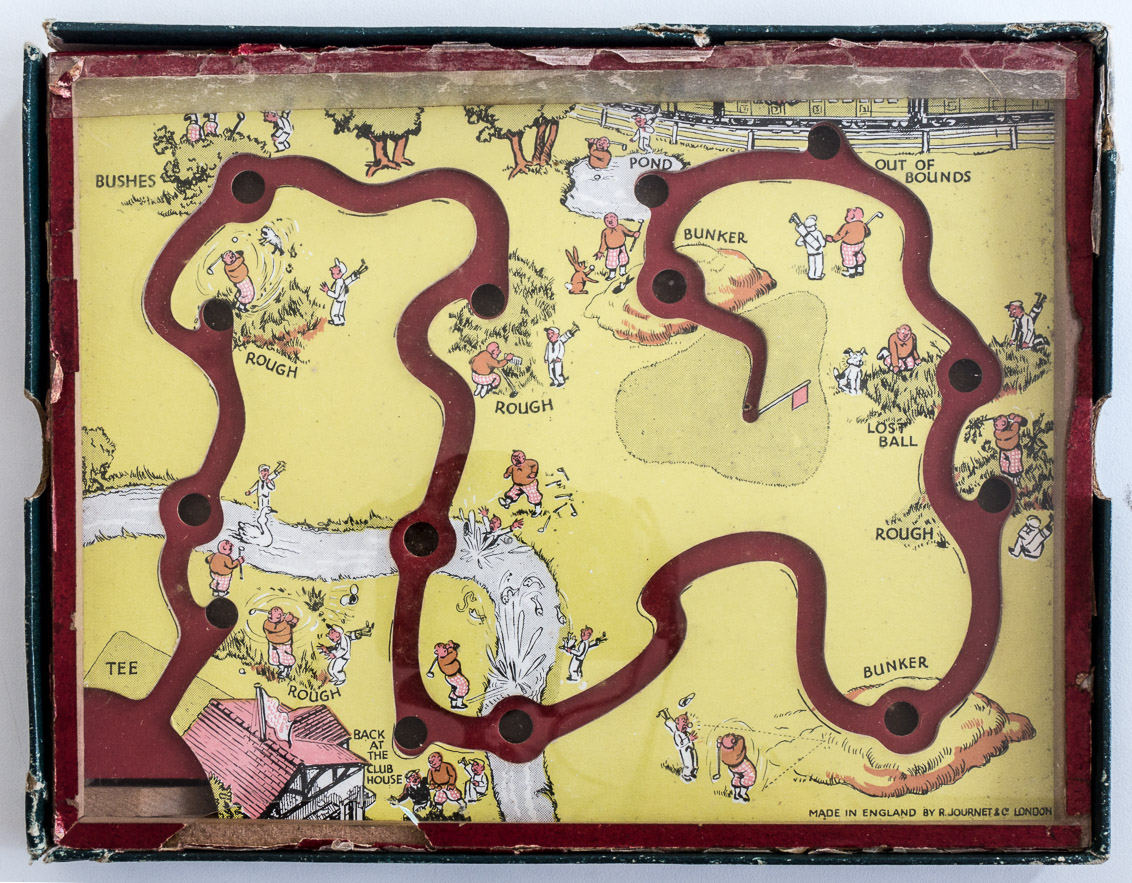
The ‘Silver Bullet’ golf game is one of those produced in the UK by R. Journet during the first half of the 20th century; it has a wooden casing, and the backing illustration is illustrated with comic golfers in period clothes. It is an example of a large and varied class of ‘dexterity games’, where the player is challenged to manoeuvre one or more metal balls into marked positions.

With the advent of war in 1939, materials for toys were in increasingly short supply, the use of metal for toys being banned from 1942. Paper was of poor quality and also in short supply. Â This collection includes several paper-based games, including the word-game Kan-U-Go , the Beetle game, and Battleships and Cruisers; the last-named a favourite with its owner to judge by the many playing sheets they and their friends completed.
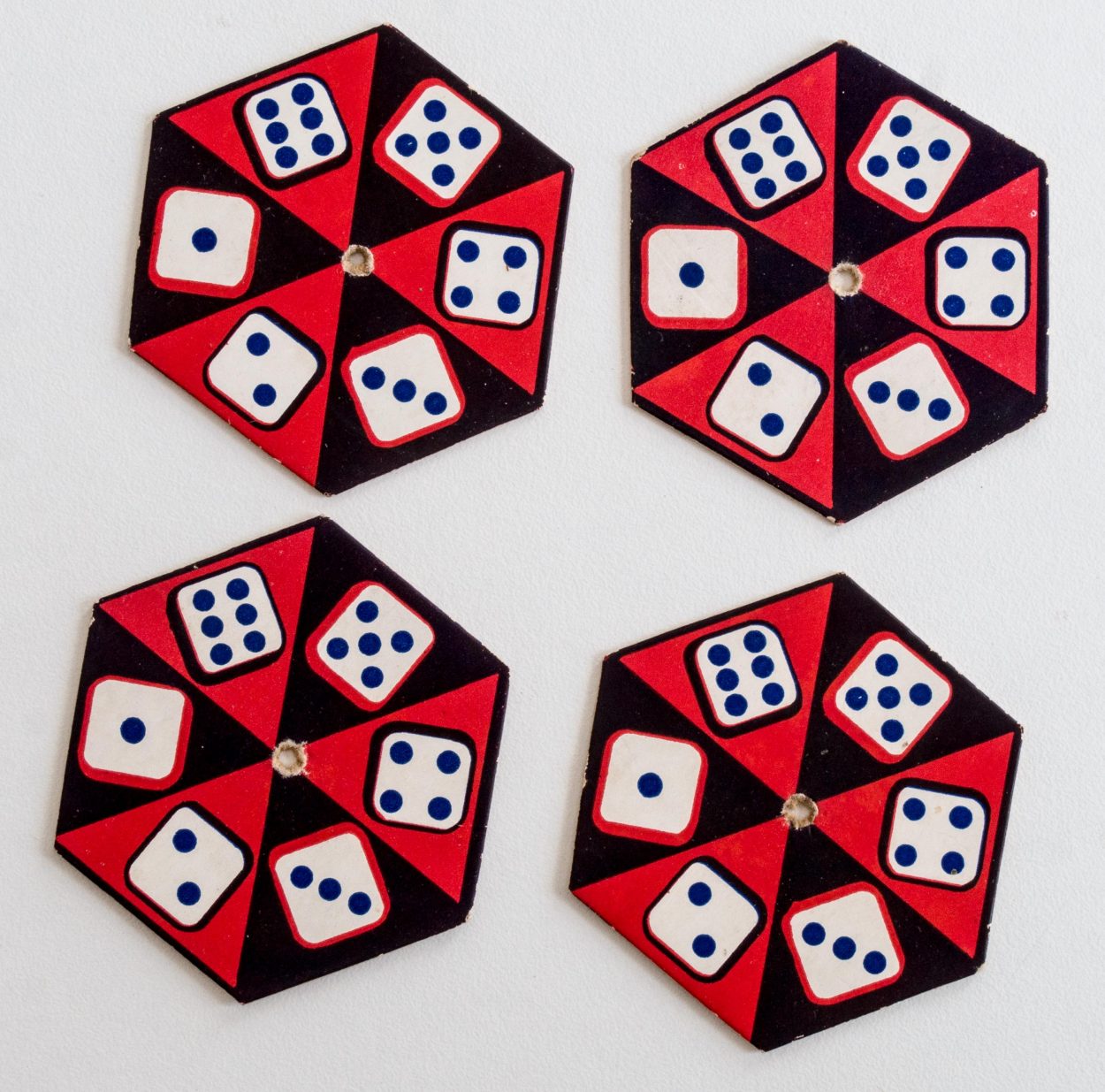
All these games were produced with an eye to economy; they are in the smallest format practicable, and the boxes have only simple text, no multi-coloured illustrations. It seems that for a time at least it was even impossible to obtain the necessary materials for making dice. One ingenious replacement consisted of a set of cardboard hexagons marked with the numerals 1 to 6, the user being required to insert a sharpened matchstick into the centre and use it like a spinning top.

This simple Picture Framing Outfit produced by Dennison’s is for a slightly older child – the owner used up a lot of the materials provided! Perhaps it was around the same time that they decided to improve their kaleidoscope; they dismantled it and added a few little screws of coloured foil to the contents, before reassembling it with sellotape.
At some period they acquired a version of the trading game, long popular as exciting and noisy entertainment for a family; our example may date from after 1945, as there is less evidence of wartime shortages in its production.
The latest items in this group of playthings date from the post-war years, perhaps presents given to a teenager. There are a few more dexterity puzzles; very different from the pre-war ‘Silver Bullet’ game with its wooden casing, these newer ones are made of plastic, much smaller, and probably much cheaper.
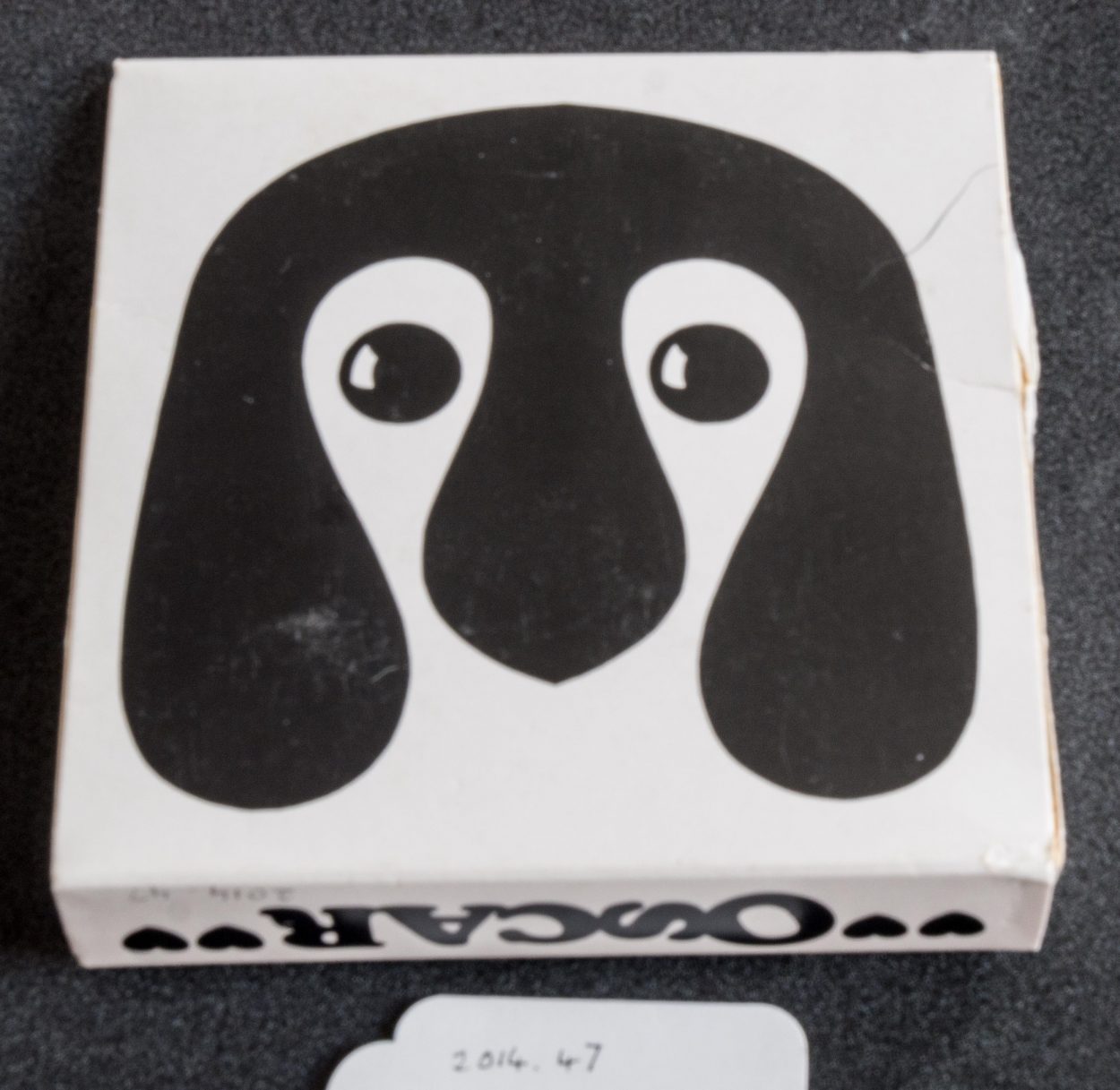
Also within the collection is an ingenious black-and white mobile displays a dogs face with drooping spaniel ears and round black eyes. This is one of the long-lasting series of Flensted mobiles; the first one was made by Christian Flensted to celebrate the christening of his daughter in 1953, and some of the subsequent Flensted designs were still on sale in the 21st century. Sadly, our example remained unused in its original box.
2014_58_2-1250×1235
4 examples of hexagon dice, a cheaper alternative to normal dice
2014_44
Wooden construction toy from the 1930s.
2014_47-1250×1217
An unused black and white mobile
2014_55
‘Silver bullet’ golf game.
Share this article
Follow us
A quick overview of the topics covered in this article.