
These were William Morris’s aims in setting up his own press. The Kelmscott Press ran from 1890 until 1898, two years after Morris’s death in 1896.
William Morris had been experimenting with producing books for years. In his own time he was perhaps best known as a writer and poet, and no matter what other creative enthusiasm overtook him he always returned to his writing. It is not surprising that he wanted his own works to look good. His first experiment was with Edward Burne-Jones in the 1860s for an illustrated edition of his Earthly Paradise, but Morris was not satisfied. The slides he saw at Emery Walker’s talk at the Arts & Crafts Exhibition Society on letterpress printing in 1888 inspired him to start his own press, and he founded the Kelmscott Press in 1890.
Morris was determined that his books would be finely crafted and made of the best materials. Walker, with his trade connections, was able to give plenty of practical help. He photographed and enlarged typefaces for Morris to study, and he also assisted with photographing the illustrations. Handmade paper was sourced from Joseph Batchelor in Kent, and after an intensive search, truly black additive-free black ink was found in Hanover, made by the Gebrüder Jänecke. The first book produced by the press was The Story of the Glittering Plain, one of Morris’s own works.
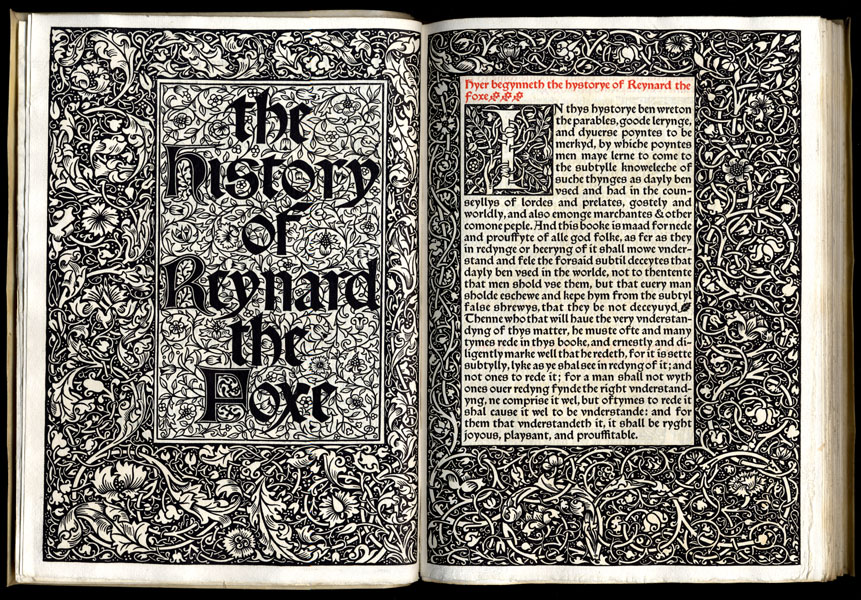
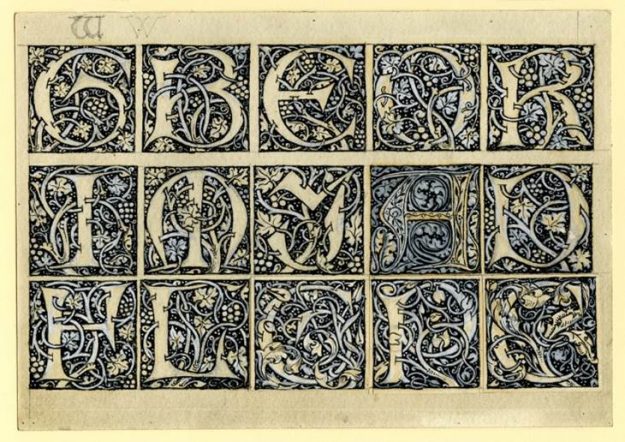
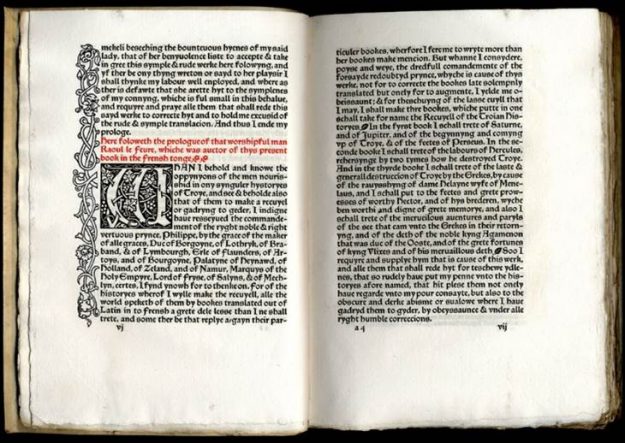
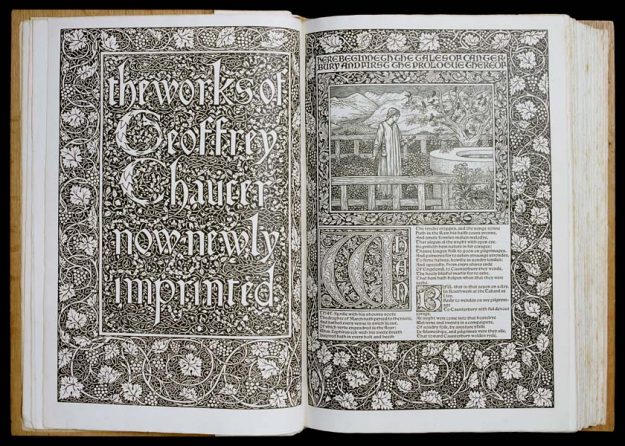
The press was an instant success. The Story of the Glittering Plain came out in May, and the edition of 200 was sold out by July. Over the course of the next seven years the Kelmscott Press produced fifty-two works in sixty-six volumes. Morris created three typefaces: Golden, based on Nicholas Jenson’s 15th century Roman type, Troy, a gothic type, and Chaucer, which was a smaller version of Troy and used for the greatest book produced by the press, The Works of Geoffrey Chaucer, 1896. Morris designed all the decorations and capitals himself, and illustrations were mostly carried out by Edward Burne-Jones, but also by Arthur Gaskin, Walter Crane and Charles March Gere.
Morris asked Walker and Sidney Cockerell, his secretary, to take over the press after his death, but the two men felt that it was too driven by Morris’s personality and so the press was closed a few months later. The Kelmscott Press was the inspiration behind most of the private presses that began in the late 1890s and early 20th century.
Why not discover some of the Kelmscott Press books in the Emery Walker Library in our Virtual Library?
Picture2-625×442
A set of initials designed by William Morris for the press, in black ink with corrections overlaid in white ink

Picture3-625×901
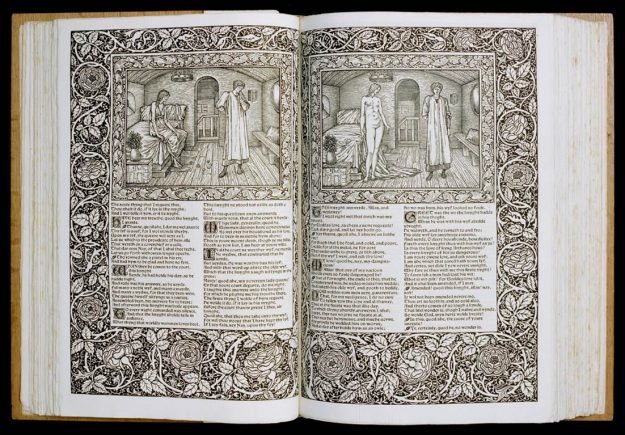
Edward Burne-Jones provided most of the illustrations for the press. The first book with his illustrations was a collection of stories about the saints, The Golden Legend, 1892.

Picture4-625×869
A photographic model of letters designed by William Morris's for his Gothic or blackletter 'Troy' typeface.
Picture5-625×443
Page from The History of Godefrey of Boloyne, 1893, using the Troy type.

Picture6-625×888
Sadly, Morris died only months after the Chaucer came out. Walker and Cockerell printed several more books already in press, but some big projects never happened, such as the Chronicles of Froissart.
1991_1016_942_001.jpg
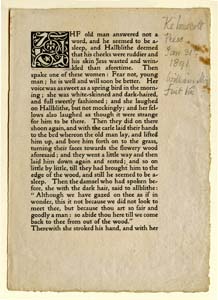
The first trial page pulled at the Press in 1891, for the Glittering Plain by William Morris. It says, in pencil, 'Kelmscott Press Jan 31 1891 William Morris fuit hic' - William Morris was here! He gave the first sheets to Walker in thanks for all Walker's help.
1991_1016_996_G1_009.jpg-625×446
The masterpiece of the press is The Works of Geoffrey Chaucer, 1896.
1991_1016_996_G1-625×435
Edward Burne-Jones provided 87 illustrations for the book.

1991_1016_996_X54_008.jpg-625×449
Morris sometimes used other illustrations. This is by Arthur Gaskin, from The Shepheardes Calendar, 1896. He provided 12 illustrations, one for each month.
1993_325
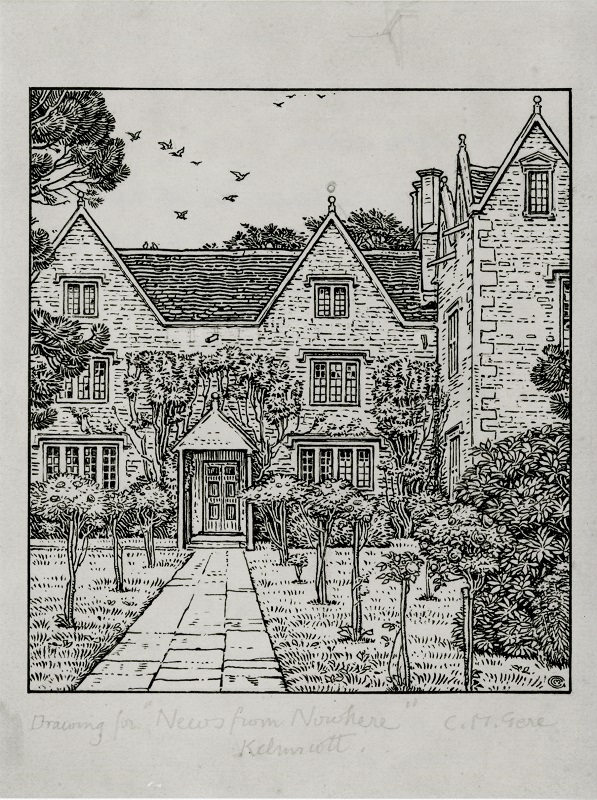
Charle March Gere, another young Birmingham-based artist, provided the frontispiece for Morris's utopian novel, News from Nowhere. This is the original sketch, based on Morris's Oxfordshire retreat, Kelmscott Manor.
Picture1-625×460
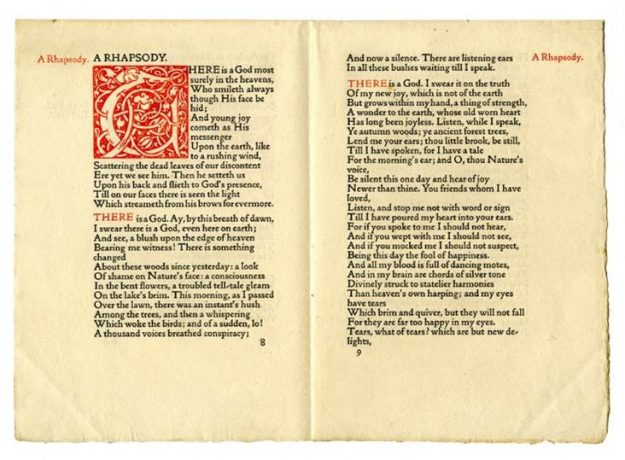
Proof pages of The Love Lyrics and Songs of Proteus by Wilfred Scawen Blunt, 1892. Morris experimented with red initials in this, the third volume published by the Press.
Share this article
Follow us
A quick overview of the topics covered in this article.