
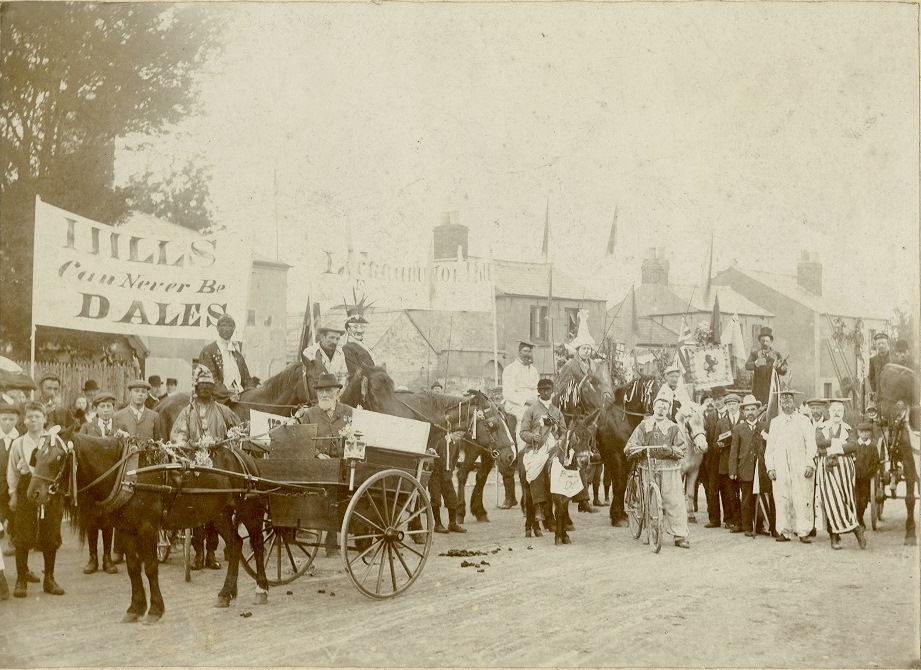
Leckhampton Hill has for centuries been used as a place of recreation and enjoyment for the people of Cheltenham. Over a hundred years ago there were allotments on the northern slopes of the hill and paths crossed in every direction. These paths were frequently used by shoppers, farmers and children going to and from school in Leckhampton. On Good Friday people flocked to the hill to attend the fair, which included coconut shies, skittles and stalls. This all changed in 1894 when the Trye family, who had for generations allowed the land to be used by the public, sold their Leckhampton estate and the quarries. The land was bought by the Cheltenham music dealer, Henry J Dale, who caused outrage when he refused to grant public access to the land. This led to a decade long feud between Dale and local people.
The feud
Soon after acquiring the hill Dale wrote to the Rural District Council refusing to admit any rights of way. He also demanded that the owners of the houses backing on to the hill provide proof of right of access for their back garden entrances. This caused great annoyance to the gentry who owned these properties, including the local historian Robert Cary Barnard and George Backhouse Witts who was a magistrate, archaeologist and chairman of the Rural District Council.
In 1897 Dale built Tramway Cottage for the quarry foreman William Cratchley on an open space at the foot of Middle Incline. The spot was an old gravel pit that had long been a recreational site during holidays. As well as destroying this site the cottage also physically prevented people from using the main footpath to the hill. Dale fenced off the northern slopes of the hill down to Daisybank Road and with the Rural District Council still reluctant to act Dale began in late 1901 to obstruct other footpaths.
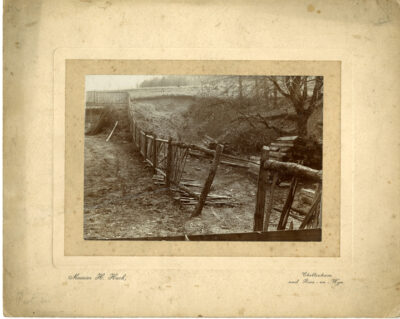
1979_2645
Some of the contested and broken fencing blocking access to Leckhampton Hill.
Intervention
Dorothea Beale, the Principal of Cheltenham Ladies’ College, took a more active approach. It had been customary for the students of the college to visit the hill, but on finding this amenity cut off she instructed Dale to kindly remove the pianos hired from his firm. Miss Beale also complained to the Town Clerk in March 1902, prompting various subcommittees to make enquiries. However, the delays were exasperating to the public and on 8th March 1902 a large crowd assembled and partially destroyed the fences. On the following Good Friday and on 7th July the task was completed when a similar gathering tore down the fences around Tramway Cottage.
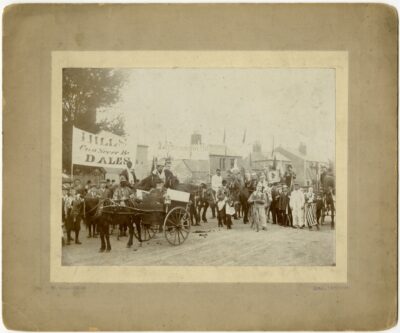
1979.2622
The procession assembling to go to Leckhampton Hill.
Leckhampton Stalwarts
Afterwards four ringleaders, Walter Ballinger, Charlie Burford, Leonard Luce and John Price, found themselves in court charged with obstructing the police. These men along with others became known as the ‘Leckhampton Stalwarts’ and their actions aroused a great deal of support among the local people. All were acquitted on 15th July and that evening an improvised band began playing in Clarence Street. A crowd quickly gathered and headed towards Leckhampton Hill; by the time they reached the foot of the hill it is estimated that approximately two thousand people had joined the procession. The crowd stopped at the Malvern Inn where the people were roused to greater excitement before they proceeded up the hill until they reached Tramway Cottage. This time the occupants were ejected from the cottage and fled to Dale’s home. The crowd pulled out the furniture which was set alight along with the house which was pulled to the ground.
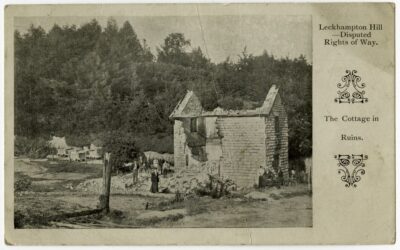
1979_2608
Tramway cottage in ruins after the riots.
Reactions and Recriminations
Dale later rebuilt the cottage precisely in its old position but once again an angry crowd assembled on Good Friday 1906. One of the ringleaders, Walter Ballinger, incited the crowd to pull down the cottage. George Backhouse Witts was brought by the police to read the Riot Act and the crowd dispersed. Arrests were made and sentences were handed down to Ballinger, Charles Barrett, William Heaven, Leonard Luce, William Sparrow, Henry Wallace, James Williams and Ernest Young.
The public regained access to the hill again in 1929 when Cheltenham Town Council purchased the land. The Mayor officially opened the hill before a large assembly and the event was described by the Echo Newspaper as ‘one of the great days in the history of Cheltenham’.
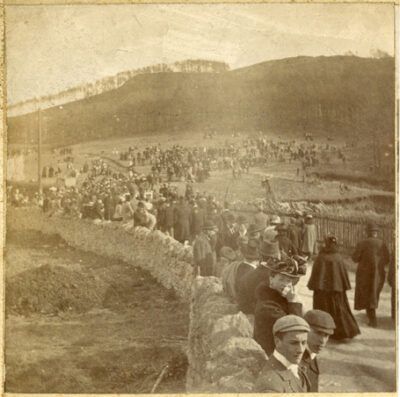
1979_2632_001
Protesters walking towards Leckhampton Hill.
Share this article
Follow us
A quick overview of the topics covered in this article.