
The collection also includes a small number of humorous cards, incorporating the name ‘Cheltenham’, and a large group of birthday, Christmas, Easter and Valentine’s Day postcards; amongst these are views of Cheltenham overprinted with seasonal greetings, and a number of silk embroidered cards produced in France for sale to Allied soldiers during the First World War. There are a large number of patriotic, sentimental and humorous First World War cards, including an extensive series of cartoons showing life in the trenches, views of towns and villages in northern France, some showing war damage, and two series showing episodes from the battle of the Somme.
Cheltenham Street Scenes
The Cheltenham postcards include views of the town’s major streets, by far the largest groups being of the High Street and Promenade. Many of the High Street views show the town’s trams, which operated between 1901 and 1930; these also feature in cards of London Road and Gloucester Road, and in views of several of the adjoining villages, where the trams terminated. Other major streets shown in postcards are Bath Road, Lansdown Road, Montpellier Walk, St George’s Road and Winchcombe Street. A small number of cards show parts of the new St Mark’s Estate, which was established by the Borough Council from 1919 onwards.
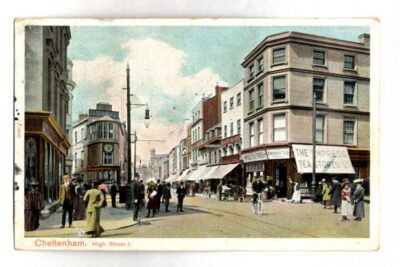
2009.5.1
Postcard of the High Street, Cheltenham, 1907.
Cheltenham parks, gardens and houses
Many cards show the town’s parks and gardens; the cards of Pittville Park include scenes from the Gloucestershire Historical Pageant, held there in 1908. Public buildings are represented by views of the Montpellier Rotunda, the Pittville Pump Room, the Winter Garden, the Town Hall, and several of the town’s churches, whilst private buildings include a number of hotels, particularly the Queen’s, and several of the town’s large Regency and Victorian houses, notably the now-demolished Priory in London Road
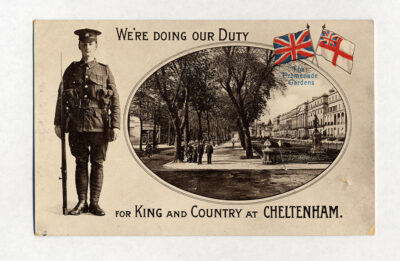
1985.765
A First World War postcard depicting a view of the Promenade Gardens, Cheltenham – framed in an oval next to a photograph of a soldier.
Publishers and messages
Although most of the cards were published by large national firms (including, before 1914, a number that were printed in Germany), several were produced locally, by, amongst others, Edward J. Burrow. Between 1894, when the country’s first picture postcards were published, and 1902, when the ‘divided back’ was introduced, any message had to be on the same side as the view (leaving the whole of the back for the address and the collection includes some examples of these very early cards.
Although the backs of many of the cards are blank, others have messages, sent from Cheltenham by residents or visitors; the stamp and postmark often helps in dating them.
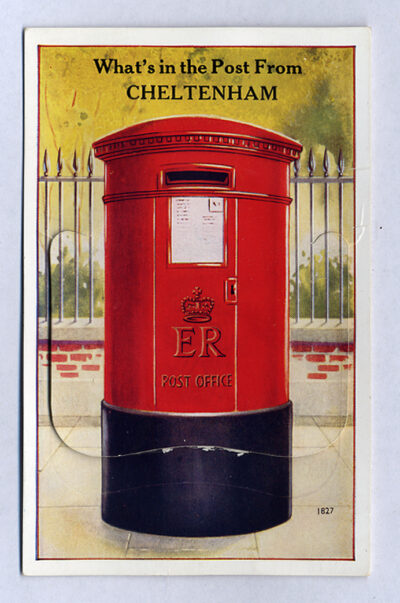
1993.16
Colour pull-out postcard. A flap in the middle of the card lifts up to reveal a strip of twelve black and white views of Cheltenham
Cheltenham schools and colleges
There are cards showing the town’s schools and colleges, particularly those in which pupils boarded, no doubt because they wished to send cards home to their family and friends. As well as the school buildings, these include photographs of staff and school plays, particularly at St Mary’s College in The Park.
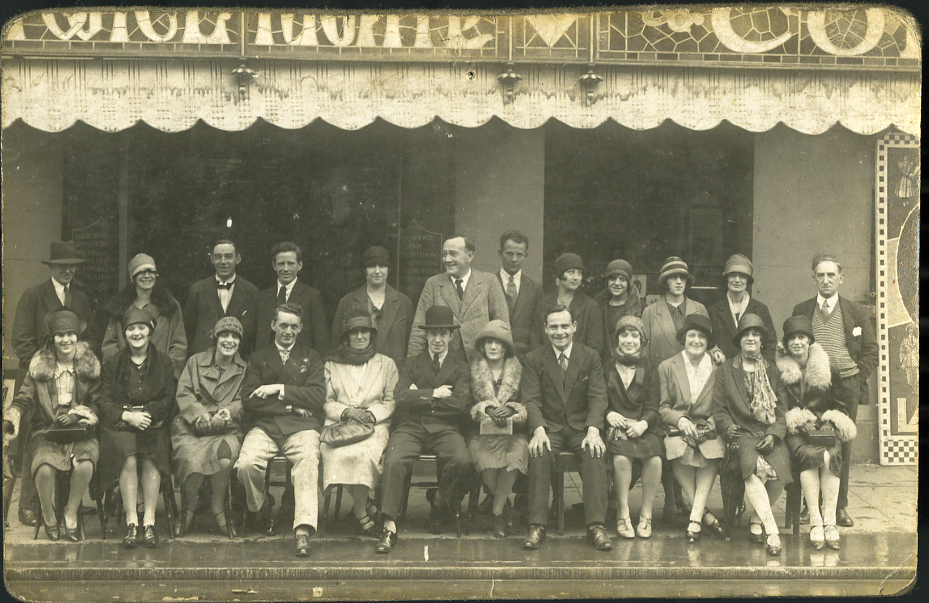
Other ‘groups’ of cards show several buildings that were converted for use as Red Cross hospitals during the First World War (including groups of soldiers), a set of aerial views of the town, taken in around 1920, and a collection of cards showing the casts of several plays that were performed at the Coliseum theatre in Albion street during 1927 to 8.
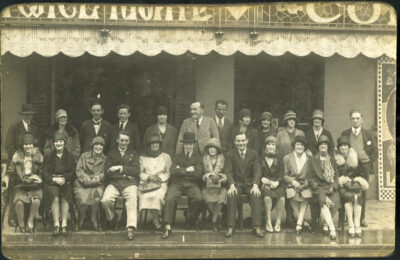
1991-1025
The cast of ‘Hear and There’, outside the Coliseum Theatre, Albion Street, Cheltenham about 1928.
Share this article
Follow us
A quick overview of the topics covered in this article.