
The Wilson holds a small collection of quilts and covers from the early 19th to the late 20th centuries. It is interesting for the range of techniques used and because we know some details of their makers. This information sheet discusses a sample of The Wilson’s quilts and covers. Quilting is the sewing of two or more layers together, with stitching. Patchwork is the sewing of pieces of fabric together to make a design.
The Jane Pizar cover
This is a coverlet made between the beginning and the middle of the 19th century in Ireland by a lady called Jane Pizar. Its intricate design of circles within the patchwork squares recalls quilts of the late 18th and 19th centuries, but it also includes fabric made with synthetic dyes, dating it to after 1850. It may have been made over a long period of time, or to an old design. As with many museum collections, we don’t know their full history. The geometric shapes are very precise, and may have been made with paper patterns. It is often called a marriage cover because it has hearts, moons and birds – including one on a nest.
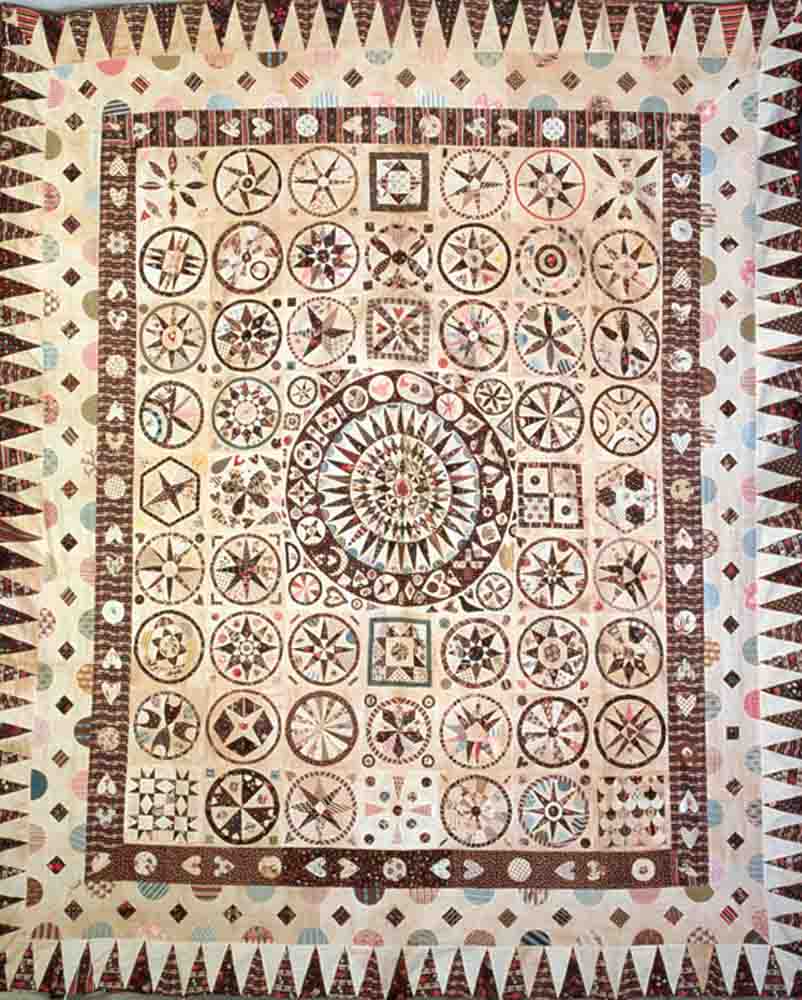
Patchwork bedcover, Ireland, 1850-60 (textile)
Cover made by Jane Pizar, Ireland PLEASE NOTE: Bridgeman Images works with the owner of this image to clear permission. If you wish to reproduce this image, please inform us so we can clear permission for you.
The Wood-Wright quilt
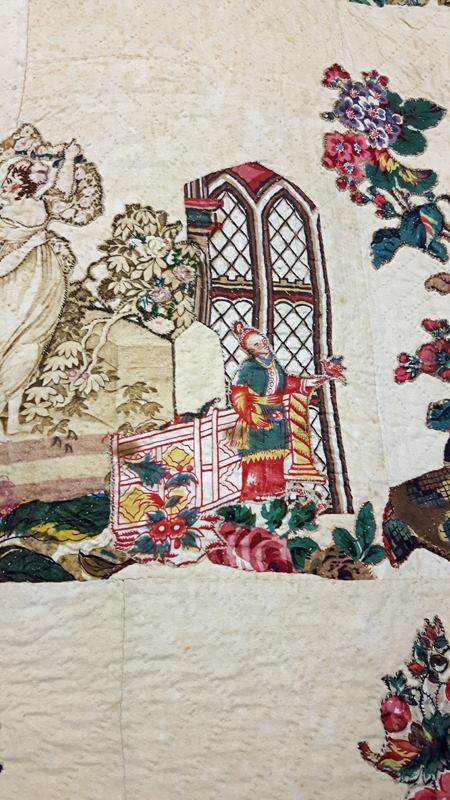
Cover made by Mrs Wood-Wright (detail of centre section).This quilt is also Irish, and is an applique quilt, made from cutting out figures, flowers etc. from printed fabrics and making a collage. It has also been quilted. It was made by Elizabeth Isabella Wood-Wright (c. 1786-1870), and according to the donor, her daughters and maids, in Golagh, Co. Monaghan in the early 1850s. It was a fashionable technique when Mrs Wood-Wright was a girl. It includes the Wood-Wright arms and motto, ‘Veritas Vincit’, Truth Conquers. One of the patterns on the fabric used is of the Thames Tunnel built by Brunel in 1843, and called the ‘Eighth Wonder of the World’.
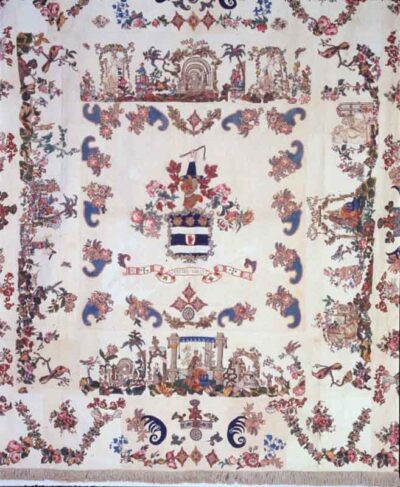
Wood-Wright-Quilt
Cover made by Mrs Wood-Wright (detail of centre section).
The crazy quilt
This style of patchwork, known as ‘crazy’, came into fashion from the late 1860s, probably inspired by fashionable Japanese designs. In 1882 Harper’s Bazaar says of the style, ‘Now we are very daring; we go boldly on without any apparent design at all and produce in the end a result which will in some cases challenge comparison with any richly stained glass.’ Rather than the earlier printed cottons, these quilts were made with silk and velvet pieces often in the bold synthetic colours of the day. This quilt has a bookmark for a masonic conclave in San Francisco in 1883. It is further embellished with elaborate embroidery. One corner has ‘Mother 63 Years 1887’ painted in an Aesthetic Movement Japanese style script.
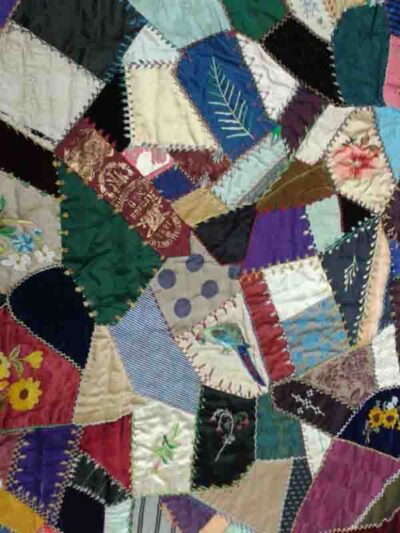
Crazy-quilt
The crazy quilt, 1887.
The log cabin cover
The central section of this cover was probably made for a table or a sofa, and is in the log cabin pattern. It is thought to have been made by a lady’s maid from dress cuttings, which probably originally belonged to the maid’s mistress. All kinds of fabric were used for covers like this, and this one is probably a mix of recycled fabrics and bought silk and velvet ribbons. It was given another lease of life as a bedcover when a purple border was added, probably in the 1920s.
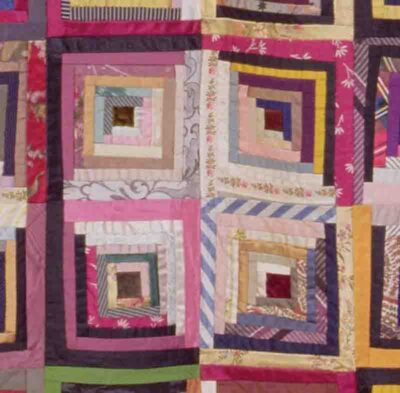
Log-Cabin-cover
The log cabin cover, 1875-1900.
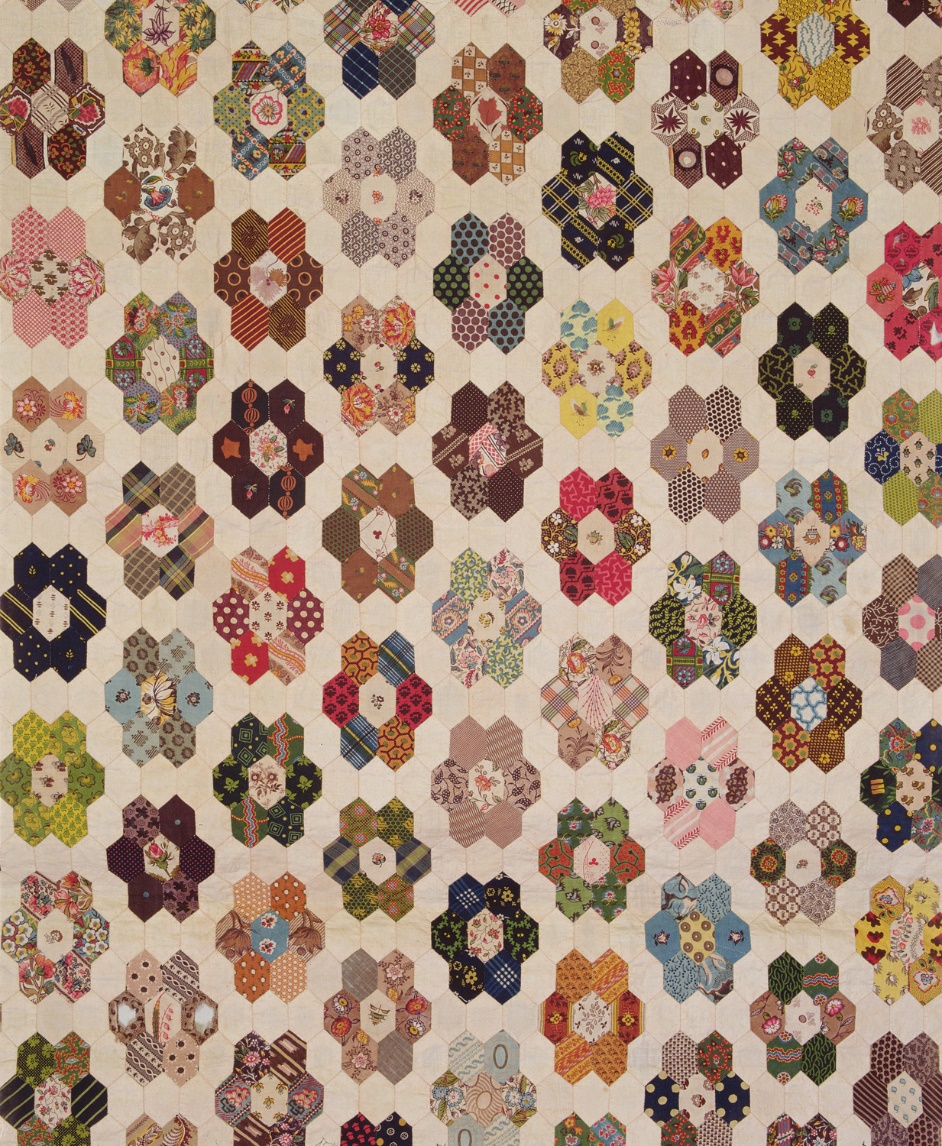
Patchwork bedcover
The back of this Grandmother’s Flower Garden pattern bedcover, made of printed cottons, bears a handwritten note: ‘This quilt was made by my great, great Grandmother, Mary Butler b. 1753 d. 1822. On the death of her daughter … she went to keep house for her son-in-law, Wm Wickham, and he used to cut out the paper hexagons on which the quilt is built, during the long winter evenings when there were few books or papers.’
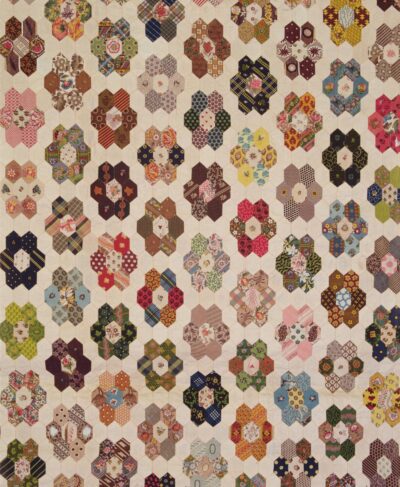
Patchwork-banner
Patchwork bedcover, 1800-1822.
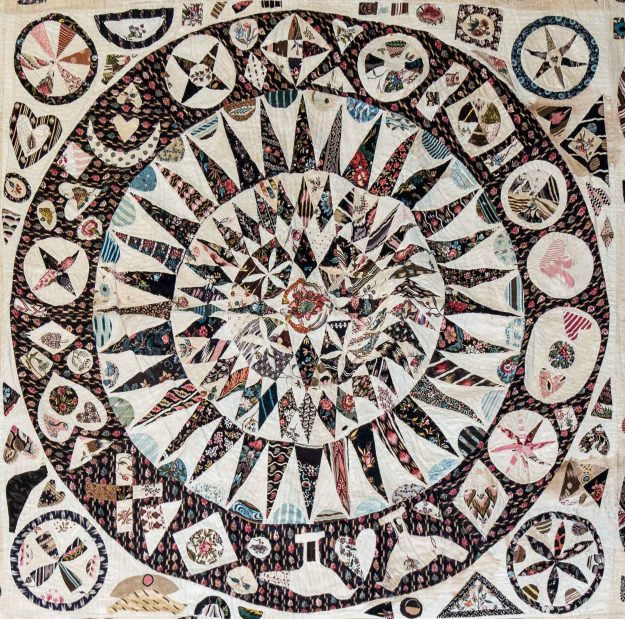
1940_339_Centre-001-625×619
Details from the Jane Pizar quilt
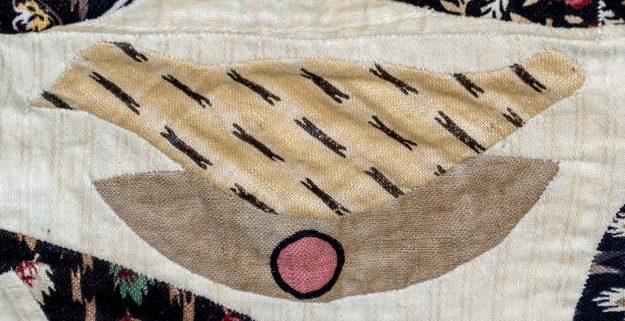
1940_339_Bird-001-625×321
Bird on nest from the Jane Pizar quilt
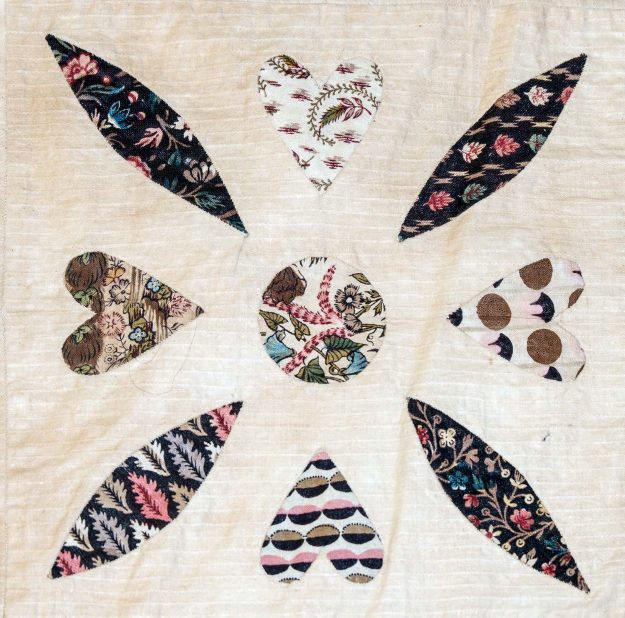
1940_339_Squares-001-625×618
Square from the Jane Pizar quilt
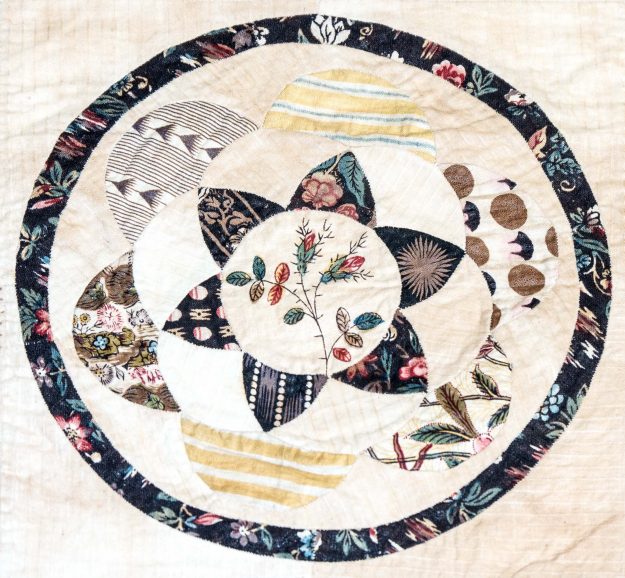
1940_339_Squares-052-625×578
Square from the Jane Pizar quilt

17190558_1496143140409603_7382373874410442432_n-625×352
Details from the Wood-Wright quilt - the Thames tunnel chintz

17264801_1496142923742958_8933191508738155779_n
Detail from the Wood-Wright quilt - the maker has embroidered the figure's cheeks to make her blush.
17308976_1496142830409634_110247308988968783_n
Detail from the Wood-Wright quilt - note the Chinoiserie figure.

17264595_1495375397153044_6730285723605909747_n-625×469
Detail from the crazy quilt.

17309364_1495376237152960_7480991735295206706_n-625×654
Detail from the crazy quilt - the Masonic bookmark.

17264811_1495375537153030_1429853727099989068_n-625×469
Detail from the crazy quilt - embroidered horseshoe.

17309275_1495375840486333_6147176168872056562_n-625×352
Detail of the crazy quilt - humorous scrap incorporated into design.
Share this article
Follow us
A quick overview of the topics covered in this article.