
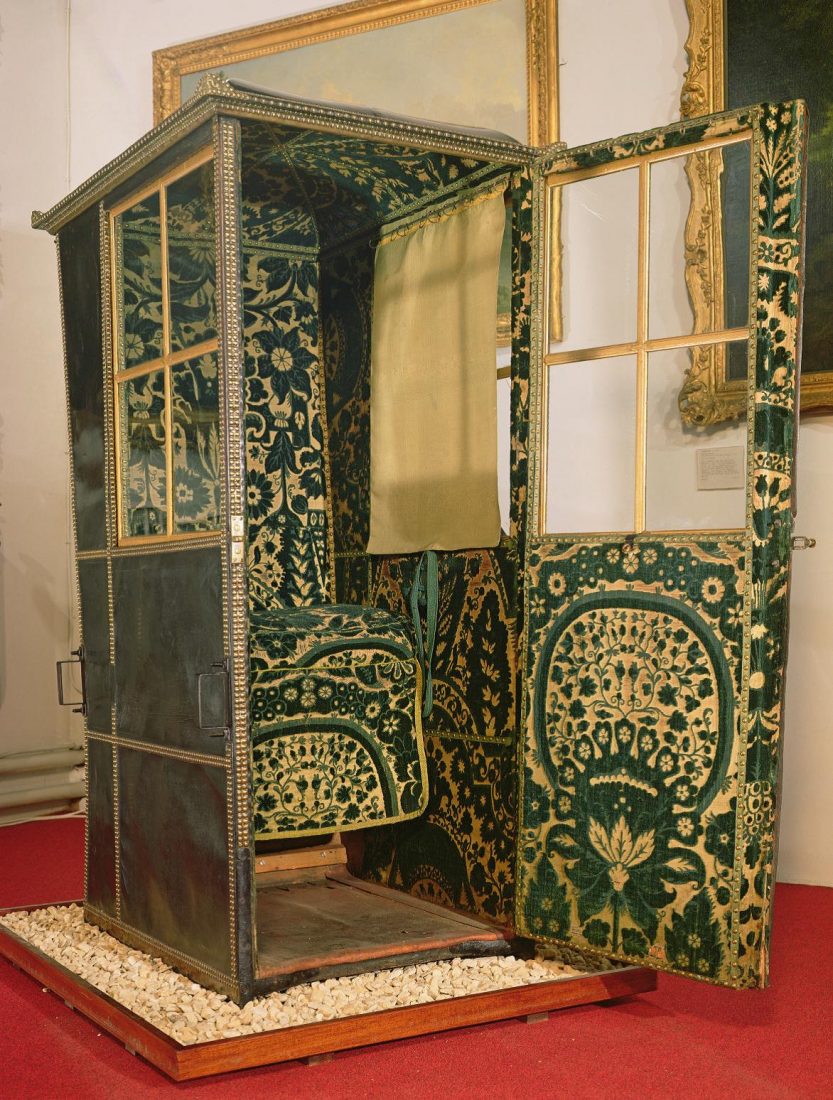
This particular chair was privately owned, as opposed to those available for public hire. It is made of black leather, with green damask cushions and curtains. The carrying poles are missing, but all the internal fittings are original, including the adjustable seat. It was probably made in London, or could have been copied from a London chair by a local coach maker.
The sedan chair was introduced into England in the 1630s, and by the 18th century was used throughout Europe. Most of those used in the United Kingdom were of British manufacture, the majority being made in London.
Sedan chairs were a very popular means of transport, providing shelter in all weathers, and safety from the many horse-drawn vehicles which clogged the streets. Chairs for public hire had to be licensed by the local authority and in Cheltenham, the Town Commissioners, appointed in 1786, were responsible for issuing the licences.
Locally, chairmen were obliged to wear a uniform consisting of a long blue coat, black breeches, white stockings, buckled shoes and a black hat. Their official scarlet badge was worn on the coat, and every owner of a chair had his individual name and number painted on it.
The fare for a ride depended on the distance travelled, starting at 6d (2 1/2 pence) for 250 yards, increasing after midnight to one shilling (5p). Journeys were usually limited to 2 miles. If a chairman was kept waiting for a long time, he might demand a higher fare. Should there be a dispute between a chairman and the hirer, it could be resolved by the local Magistrates. In bad weather, chairs could be carried into a building, and even upstairs, when the usual 10 foot poles were exchanged for two just 7 feet in length.
In Cheltenham, there were probably no more than ten chairs at first, but as the resident population increased, due to the popularity of the Spa town, so the number of sedans grew. In an 1830 letter from one William Barton, working in Cheltenham at that time, he writes of ‘chairs in great request.’
From July 1816 there were fixed stands, like taxi ranks, at Cambray Street, Winchcombe Street, New Street, and at Colonnade Road, which no longer exists. At one time, no chair might stand within 60 yards of another, presumably to avoid disputes. The work was seasonal as chairs were mostly used in bad weather, so many of the chairmen found alternative employment in the summer months.

1941_225_116-detail-625×570
Gimson sketched this carved stone in the Museum of Torcello, near Venice, in 1889. He reused the design for one of the roundels in the clergy seats.
1945_017-detail-625×709
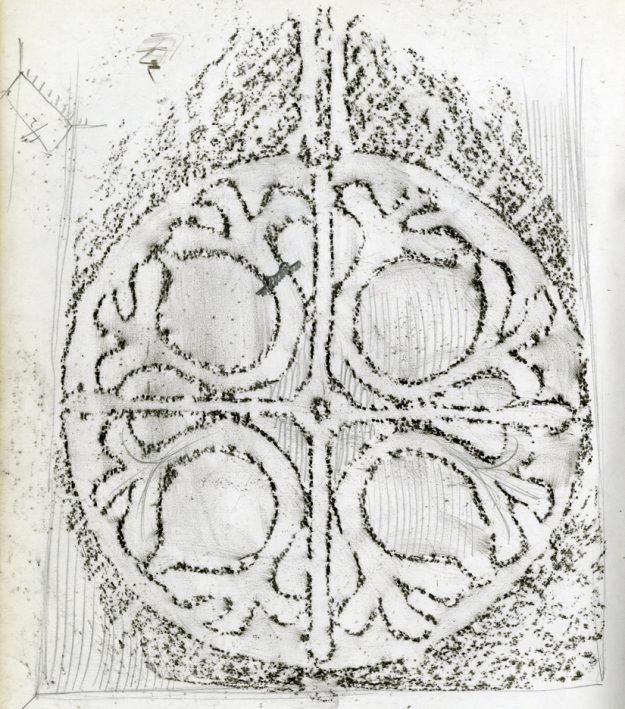
He also took inspiration from nearer home - this rubbing of metalwork from a door in Durham Cathedral, sketched in 1888 also appears to have inspired him.
1941_222_059-625×469
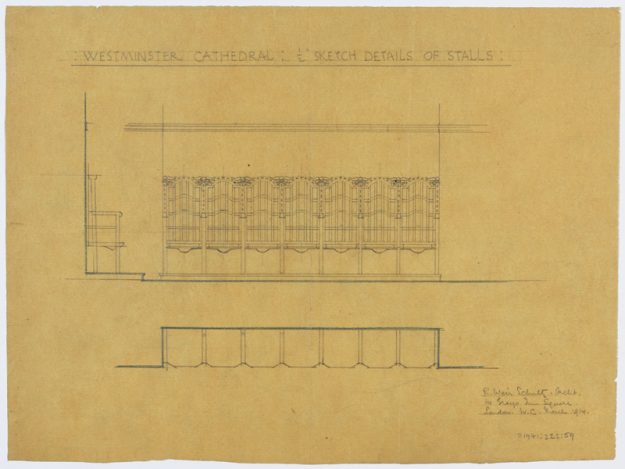
This design by Robert Weir Schultz was done in March 1914, and shows his initial ideas for the chairs.
1941_225_118_008-1-625×503
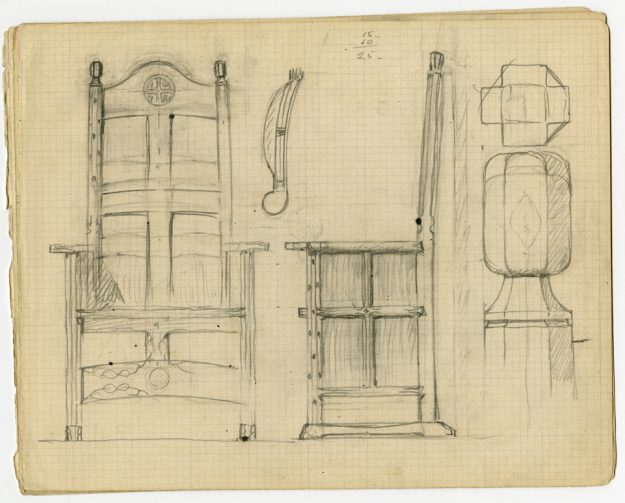
Gimson sketched this rough idea for a clergy chair in his working sketchbook - it may relate to his design process for the Westminster chairs.
1941_222_11-625×519
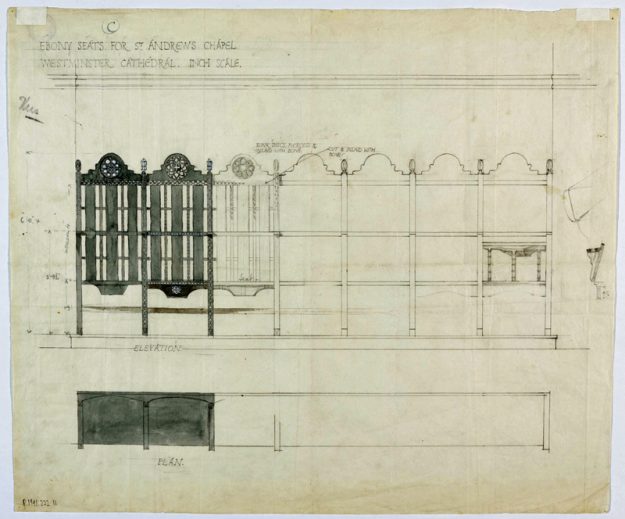
This is Gimson's worked up design for the clergy seats. You can see it is rather different to Schultz's initial design, but there are still similarities.
1941_222_11_001
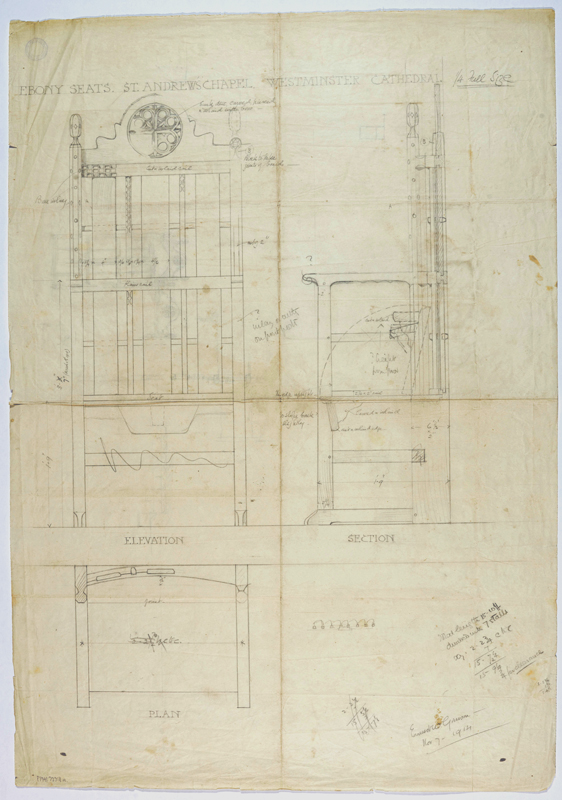
This measured drawing, a quarter of full size, shows all the details of the chair complete by 7 November 1914.
1970_47-625×1258
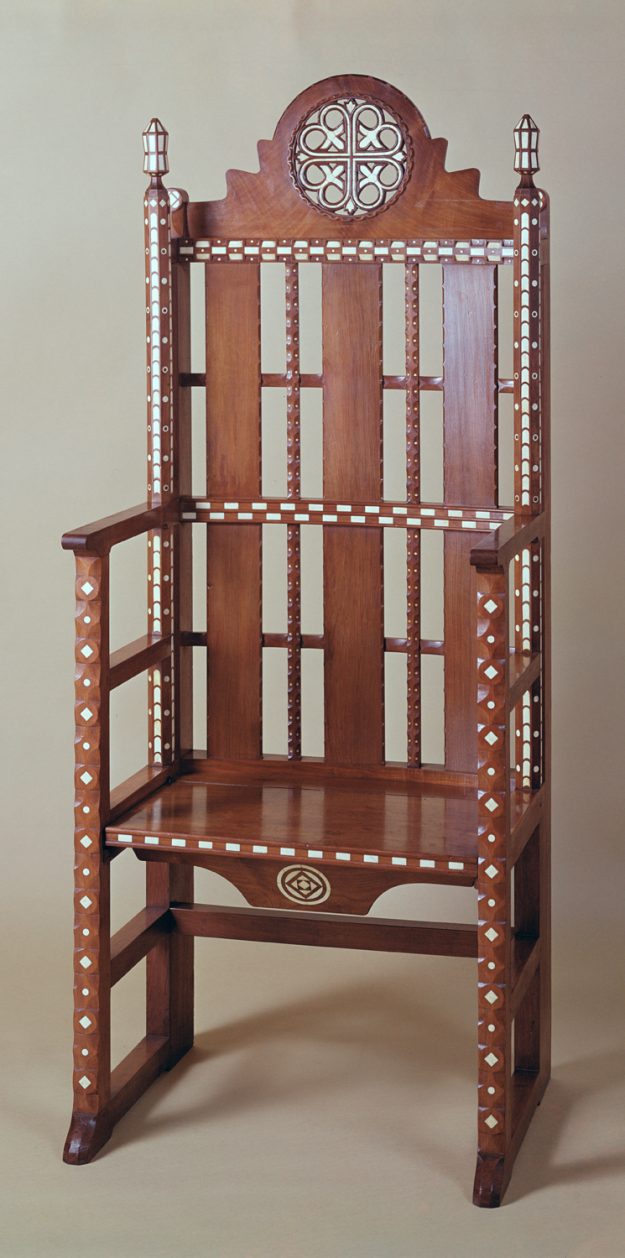
This is the prototype chair. Work started on this in November 1914, once the measured drawing was done.
1941_225_121-625×449
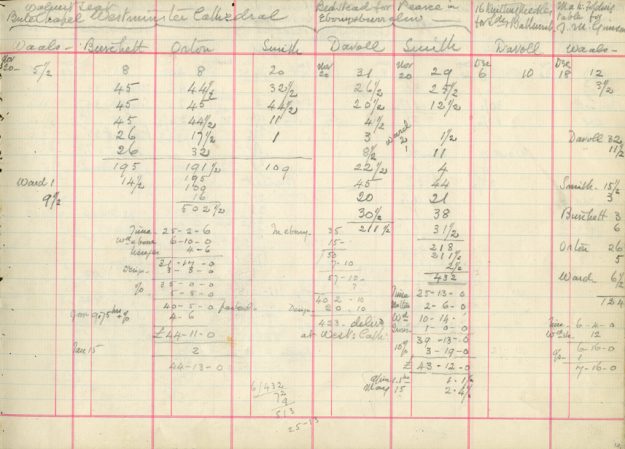
This is the page from the job book that shows the calculations per maker, of the time spent on the prototype chair. Gimson then worked out how much it would cost.
Clergy-Stalls-625×410
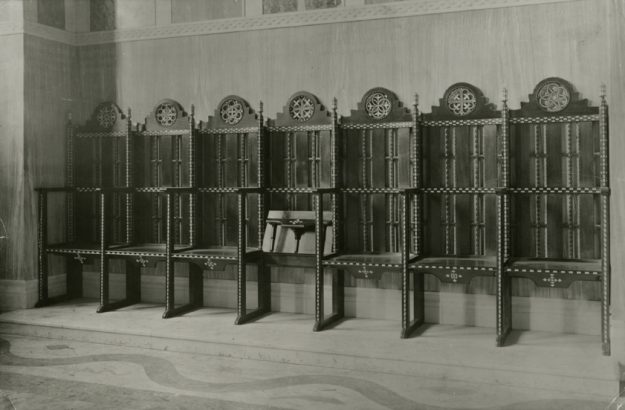
These are the chairs installed in St. Andrew's Chapel, Westminster Cathedral in 1915. They are still there today.
Share this article
Follow us
A quick overview of the topics covered in this article.