
Slade’s shop in the Promenade was a feature of Cheltenham’s smart shopping scene for well over a century, catering for middle class customers who could afford quality clothing, and expected high standards. It opened in 1846, a branch of the family firm of boot and shoe makers established in Worcester in 1799, and was still at the same premises when it finally closed in 1971. The address in the early days was Imperial House, 12 Promenade Villas; later, around 1930, the premises were renumbered as 78 Promenade.
For most of its long existence the Cheltenham business was managed by successive members of the family. The first manager appears to have been a W Slade, perhaps the same William D Slade recorded in 1876; the shop traded under that name until at least 1916. Towards the middle of the 20th century the shop was trading as H C Slade, becoming a limited company of the same name by the mid-1960s. Direct family involvement in the store came to an end in 1952, and the manager from that date until the closure was Mr W V Ingram
Footwear for a Queen
Boots and shoes were designed and made in the rooms above the shop, and Slade’s offered a custom-fitting service, with individual lasts (a wooden copy of a human foot) kept for each customer. They boasted that they could provide footwear “for dancing to deer-stalkingâ€. When Queen Adelaide, the consort of William IV, was staying at Witley Court in Worcestershire, Slade’s were proud to design for her “a new and improved clog, manufactured expressly for her Majestyâ€. A plaque recording this royal patronage used to be on display in the store, and is now held by the museum. Until 1960 Slade’s made boots for the Royal Canadian Mounted Police, and soft suede ‘chukka boots’ for the Indian Army. These light boots were also adapted for use by the British forces fighting in the North African campaign of 1940 – 1943, and after the war ‘desert boots’ were widely popular.
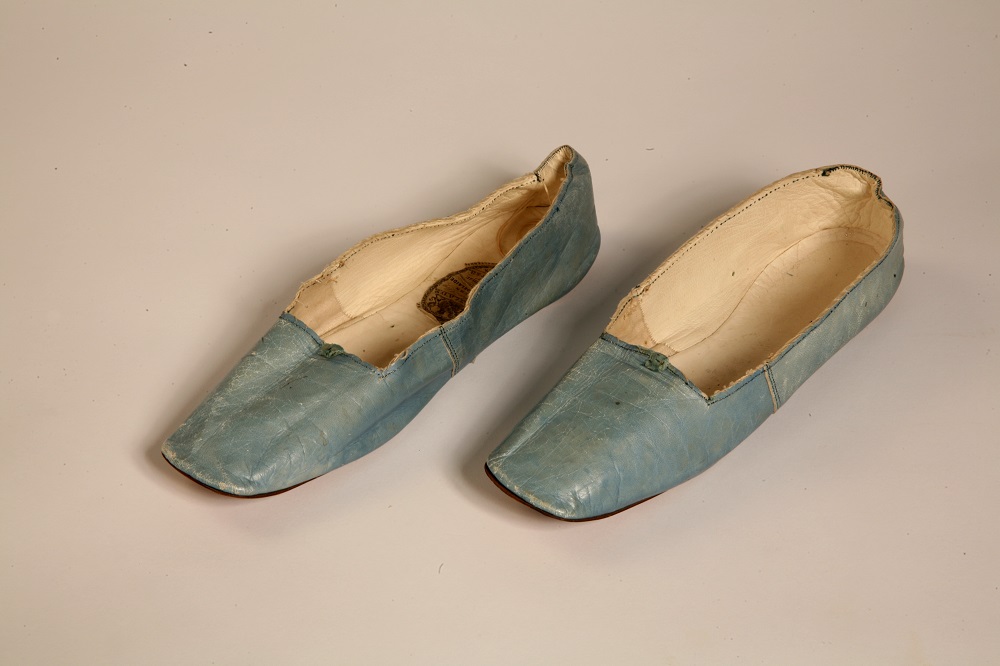
The museum has a ladies shoe made by Slade’s in the late 1840s, in the first years of trading in Cheltenham, and also a gentleman’s boot and a lady’s riding boot from a later period.
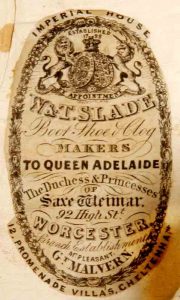
1936_178-interior-detail-180×300 (1)
An interior label from a Slade shoe, highlighting the company's royal patronage.
Expansion
In 1916 the firm expanded into hosiery and other menswear, taking over the adjacent premises at 11a Promenade Villas (76 Promenade) for this department. The main business however continued to be the manufacture and sale of bespoke boots and shoes; shoes which were still designed and made on the premises until 1966.
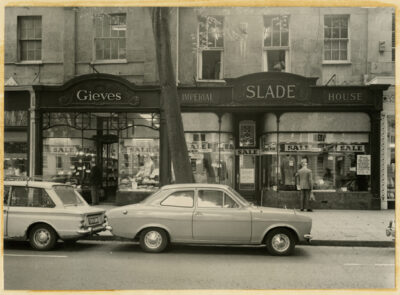
1991_307
The Slade shop photographed in the 1960's.
The menswear department
The museum holds a large number of business documents from the menswear department, dating for the most part from 1963 – 1964. Most are working documents used in day to day processing of stock and orders, insubstantial carbon copies containing only the briefest of information. Individually unimpressive, taken together they show the range of Slade’s stock, the wide selection of suppliers and the level of service offered.
Slade’s stocked everything for a gentleman’s wardrobe except for tailored suits; for these a customer would patronise his own tailor. At Slade’s he could find underwear and socks, shirts in variety, pullovers and cardigans, ready-made trousers and casual jackets, waistcoats, ties and cravats, hats, and even umbrellas. Bowler hats were still being worn by some, and Slade’s stocked the best, made at the factory of J Woodrow & Sons in Salford, hat-makers by appointment to Edward VII and his sons.
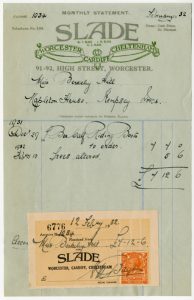
2004_106_1-194×300 (1)
An invoice/receipt for a pair of riding boots purchased in 1932.
As well as clothes for the town, the customer could equip himself for country pursuits with woollen shirts and tweeds, heavy sweaters and waterproof jackets. He could find club ties, and the right gear for riding, for golf or cricket. The more fashion-conscious were not forgotten. Cravats were fashionable in the 1960s and sold in large numbers, and there was a vogue for suede, in ties and waistcoats. The customer might choose a pink shirt, or a greystriped one with white collar and cuffs. New fabrics were making an appearance, with some shirts in nylon or terylene. At the same time the traditional market still provided shirts with no attached collar, and a front opening extending only part-way down; the more modern garments with full-length opening were sometimes described as coat – shirts.
Parcels of new stock arrived regularly; much came direct from the manufacturer, while luxury items such as silk ties, scarves and dressing-gowns came from shops in Mayfair. Some firms are still trading today: Vyella and Van Heusen still produce shirts, Aertex casual clothing, Sunspel underwear, Morlands’ sheepskin jackets; Harry Hall of Basingstoke still produces quality riding gear.
Customer service
The aim of the menswear department was to satisfy the customer’s need, and if the right item was not in stock it would be ordered immediately, even if that meant going to an unfamiliar supplier. The clientele expected maximum use from their purchases, shirts were returned for new collars or cuffs, gloves for re-lining. The customer was (nearly) always right, though one manufacturer refuted the suggestion that a pair of socks could have left their moth-proof premises with a moth-hole; nevertheless they sent a replacement. To suit a customer’s convenience, orders might be delivered to a home address; a single item of knitwear or a pair of socks could be packaged and sent to a customer in Upton St Leonards, Banbury or Buscot. A bishop had two shirts re-collared and forwarded to him at his holiday home on the Isle of Mull.
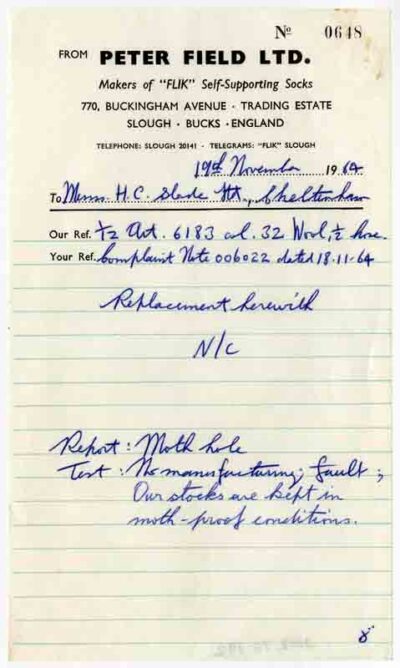
Invoice-for-replacement-items
An invoice for replacement items, dated to 1964.
Retrenchment and closure
By the 1950s Cheltenham society was changing; Slade’s traditional customer base was shrinking, and the new Cheltonians who came to work in the town’s light industry or the Civil Service were more likely to shop in the High Street than the Promenade. It seemed that Slade’s had outlived its time. In 1968 management of Slade’s outfitting department at no. 76 was transferred to Messrs Gieves, with the Slade name over no. 78 only.
Three years later, Slade’s ceased trading in Cheltenham altogether. After a final closing down sale, the doors closed for the last time on 23 January 1971. The manager then was Mr W V Ingram; other staff were Mr B N Davies, manager of the men’s department, who had spent 14 years with Slade’s, and Miss G Stoate, with 13 year’s service. The manager was quoted as saying that those who most regretted its absence would be the “local county peopleâ€. A year later Gieves too had moved out.
In 1973 number 76 Promenade was occupied by J Baker’s shoe shop, while number 78 was empty. The museum obtained several parts of the architectural decoration from no. 76, including the shop front and the main door, as well as a cash register, a shoe mirror, a display stand and other interior fittings.
In 2014 number 78 Promenade, opposite the War Memorial, is occupied by Goldsmiths jewellers. Some of the decorative detail of the fine shop front has gone, but its main structure remains unaltered. Slade’s shortly before its closure in 1971
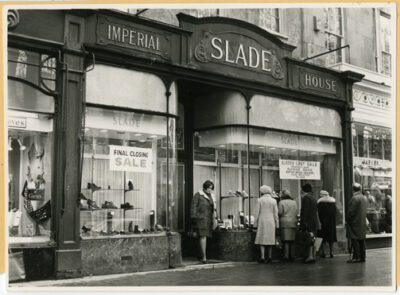
1991_310
A photograph of Slade shortly before it closed in 1971.
Share this article
Follow us
A quick overview of the topics covered in this article.