
The Wilson has a collection of around 300 topographical prints of Cheltenham, dating from the late 18th and 19th century. These were produced either to illustrate histories and guides to the town, or for sale to its residents and visitors. They were, in effect, an early version of the photographs and postcards that superseded them in popularity from the second half of the 19th century. The collection includes examples of every major print-making technique, from copper plate engravings, etchings and aquatints to woodcuts, lithographs and steel-plate engravings.
Early prints
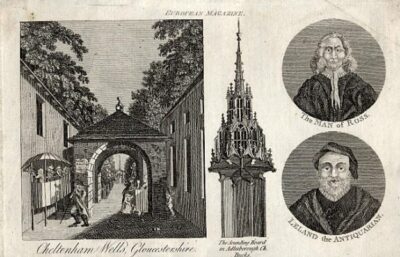
The earliest known prints of Cheltenham are two copper plate engravings of the Original Well and Well Walk, which were published in February 1786 to accompany the second edition of Simeon Moreau’s Guide to Cheltenham Spa. Also in 1786, The European Magazine published a view of the Well, while the earliest known print of St Mary’s, the town’s medieval parish church, dates from 1787 and was produced as an illustration for Richard Bigland’s Gloucestershire Collections.
1907-25-2-625×402
Print from ‘The European Magazine’, 1786.
The heyday of prints
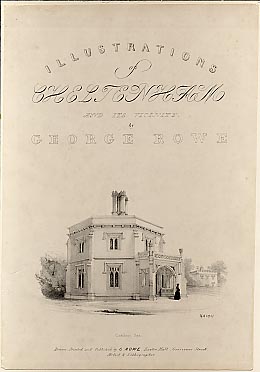
As the number of visitors to Cheltenham increased during the last decade of the 18th century, so too did the number of prints that were produced for sale to them, either singly, in pairs, or in sets. The largest of these, comprising 21 views, was George Rowe’s Illustrations of Cheltenham and its Vicinity, published in 1840. Other important sets were those by George Dinsdale (1811 and 1825), Thomas Hulley (1813), Daniel Egerton (1821), Henry Lamb (1824 and 1833), George Phillips Johnson (1836) and Dederick Eichbaum (c.1840-5).
Apart from Hulley’s Six Views of Cheltenham (1813), which were published at Ackermann’s Repository of Arts in London, the prints were generally commissioned and published by local librarians and print-sellers, who sold them in their shops. Histories and guides containing prints include Samuel Griffith’s New Historical Description of Cheltenham (1826, with a revised edition in 1838), Henry Davies’ Stranger’s Guide to Cheltenham (several editions between 1832 and 1843) and George Rowe’s Illustrated Cheltenham Guide (1845).
1999-20
Frontispiece print from Rowe’s ‘Illustrations’, 1840, showing Cambray Spa.
Subjects and themes
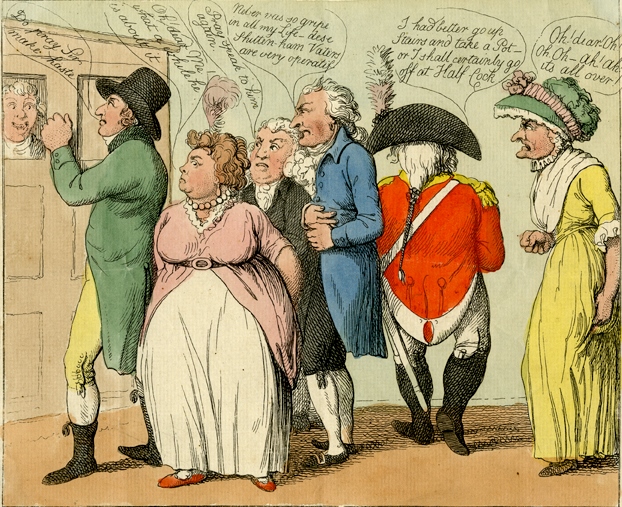
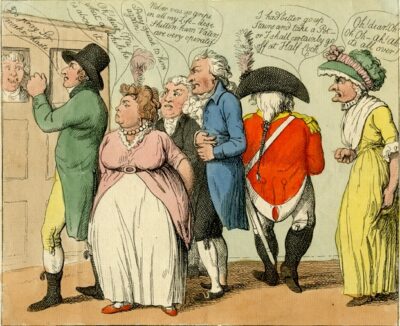
The prints provide important evidence for the appearance of the late 18th- and 19th-century town, and include many buildings that have since been altered or demolished. Amongst the largest groups are views of the town’s spa wells, street scenes (particularly of the High Street and Promenade), many of its villas and terraces, and its public buildings, including churches. Other prints show well-known local residents, and significant occasions in the life of the town, including the visit of King George III in 1788 and a series of events held between 1837 and 1860, such as balloon ascents, parachute jumps, political banquets and gala fetes. The collection also includes a small number of satirical cartoons lampooning aspects of the town’s social life, including the laxative effects of its spa waters!
The Wilson also has a collection of prints showing views of Gloucestershire, and of places beyond the County where the print-maker or publisher was Cheltenham-based, most notably by George Rowe.
1978_448-Banner
Hand coloured caricature print entitled ‘The Rapid Effects of the Cheltenham Waters’
Share this article
Follow us
A quick overview of the topics covered in this article.