
Women have been involved in archaeology from the science’s very early days. Think of Amelia Edwards (1831-1892), Gertrude Bell (1868-1926) and Agatha Mallowan (better known as Agatha Christie). All three achieved significant reputations during the latter half of the 19th and early 20th centuries, especially in the field of Near Eastern archaeological research. Archaeology continued to attract female activists around the country and, in Gloucestershire, the first half of the 20th century saw two eminent female archaeologists working at about the same time and making significant contributions to the archaeological record of the county. These were Helen O’Neil and Elsie Clifford.
Time has moved on and the techniques and science of archaeology today are much more advanced. Even so, a great debt is still owed to these two early women archaeologists of Gloucestershire. The Wilson is privileged to hold in its collection a sizeable body of finds and archival material relating to their excavations, material which is still a highly valued resource for archaeological research.

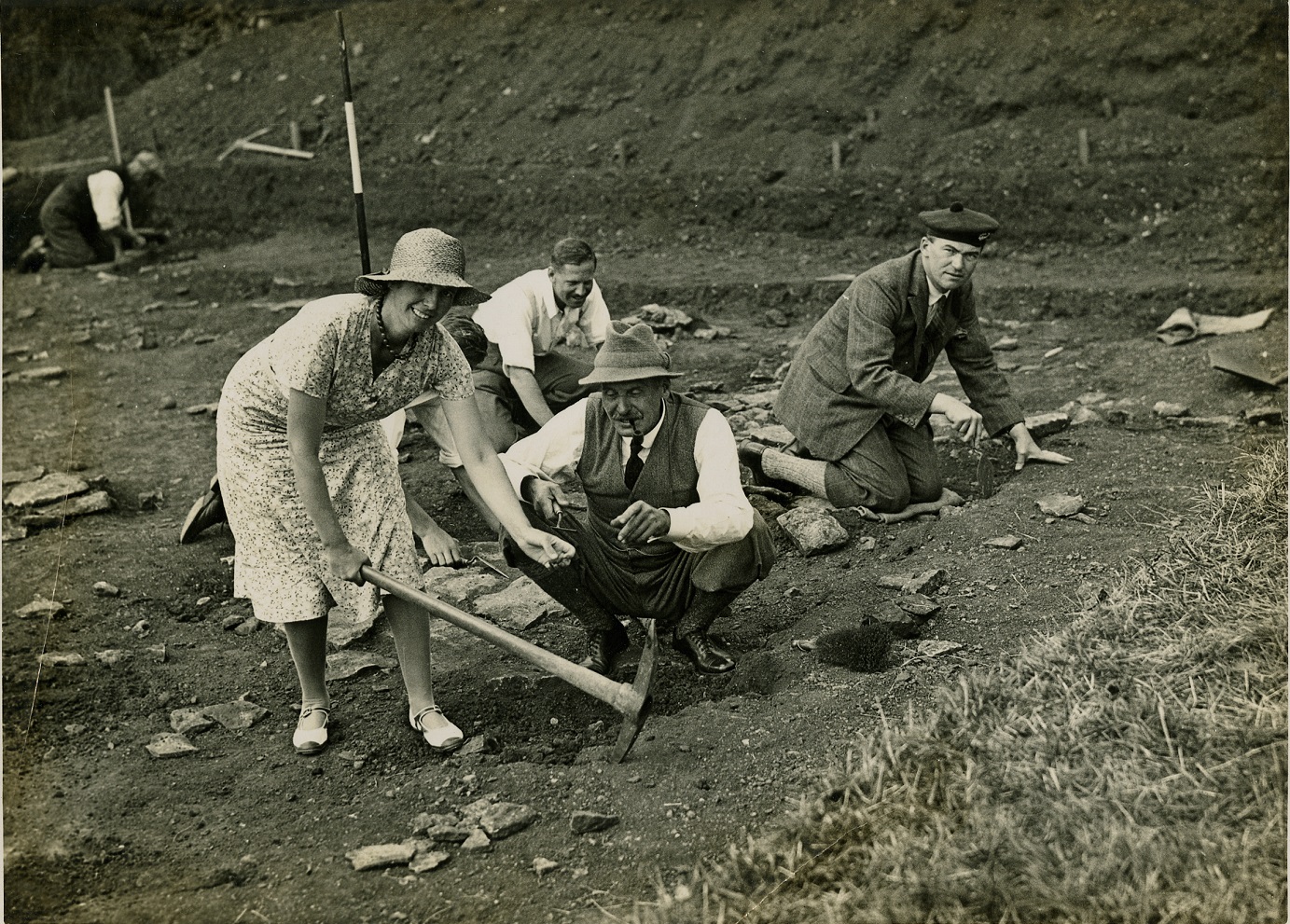
Dunning on-site at Salmonsbury
Born Helen Evangeline Donovan, the young Mrs O’Neil lived with her family at Camp House in Bourton-on-the-Water. The house straddled the west entrance of the great Salmonsbury Iron Age camp and this undoubtedly influenced her aspiring interest in archaeology. In 1931, she became actively engaged in excavation work at Salmonsbury and her attachment to this important archaeological site remained with her throughout her life. She became a member of the Royal Archaeological Institute in 1932 and a year later a member of the Bristol and Gloucestershire Archaeological Society. Such was her reputation locally that in 1938 she was invited to become Honorary Curator of the new Corinium Museum in Cirencester.

Around this time at Salmonsbury, she worked closely with the eminent archaeologist Dr Gerald Dunning FSA of London Museum, the director of excavations at that site, and it was through her work there that she met her future husband Bryan O’Neil, a distinguished archaeologist at the Ministry of Works and eventually Chief Inspector of Ancient Monuments. She herself subsequently carried out work for the Ordnance Survey and the Ancient Monuments Inspectorate and in 1948 was elected to be a Fellow of The Society of Antiquaries. Most of this time, the O’Neils lived away from Gloucester but, following her husband’s death, Helen returned to Camp House in Bourton-on-the-Water from where most of her later work in the county was carried out.

Bourton on the Water.
The archaeology collection in the Museum contains a large corpus of material relating to a number of sites where Helen O’Neil played a key excavating role, as well as to other sites in the county where she was involved more in an expert advisory or observational role. The material donated by Mrs O’Neil includes a wide variety of finds, site drawings, note books and photographs. Mention has already been made of the prehistoric site at Salmonsbury where her painstaking excavations with Gerald Dunning during the 1930s resulted in an extensive archive and finds (including human remains) and, exceptionally, a hoard of Iron Age currency bars. No less notable is the work she undertook on at least nine Romano-British sites along the Fosse Way around Bourton during the 1930s and later in 1972: sites such as Avalon, The Naight, Greenlake and Lansdown. Among the finds from Lansdown in the Museum are two impressive ornamental lead water tanks or cisterns, each over 30 ins in diameter and around 15 ins. deep. Other excavations by Mrs O’Neil represented in the collection are of the Leadenwell Roman Villa (1934), Whittington Court Roman Villa (1948-51) and the Prestbury medieval moated manor site (1951). Between 1958 and 1964, she also carried out, and reported on, a series of small scale excavations across the defences of Gloucester city (archive now preserved in Gloucester City Museum).
Her numerous publications in the Transactions of the Bristol and Gloucestershire Archaeological Society extended from 1934 to 1977 and remain a valued source of information for archaeologists. Finally, in 1968, her achievements were recognised by an award of an MBE for services to archaeology nationally.

Like Mrs O’Neil, Elsie Clifford’s archaeological endeavours covered a wide range of sites in the county of Gloucestershire, encompassing both prehistoric barrows and Roman villas. Consequently, material from her work is to be found in more than one museum in the county but Cheltenham Art Gallery and Museum is privileged to have received the full collection of material from the important excavation she carried out of the Notgrove long barrow in 1934-35. The museum also holds collections from her work at Romano-British villa sites such as Witcombe, Hucclecote and Barnwood.
Through her excavation work around Gloucestershire, she became established as a ‘professional archaeologist’, counting among her close associates such figures as Sir Mortimer Wheeler. Somewhat unlike Mrs O’Neil however, she firmly held on to her standing as an amateur, and took great pleasure from working with, and encouraging, young local archaeologists. Also, much of her life’s work was concerned with re-excavating and re-interpreting previously investigated sites. A notable exception to this is her ground-breaking work in 1969-71 at the previously-unexcavated Iron Age ‘oppidum’settlement at Bagendon near Cirencester (a ‘dig’she directed herself).
Elsie Clifford (neé 1885) belonged to a prosperous farming family living in Little Witcombe near Gloucester. The wealth of archaeological artefacts to be found virtually on her doorstep led to an abiding interest in archaeology from a young age. By the 1920s, she was already recognised as a competent archaeologist. Modest approaches she made around this time to the British Museum and other eminent scholars in the field soon led to a wider recognition and an open invitation to attend lectures and classes at Cambridge University for a year as a mature student.

In 1934, Mrs Clifford turned her attention to the Neolithic long barrow at Notgrove (SP09592119). This feature had been examined by an earlier Gloucestershire antiquarian, G B Witts, in 1880-81 but, with her more scientific and thorough approach, Mrs Clifford successfully carried out the first proper excavation of the site. Not only did she produce more accurate plans of the barrow but her excavation also brought to light significant new information, not the least being the presence of a second mound within the barrow containing a stone cist burial. Her two-year long excavation produced a large quantity of pottery, flint tools and human bone. These finds together with her plans, drawings, site photographs and related correspondence were donated to Cheltenham Art Gallery & Museum by Mrs Clifford herself. Her work at Notgrove was held to be sufficiently significant to warrant a full report in the journal of the national Society of Antiquaries (Archaelogia 86 (1936), 119-161).
The 1930s saw further excavation work by Mrs Clifford on the Nympsfield and Rodmarton barrow mounds and on several Roman villa sites, notably those at Hucclecote, Barnwood and by request of the then HM Office of Works) at Witcombe. Around this time Mrs Clifford also produced two scholarly papers: the first on ‘Roman Villas in Gloucestershire’ and the other on ‘The Neolithic Period in Gloucestershire’ (Proceedings of the Cotteswold Naturalists’ Field Club 25/3 (1935) and 26/1 (1936) resp.)
Between 1936 and 1938, Mrs Clifford served as President of the Cotteswold Naturalists’ Field Club. Later, she was granted fellowship of both the Royal Anthropological Institute (FRAI) and the Society of Antiquaries (FSA), and served for a time on the Council of the latter Society. In 1968, her achievements in archaeology were recognised by the award ofan OBE.

1941_225_116-detail-625×570
Gimson sketched this carved stone in the Museum of Torcello, near Venice, in 1889. He reused the design for one of the roundels in the clergy seats.
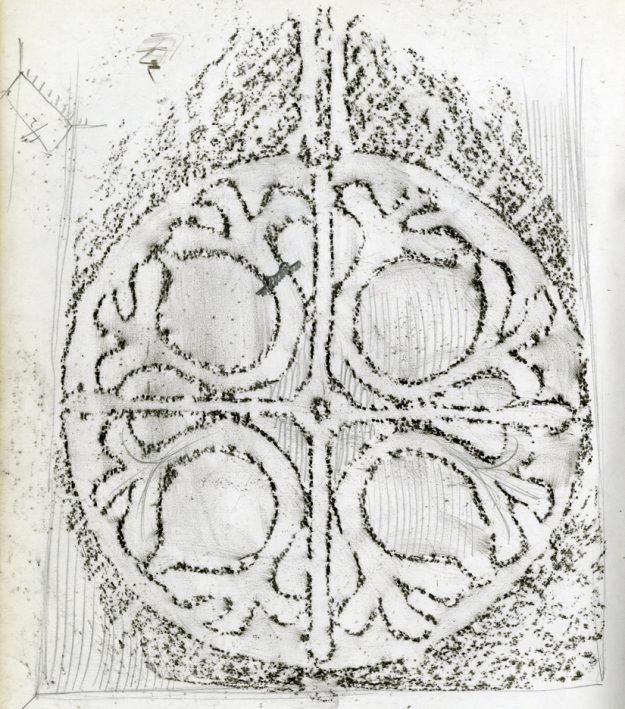
1945_017-detail-625×709
He also took inspiration from nearer home - this rubbing of metalwork from a door in Durham Cathedral, sketched in 1888 also appears to have inspired him.
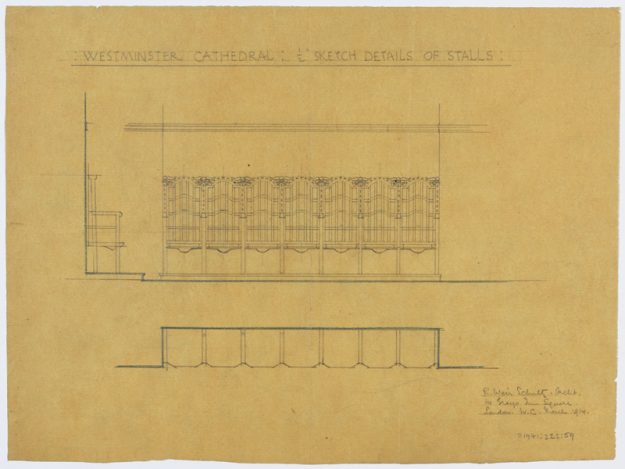
1941_222_059-625×469
This design by Robert Weir Schultz was done in March 1914, and shows his initial ideas for the chairs.
1941_225_118_008-1-625×503
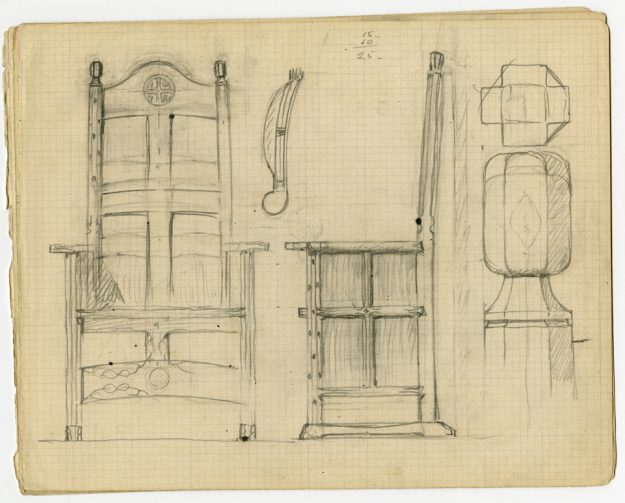
Gimson sketched this rough idea for a clergy chair in his working sketchbook - it may relate to his design process for the Westminster chairs.
1941_222_11-625×519
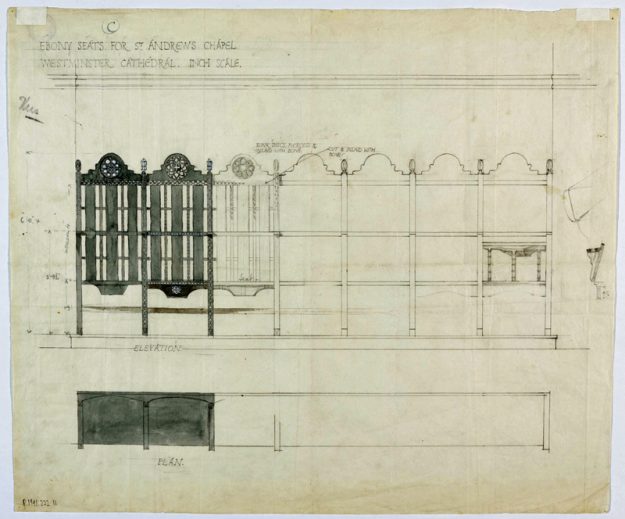
This is Gimson's worked up design for the clergy seats. You can see it is rather different to Schultz's initial design, but there are still similarities.
1941_222_11_001
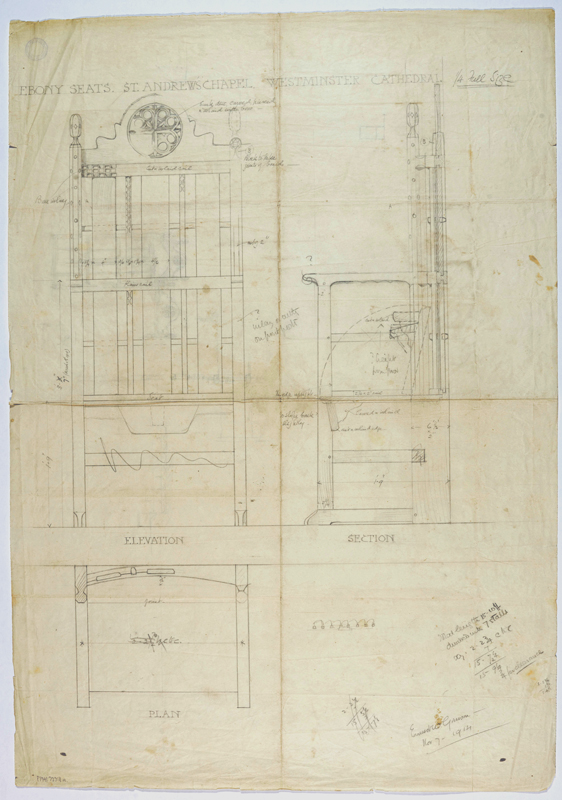
This measured drawing, a quarter of full size, shows all the details of the chair complete by 7 November 1914.
1970_47-625×1258
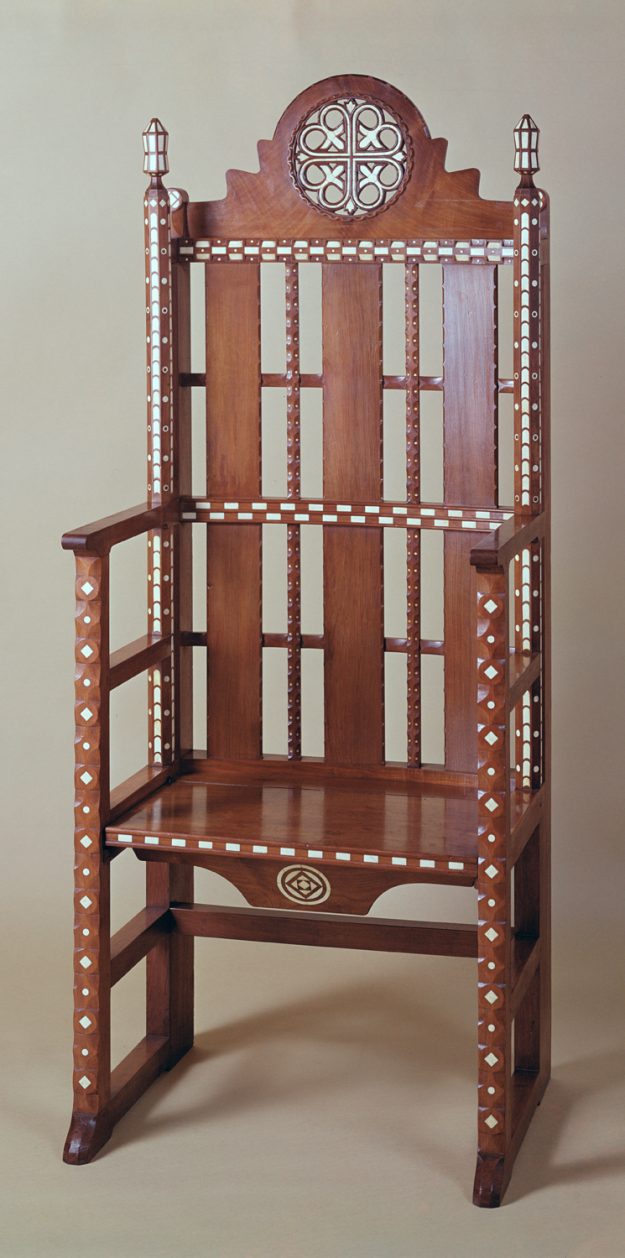
This is the prototype chair. Work started on this in November 1914, once the measured drawing was done.
1941_225_121-625×449
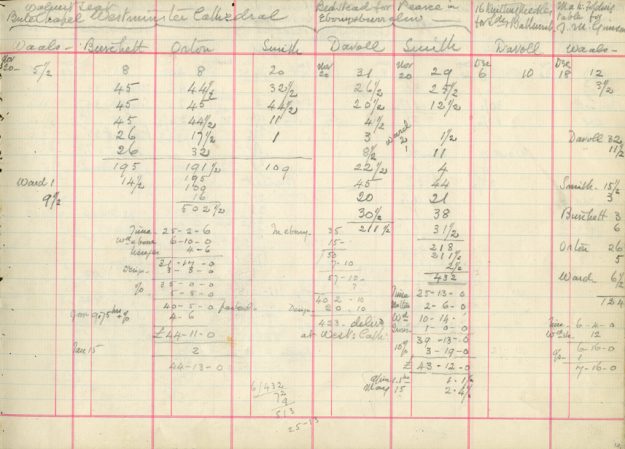
This is the page from the job book that shows the calculations per maker, of the time spent on the prototype chair. Gimson then worked out how much it would cost.
Clergy-Stalls-625×410
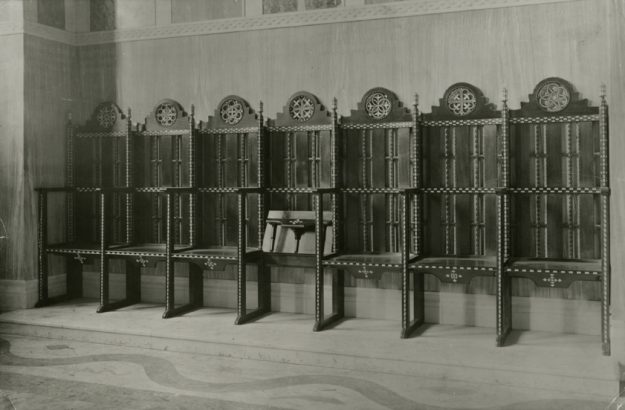
These are the chairs installed in St. Andrew's Chapel, Westminster Cathedral in 1915. They are still there today.
Share this article
Follow us
A quick overview of the topics covered in this article.